
A $2.2 Billion LSM Contract Still Cannot Move Marines Fast Enough
 Marcus Chen
A $2.2 Billion LSM Contract Still Cannot Move Marines Fast Enough
Eight ships is the number that matters. The U.S. Navy has awarded TOTE Services a $2.2 billion vessel-construction-manager contract for the Landing Ship Medium program, with options that could bring the value to roughly $2.6 billion and cover as many as eight McClung-class LSMs. That sounds like progress. It is progress. It is also too small and too late for the operational problem the Marine Corps says it is trying to solve in the Western Pacific.
The LSM is not a glamour platform. It is supposed to be a 4,000-ton class, beachable, relatively simple ship based on Damen shipyard design work, built to move small Marine units, vehicles, fuel, missiles, and sustainment gear between islands and austere shorelines. USNI News reported that Bollinger Shipyards is building the first ship, while Fincantieri Marinette Marine has long-lead work for four more. Breaking Defense noted that the Navy wants TOTE to use commercial practices to accelerate delivery and manage shipyard subcontracts.
That is the right instinct. But the math still does not close.
The Contract Fixes Acquisition Friction
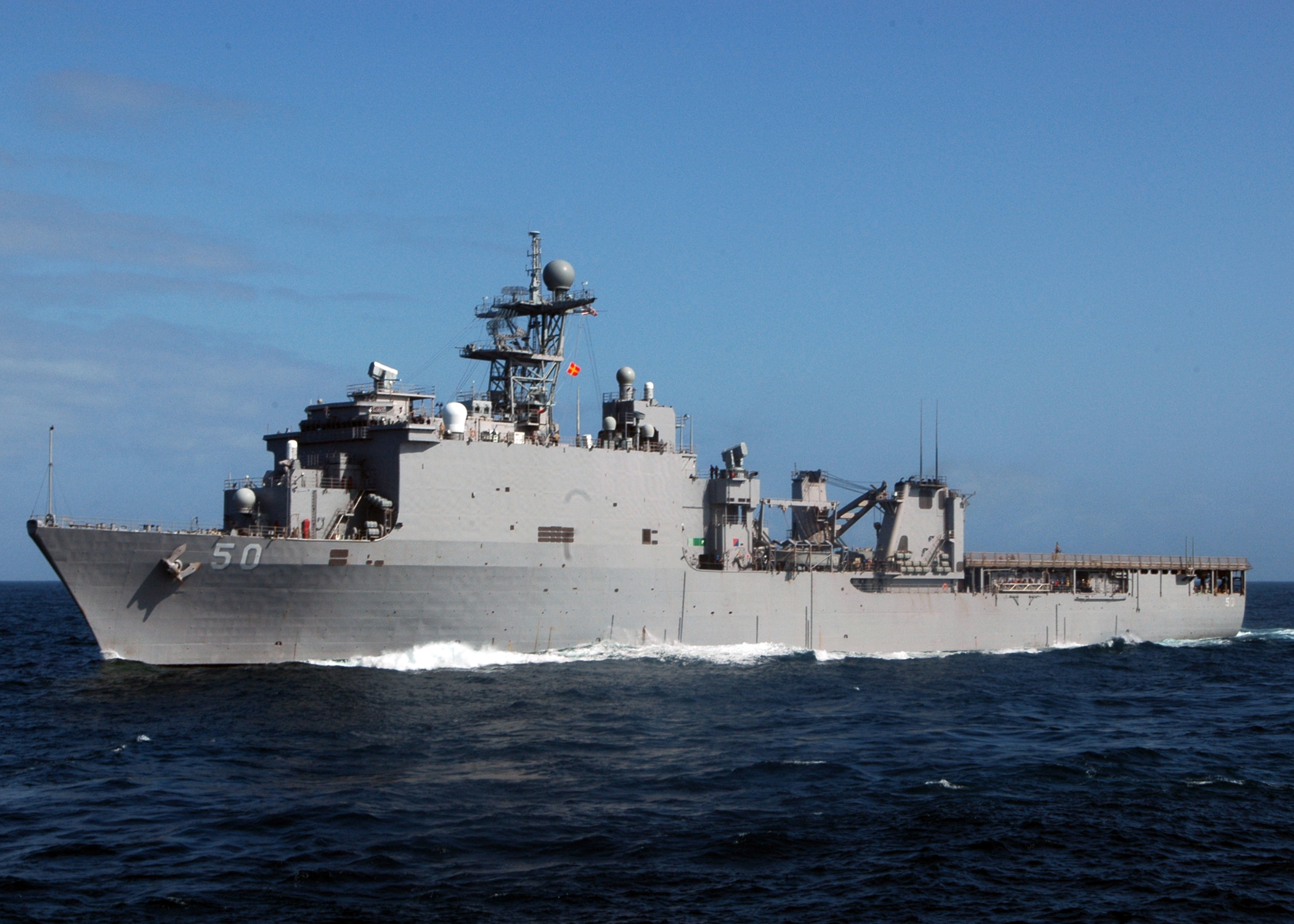
The vessel-construction-manager model is unusual for a Navy combatant program but ordinary in commercial shipbuilding. Instead of forcing the Navy to manage every yard relationship directly, TOTE will hold the prime contract and then manage subcontracts with Bollinger, Fincantieri, and potentially other yards. For a program that has already suffered from years of requirements churn between the Navy and Marine Corps, this matters.
Anyone who has served around amphibious shipping knows the worst answer is a perfect requirement that arrives five years late. The Marine Corps does not need an exquisite mini-LPD. It needs a truck with a ramp, enough survivability to operate in a dirty electromagnetic environment, and enough numbers to make loss or mission-kill survivable at the campaign level. Moving to an off-the-shelf LST-100-derived design is a quiet admission that the original concept had been overworked.
But acquisition friction was only one problem. Capacity is the bigger one. A force design based on stand-in forces, expeditionary advanced bases, and anti-ship missiles depends on repeated movement. A Marine littoral regiment cannot be a static missile battery on a postcard island. It has to shift launchers, radars, reloads, fuel bladders, maintainers, spare parts, air-defense teams, and command nodes before Chinese surveillance and fires catch up.
Eight Ships Do Not Make A Western Pacific Network
Look at the map before looking at the contract value. Okinawa to northern Luzon is about 700 nautical miles. Guam to Palau is roughly 800 nautical miles. Darwin to the southern Philippines is more than 1,500 nautical miles. Even inside the first island chain, the distances punish small ships. A vessel that looks plentiful in a program chart becomes scarce once it has to load, transit, unload, hide, repair, and repeat.
If all eight ships were available tomorrow, the practical deployed number would be lower. Some would be in maintenance. Some would be training. Some would be tied to exercises or prepositioning tasks. In a crisis, commanders would also hold back hulls for casualty replacement and deception. A paper fleet of eight can quickly become three or four usable ships in the right place on the right week.
That is not a theater lift architecture. It is a pilot program with a hull number.
The Marine Corps has been honest about the logic. Smaller units inside a Chinese weapons engagement zone need smaller connectors because large amphibious ships are too valuable, too visible, and too few. A 40,000-ton big-deck amphibious assault ship is useful for aviation and command-and-control, but nobody should want it loitering close to a contested beach just to move a handful of launchers. LSM is meant to put a cheaper, more numerous layer under the traditional amphibious fleet.
The word cheaper is doing too much work. Eight hulls do not create the distribution the concept requires. The United States needs dozens of small logistics and connector platforms, some crewed, some optionally crewed, some civilian-pattern, and some ugly enough that no admiral feels compelled to protect them like capital ships. The LSM contract is a start toward that force, not the force itself.
China Gets A Vote
The People Liberation Army Rocket Force and Navy are not planning against a PowerPoint version of Marine Corps Force Design. They are planning against ports, beach exits, fuel points, satellite links, and predictable transit routes. LSMs would operate inside range rings covered by DF-21 and DF-26 ballistic missiles, land-based airpower, maritime patrol aircraft, submarines, unmanned systems, and long-range rockets. The problem is not whether each LSM can survive a direct hit. It cannot. The problem is whether the network can keep moving after the first wave of losses and disruption.
That requires numbers, repair capacity, and command discipline. It also requires accepting that some vessels will be expendable in operational terms, even if no crew is ever expendable in moral terms. Washington is still uncomfortable buying ships that way. The Navy tends to add capability until cheap platforms become expensive enough to protect, then wonders why quantity disappeared.
The TOTE contract is interesting because it points in the opposite direction. Commercial management, multiple yards, an existing design, and a finite initial block all suggest the Navy is trying to escape the custom-warship trap. If TOTE can actually keep yards synchronized and avoid requirement creep, the LSM program could become a template for building useful auxiliary combat logistics ships faster than the traditional acquisition system permits.
That is the optimistic case. The pessimistic case is familiar: the Navy buys a handful, discovers integration problems, adds systems, slows production, and leaves the Marine Corps with another boutique capability that briefing slides treat as a fleet.
The Real Test Is The Second Block
The first eight LSMs will not decide whether stand-in forces can fight. The second and third blocks will. If the Navy and Marine Corps move quickly from this contract to a larger production rhythm, the program can become part of a genuine island-chain mobility system. If they pause after eight ships to study lessons, redesign the class, or chase perfect survivability, then the contract will have bought a demonstration fleet.
There is also an alliance angle Marcus Chen readers should watch. Japan, Australia, and the Philippines all have stakes in distributed maritime logistics. A U.S. LSM force that can plug into allied ports, repair sites, and fuel networks is far more useful than one that exists only as a U.S. Marine Corps shuttle. But that requires agreements, exercises, pier surveys, ammunition handling rules, and boring host-nation logistics work long before a shooting war.
The Navy has made the correct acquisition move. TOTE, Bollinger, and Fincantieri now have a chance to prove that commercial-style management can deliver a simple military ship without turning it into a science project. But the operational requirement is larger than one contract.
Eight LSMs can move Marines around a map. They cannot make the map survivable. Unless the Navy treats this award as the opening order for a much larger logistics fleet, the Marine Corps will still be asking small units to fight inside Chinese range rings with a mobility plan that runs out of ships before it runs out of slogans.
The U.S. Navy awarded TOTE Services a $2.2 billion contract to construct eight McClung-class Landing Ship Medium (LSM) vessels to enhance Marine Corps mobility in the Western Pacific. This initiative addresses logistical challenges posed by vast distances between operational areas, as the Marine Corps requires more effective transport solutions for small units and equipment. However, the current contract may not sufficiently meet the operational demands in the region.
- U.S. Navy awarded TOTE Services a $2.2 billion contract for LSM construction.
- The contract covers up to eight McClung-class LSMs.
- The Marine Corps requires more logistics support to operate effectively in the Western Pacific.
- The distances between key locations in the region challenge small ship operations.
- The LSM program aims to enhance mobility and logistics for Marine units.