

The Cavour is Italy’s purpose-built, conventionally powered STOVL aircraft carrier and the flagship of the Marina Militare, or the Italian Navy. But instead of acting as a smaller version of the other, larger aircraft carriers seen in other navies, the Cavour is instead an important but flexible national tool for Rome. It serves as a sea base for Italy’s fifth-generation stealth fighter, a command node, an amphibious and logistics platform, and a hospital ship.
The Cavour Design and Air Wing
Fincantieri, an Italian shipbuilder, built the Cavour in 2009.
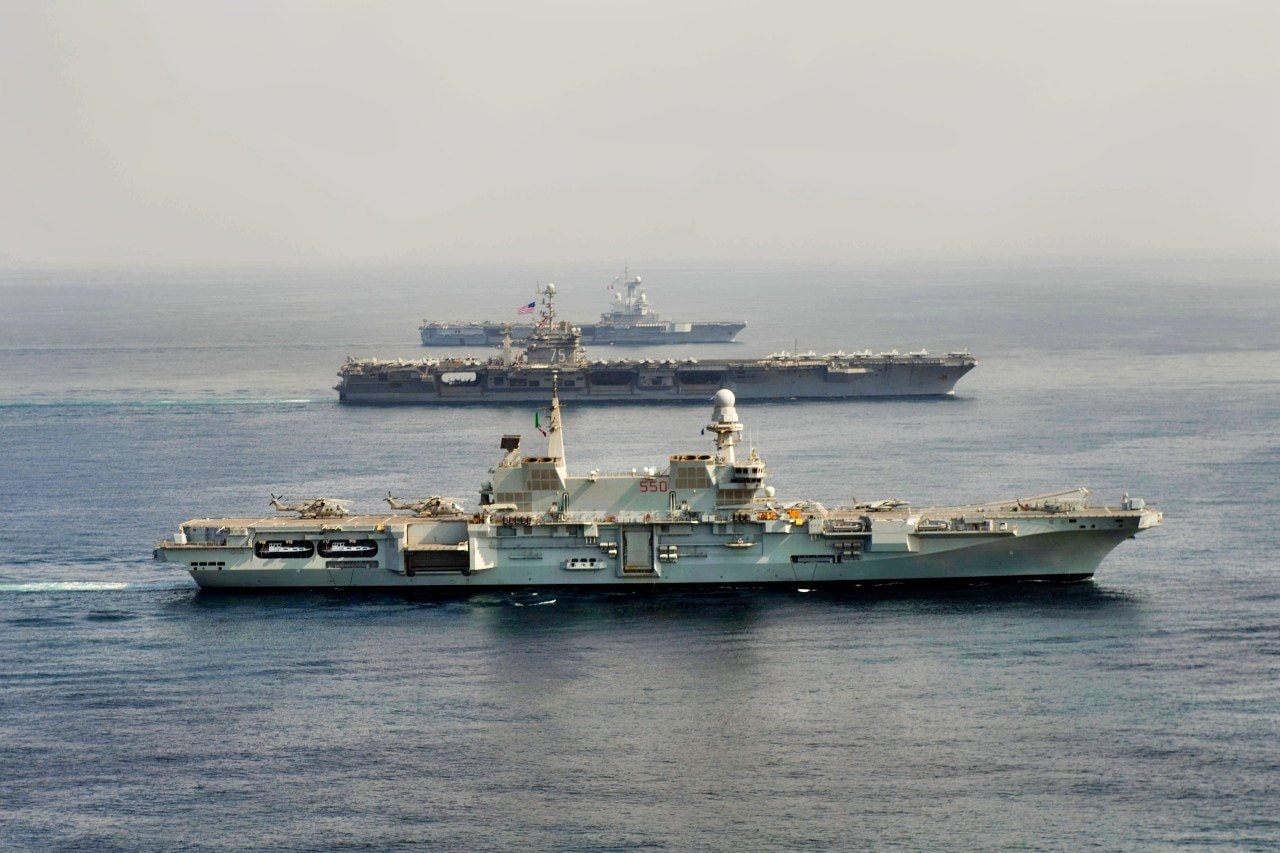
(Jan. 3, 2014) The Italian navy aircraft carrier ITS Cavour (CVH 550), front, the aircraft carrier USS Harry S. Truman (CVN 75) and the French navy aircraft carrier Charles de Gaulle (R 91), conduct operations in the Gulf of Oman. Harry S. Truman, flagship for the Harry S. Truman Carrier Strike Group, is conducting operations with Task Force 473 to enhance levels of cooperation and interoperability, enhance mutual maritime capabilities and promote long-term regional stability in the U.S. 5th Fleet area of responsibility. (U.S. Navy photo by Mass Communication Specialist 3rd Class Ethan M. Schumacher/Released)
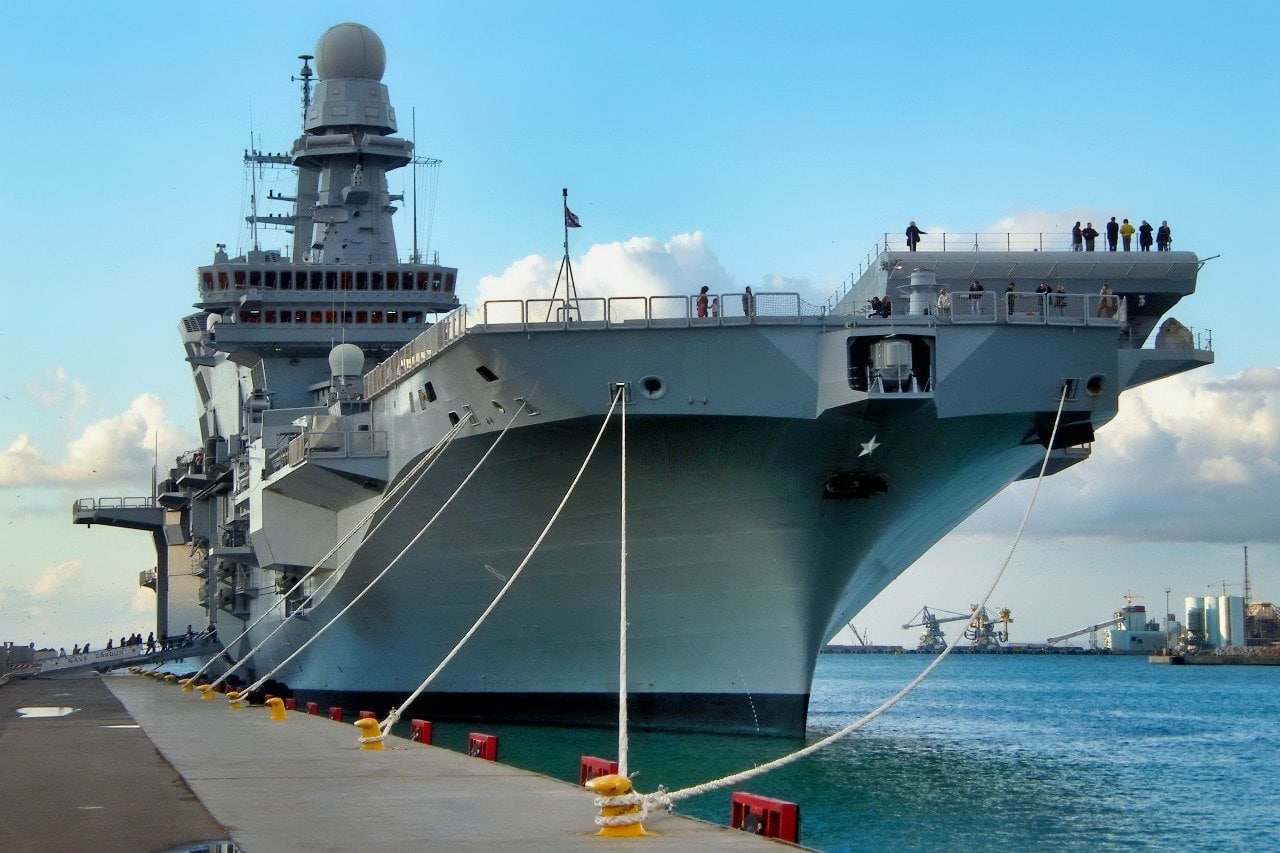
ITS Cavour at Port. Image Credit: Creative Commons.
When fully equipped, it displaces over 28,000 tons and can exceed 28 knots while underway thanks to its four gas turbine engines.
At 16 knots, the Cavour has a range of 7,000 nautical miles, giving it significant endurance despite not being nuclear-powered.
Like other aircraft carriers, the defining feature of the Cavour is its 234-meter flight deck and its ski-jump nose, a design feature that facilitates the launch of short-take-off-vertical-landing aircraft.
She can normally embark with eighteen to twenty F-35B Lightning IIs or AV8B Harrier IIs, alongside EH101s, NH90s, or other helicopters.
Alternatively, the ship’s 25-square-meter hangar can accommodate a variety of vehicles.
The flight deck has six operating spots, plus parking for eight more aircraft.
But the Cavour is not only a naval aviation platform.
The ship’s combat systems include Aster 15 surface-to-air missiles in a pair of 16-cell vertical launchers.
The ship also carries a pair of 76mm guns and 25mm cannons, giving it a measure of organic self-defense rather than relying entirely on escorts for protection.
The Cavour’s Role in the Italian Navy
The Marine Militare treats the Cavour as the centerpiece of its Carrier Strike Group.
The ship is also the primary means of deploying its fixed-wing aircraft from the sea.
In 2024, Italy declared initial operational capability for an embarked joint F-35B air wing, giving the ship the ability to conduct offensive counter-air missions, including strikes and the suppression of enemy air defenses.
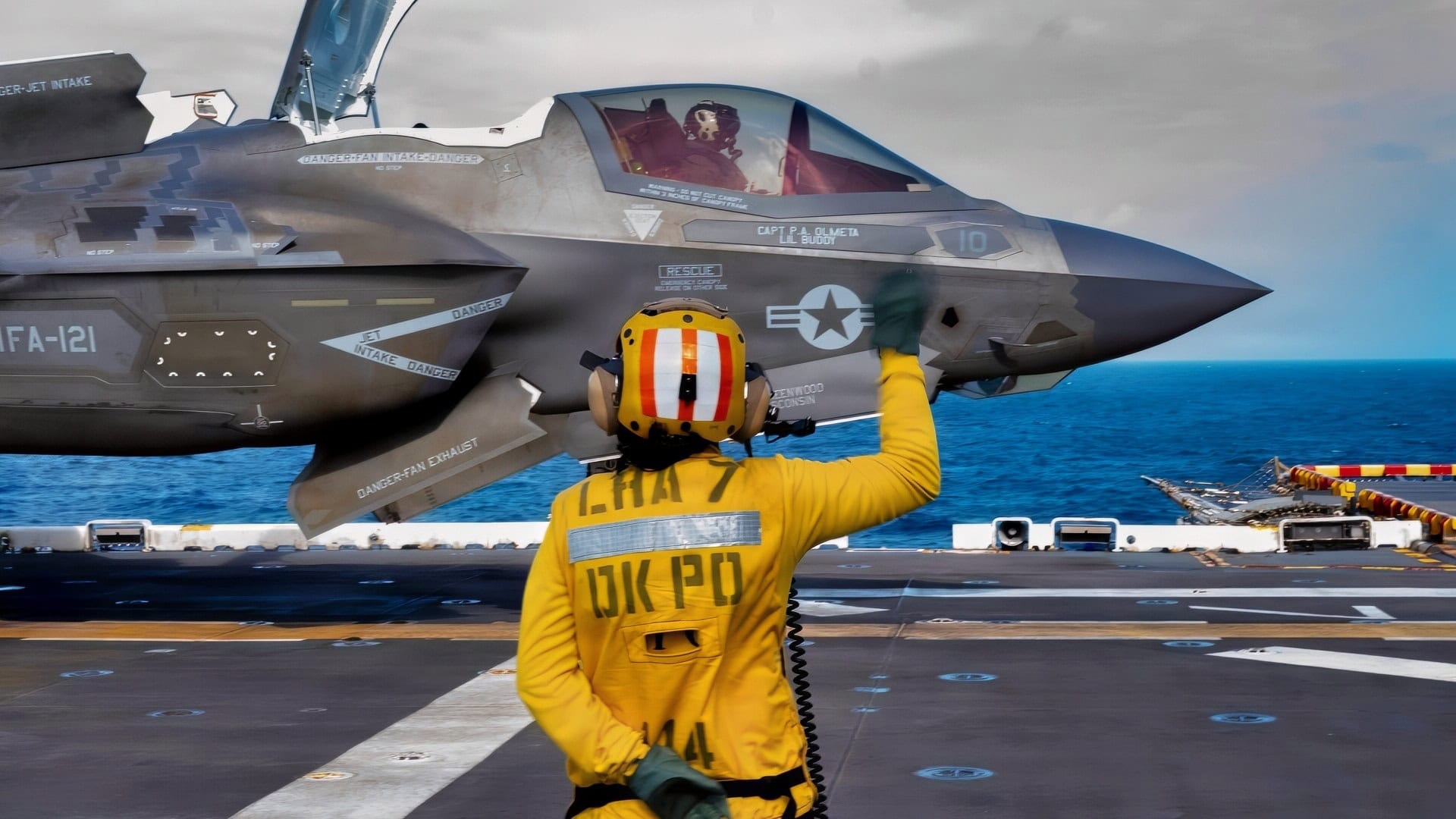
Aviation Boatswain’s Mate (Aircraft Handling) 3rd Class Anika Ramos directs the launch of an F-35B Lighting II, attached to Marine Fighter Attack Squadron 242 during flight operations on the flight deck of the America-class amphibious assault ship USS Tripoli (LHA 7) in the South China Sea, Dec. 11, 2025.
Italy can now deploy a fifth-generation air wing under national command.
The navy describes the capability as expeditionary, and the Cavour and her escorts can operate far from home with substantial logistical autonomy while still serving Italian interests in the Mediterranean and elsewhere further afield in Europe.
Secondarily, the Cavour can carry wheeled and tracked vehicles, accommodate a Marine contingent, command joint and combined operations, and provide hospital facilities for military or humanitarian missions.
In Italian practice, this makes the ship useful in four essential functions: as an aircraft carrier, an amphibious and logistics platform, a command-and-control ship, and a hospital ship.
The Cavour and the Trieste
However, another aircraft carrier exists within the Marine Militare: the Trieste. But the Trieste is not simply a larger version of the Cavour.
It is a landing helicopter dock, commissioned in 2024, and its primary mission is to place and sustain a marine force ashore.
Fixed-wing aviation is an important capability, but for the Trieste, it is secondary.
The difference between the two ships is therefore both functional and numerical.
Cavour is about three knots faster and is designed and optimized around a concentrated fighter air wing.
The Trieste, by contrast, is much broader and heavier, with a floodable well deck, landing craft, vehicle space, and accommodation for over 1,000 personnel. But the two ships do overlap to a certain extent.
Trieste has a ski-jump range and can operate F-35B fighters, providing an important backup for the Cavour when that ship is unavailable or tasked elsewhere.
Place Among European Carriers
Within Europe, the Cavour sits between the smaller amphibious carriers and larger fleet carriers.
France’s Charles De Gaulle remains the only European nuclear-powered aircraft carrier and the only one using catapults, allowing heavily loaded Rafale M fighters and E-2 Hawkeye airborne early-warning aircraft to launch off of its flight deck.
That gives Paris a deeper, more conventional carrier-air-wing capability.
The Queen Elizabeth-class ships of the British Royal Navy are far larger, at about 65,000 tons, and can embark a substantially larger F-35B force. But like the Cavour, they lack catapults and arrested recovery systems.
The Cavour, therefore, offers Rome a kind of balanced naval aviation capability.
While the ship cannot match the sortie generation or heavy-strike payload of larger aircraft carriers, it gives the Marine Militare something few European states possess: a fifth-generation carrier capability that can respond to wars, natural disasters, humanitarian projects, and other crises as they arise.
About the Author: Caleb Larson
Caleb Larson is an American multiformat journalist based in Berlin, Germany. His work covers the intersection of conflict and society, with a focus on American foreign policy and European security. He has reported from Germany, Russia, and the United States. Most recently, he covered the war in Ukraine, reporting extensively on the war’s shifting battle lines in Donbas and writing about its civilian and humanitarian toll. Previously, he worked as a Defense Reporter for POLITICO Europe. You can follow his latest work on X.