
A Life Relay Across Thousands of Miles: A Documentary on the Transport of Critical Condition Soldiers by the Western Theater Command Using Y-20 Transport Aircraft
A Life Relay Across Thousands of Miles
——A Record of the Western Theater Command Organizing the Y-20 Transport Aircraft to Transfer Critically Injured Soldiers
■ China Military Network Reporter Zhao Songyan
In July, the warm wind brushes over the border military camp.
In the company study room, Army Sergeant First Class Zeng Yihua, who is preparing for a missile specialty assessment, gently closes his book and looks up at the sky outside the window.
He still cannot believe that the "national heavy weapon" Y-20 transport aircraft flew back and forth over thousands of miles just to save him.
Touching the scar on his abdomen, everything feels so real again...
One
At 8:00 AM on April 24, the Ali Plateau was still asleep, and the highest surgical room in the military quietly lit up the shadowless lamp. On the operating table lay 27-year-old border guard Zeng Yihua.
High fever, unstable blood pressure, tachycardia, respiratory rate peaking at five times the normal value... The emergency records are shocking.
The scene under the laparoscope made Dr. Zhao Yuxiao from the General Surgery Department of the 957th Hospital of the Army's heart tighten. Contaminants, abscesses, adhesions, perforations—Zeng Yihua's abdominal cavity looked like it had gone through a fierce battle; this was a dangerous signal of acute appendicitis perforation!
Subsequent examinations confirmed the doctor's judgment: the perforation had caused diffuse peritonitis, accompanied by septic shock. The patient's coagulation function was disordered, a huge abscess enveloped the lower right abdomen, and contaminants had flowed to the upper edge of the liver...
Under the shadowless lamp, the young soldier was just a step away from the "cliff of life."
Three and a half hours later, the lights in the operating room went out, marking the end of the first round of the battle with death. However, toxins had already entered the bloodstream through the peritoneum, and Zeng Yihua remained in a state of shock.
What was even more distressing was that in the low-pressure, low-oxygen environment of the "death zone," Zeng Yihua's blood pressure continued to drop, and the infection in his body was still worsening...
The medical conditions here were extremely limited, and Zhao Yuxiao and his comrades continued to try various rescue methods. After administering medications urgently dispatched from the Ali District People's Hospital, Zeng Yihua's condition still showed no signs of improvement.
Thousands of kilometers away in the mountain city of Chongqing, the medical data was transmitted to the Army's Characteristic Medical Center, and the experts furrowed their brows in unison: "The plateau conditions are insufficient to cope with subsequent treatment; we must immediately apply to higher authorities for emergency air transport!"
However, challenges followed:
——There are no direct civil aviation flights between the two locations; how can we ensure a smooth life line?
——During air transport, Zeng Yihua is at risk of life at any moment. Unless we move the intensive care unit (ICU) onto the plane to implement life support during the flight, can this be achieved?
——Ali Kunsha Airport, at an altitude of 4,274 meters, poses extreme tests for aircraft thrust, takeoff and landing performance, and plateau adaptability; who can take on this heavy responsibility?
The challenge report reached the Western Theater Command Joint Command Center, and a directive was swiftly issued: deploy the Y-20, equipped with an "airborne ICU," to fly to the Ali Plateau to save lives!
A life relay race involving multiple military branches and nearly a hundred participants began, marked by the ticking of the soldier's life clock.
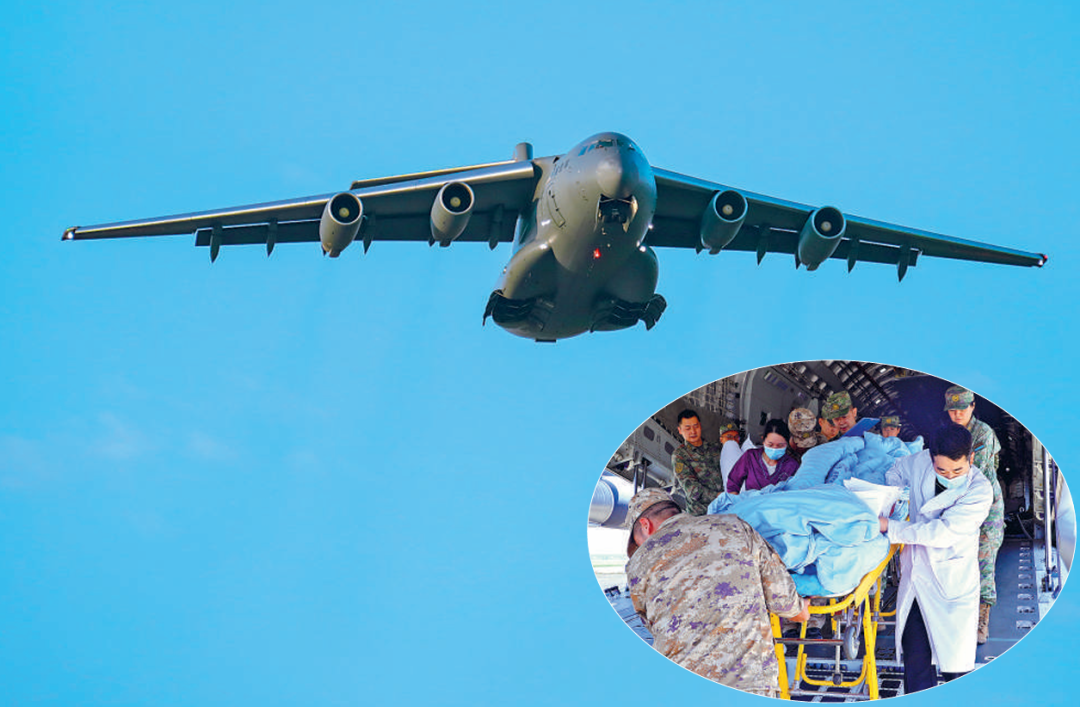
Y-20 airlifting critically injured soldiers. Photos by Gu Kuoye and Wan Zhongyu
Two
"There’s a mission, prepare personnel and materials, and be ready to depart!"
At 12:41 AM on April 25, the screen of Yang Jingxuan, the leader of the medical team at the Western Theater Command Air Force Hospital, suddenly lit up. He jumped up and rushed out of the house.
Assessing the patient's condition, organizing personnel, preparing supplies... Along the way, his phone received over 20 call records.
At 1:20 AM, six medical team members from the Intensive Care Unit, General Surgery, Medical Engineering, and Nursing Department gathered, including one department head and two head nurses.
Sorting out patient needs, increasing drug supplies... After 35 minutes, the "airborne ICU" plan was finalized!
At 1:30 AM, the lights in the conference room of a flight squadron of the Western Theater Command Air Force turned on. The Y-20 crew had assembled.
Half an hour earlier, the experienced captain Ren Yongjun was appointed on short notice. Meanwhile, the crew also broke the norm and added one more person.
The mission involved a high-altitude airport, flying in the middle of the night, and transporting critically injured soldiers... The optimal plan had to be finalized in the shortest time possible. Co-pilot Li Yongbin held two A4 sheets filled with notes—takeoff time window, air-ground coordination data, high-altitude airport approach methods, route point coordinates, segment distances, estimated fuel consumption... Everything was taken into account.
At 2:30 AM, at the airport, the cabin lights of a Y-20 transport aircraft lit up, and the airborne mechanics and ground crew began their tense operations. Before the medical team arrived, the rear cabin of this "Kunpeng" had to complete the medical configuration transformation.
At 4:00 AM, the medical team's vehicle broke through the night and arrived at the tail of the aircraft. ECG monitors, infusion pumps, negative pressure suction devices... A total of eight boxes of "airborne ICU" equipment and supplies were transported into the rear cabin.
At this point, there was less than one hour until takeoff.
Every second counts! With the continuous "click" sound of securing the equipment, the "airborne ICU" was ready in just 25 minutes.
This time, the enormous belly of the Y-20 was empty of equipment and troops.
This time, the "Kunpeng," which could carry hundreds of soldiers, was poised to take off for just one soldier.
Three
As dawn approached, the "Kunpeng" soared into the sky, heading towards the still dark Ali Plateau.
As the destination drew closer, amidst the loud roar, a jolt was felt, and the thoughts of everyone in the cabin collided and intertwined like the airflow beneath the wings, generating new vectors—
Low pressure, low oxygen, turbulence, vibration, noise; these factors during flight pose a great threat to critically ill patients, and this life journey must be as smooth as possible.
If blood pressure drops suddenly, if respiratory failure occurs... Behind every "if," there must be a complete contingency plan to ensure everything goes perfectly.
This flight was very "light," carrying less than one-thousandth of the "Kunpeng's" capacity!
This flight was very "heavy," bearing the life of a young border guard!
Daylight broke over Ali. The "Kunpeng" landed smoothly, the cabin door opened, and the cold air rushed in. Zeng Yihua, tightly wrapped, was quickly lifted into the Y-20, and the numbers on the monitor began to fluctuate...
After completing the handover of the injured, the "Kunpeng" transformed into a "life ark" and ascended once more.
Below the wings, snow-capped mountains and winding river valleys; inside the cabin, everyone's gaze was focused on Zeng Yihua.
Each time they crossed altitude layers, the crew members operated with utmost care; the medical team conducted continuous ECG monitoring, fluid infusion, sedation, analgesia, and critical care, recording a new set of monitoring data every ten minutes; co-pilot Li Yongbin made a round at the stretcher, returned to the cockpit, and raised the air conditioning temperature by 2°C...
Four
A winding and persistent red line appeared on the large screen of the Western Theater Command Joint Command Center, tugging at the hearts of the officers and soldiers in attendance.
At 1:38 PM, the Y-20, having flown back and forth over thousands of miles, landed smoothly in Chongqing.
At the same time, in a small fishing village in Nanao, Guangdong, Zeng Yihua's parents' phone screens lit up: "The plane has landed, and Xiao Zeng has been sent to Chongqing."
At the same time, on the Ali Plateau, the soldiers in Zeng Yihua's company also awaited this news. Since the night they sent him to the emergency room, the hearts of all his comrades had been tightly knotted.
The ambulance sirens blared through the city. The intensive care unit of the Army's Characteristic Medical Center was already prepared, and the rapid rescue transfer was coming to its final leg.
Wang Zhen, the director of the Intensive Care Unit, finally met the young soldier he had seen during the remote consultation.
At this point, Zeng Yihua's vital signs still indicated the most dangerous situation. After an emergency multidisciplinary consultation, the medical team decisively decided to perform puncture drainage on the encapsulated abdominal abscess to clear the obstacles causing antibiotic failure.
The day after the surgery, the infection indicators began to decline. Meanwhile, the psychology and rehabilitation departments took turns to provide assistance for Zeng Yihua's comprehensive recovery.
A few days later, the infection was fully contained, coagulation disorders were corrected, and vital signs became increasingly stable... Upon hearing the news, Zeng Yihua's parents repeatedly said, "Thank the Party, thank the country, thank the army!"
"This is a systematic project involving command institutions, air-ground medical teams, and transport aircraft units, requiring collaborative efforts from multiple parties." A commander said that this time, the soldier was supported by the national heavy weapon "Kunpeng"; while more soldiers were supported by a safety net that had long been woven. In recent years, the seamless chain of "on-site rescue—air transport—hospital reception" has repeatedly crossed mountains and rivers, safeguarding the lives of border defense soldiers.
The news spread on the internet, and a netizen posted: "This may be the lightest payload delivered by the Y-20, but it is also the heaviest!"
Zeng Yihua is one of the soldiers of the Republic, and he represents all the countless soldiers!
(Interviews received strong support from Gao Bilin, Deng Dongzhi, Liang Chao, Gu Yi, Zhang Jingyu, Yu Zunsu, Zhu Guangping, Meng Yuhan, Sun Yang, Shi Jingguang, and others)
Source: PLA Daily
On April 25, 2023, the Western Theater Command Air Force conducted an emergency airlift of a critically injured soldier from Ali to Chongqing using a Yun-20 transport aircraft equipped as an 'airborne ICU'. Medical personnel prepared for the operation to ensure the soldier received necessary care during the flight, which was critical due to his severe condition.
- A critically injured soldier was airlifted from Ali to Chongqing.
- The operation involved the use of a Yun-20 transport aircraft.
- Medical personnel prepared an 'airborne ICU' for the flight.
- The operation was conducted by the Western Theater Command Air Force.
- The soldier was suffering from severe complications after surgery.