
After World War II, Japan Sends Its First Overseas Deployment of Construction Combat Forces
Currently, the "Shoulder-to-Shoulder" joint military exercise led by the United States and the Philippines for the year 2026 is taking place in several areas in the northern Philippines and near the disputed waters of the South China Sea. According to reports, this exercise began on April 20 and will last until May 8. Not only has the scale of the exercise been upgraded, with participating forces exceeding 17,000, but there is also a significant change: Japan is participating for the first time as a formal member. Public opinion is generally concerned that the targeting of the US-Philippines military exercises is becoming increasingly strong, which will have a serious impact on the security landscape of the Asia-Pacific region.
So, what are the sinister intentions behind the accelerated military ties between the US, Japan, and the Philippines? Can the US, which is intent on building an exclusive "small circle" in the Asia-Pacific, shake the trend of peaceful development in the region? These are the topics that this issue of the "Yi Nan Military Forum" will focus on.
The US, Japan, and the Philippines each have their own calculations
Li Yue:
We all know that the US-Philippines "Shoulder-to-Shoulder" joint military exercise is a "highlight" among many joint exercises between the two countries and has long become an important stage for the US, the Philippines, and their allies to "show off their muscles." This year's exercise is particularly noteworthy because Japan has jumped from its previous status as an "observer" to a formal member. It should be said that this is Japan's first deployment of organized combat forces overseas since the end of World War II. Professor Yi Nan, given the ongoing conflict between Russia and Ukraine and the tense situation in the Middle East, why does the US and the Philippines continue to expand the scale of the exercises? What ulterior motives does Japan have in joining at this time?
Jin Yi Nan: In terms of this exercise, the most noteworthy aspect is the motivations of the US, Japan, and the Philippines. I believe that each of them has its own agenda.
First, let's look at the US side. Currently, the US is deeply embroiled in conflict with Iran, and the Trump administration has tried many methods recently but has not been able to end the hostilities, leading to continuous criticism within the US. The annual US-Philippines "Shoulder-to-Shoulder" military exercise provides a good opportunity for the US to divert attention. At the same time, the US aims to convey a message through the expansion of the exercise scale: although it has not yet extricated itself from the situation in Iran, it still has the capability to control the Asia-Pacific region.
Now, let's look at the Philippines. The Marcos government in the Philippines hopes to use the US-Philippines military exercises to demonstrate its strong defense capabilities domestically and to enhance its bargaining chips in the South China Sea issue against China. However, this action by the Philippines is very dangerous. In the past two years, the US military deployment in the First Island Chain has been shrinking. The US believes that its relevant deployment areas are within the fire coverage of the People's Liberation Army and are not safe, necessitating a withdrawal to safer locations, with the Philippines being a potential option for the US military's retreat. From the Philippines' perspective, it is also willing to cooperate with the US military's relevant deployments, hoping to gain confidence from the Americans. However, we must be clear that if a conflict breaks out in the Western Pacific in the future, and if the Philippines becomes a base for hostile forces intervening in China's internal affairs, it will inevitably face severe retaliation from China. The previous Philippine government was aware of these risks, which is why it terminated military agreements with the US, including prohibiting US forces from using military bases in the Philippines, etc. Of course, the Marcos regime cannot remain in power forever; as the political landscape in the Philippines changes, I believe that more wise individuals in the Philippine political sphere will realize what the Philippines' greatest interests are and make wiser choices.
Finally, let's look at Japan. The government of Japan, led by Sanae Takaichi, is very eager to use a large-scale joint exercise to enhance Japan's status and role. The US-Philippines "Shoulder-to-Shoulder" joint military exercise provides Japan with such an opportunity. This is Japan's first deployment of organized combat forces overseas since World War II. During the exercise, Japan also launched Type 88 anti-ship missiles in the waters off Luzon Island. Japan's various actions show a clear trend: it is attempting to turn the Philippines into a forward base for Japan. Japan's ambition to use the Philippines to intervene in China's unification efforts is clearly exposed.
Significant changes in exercise content
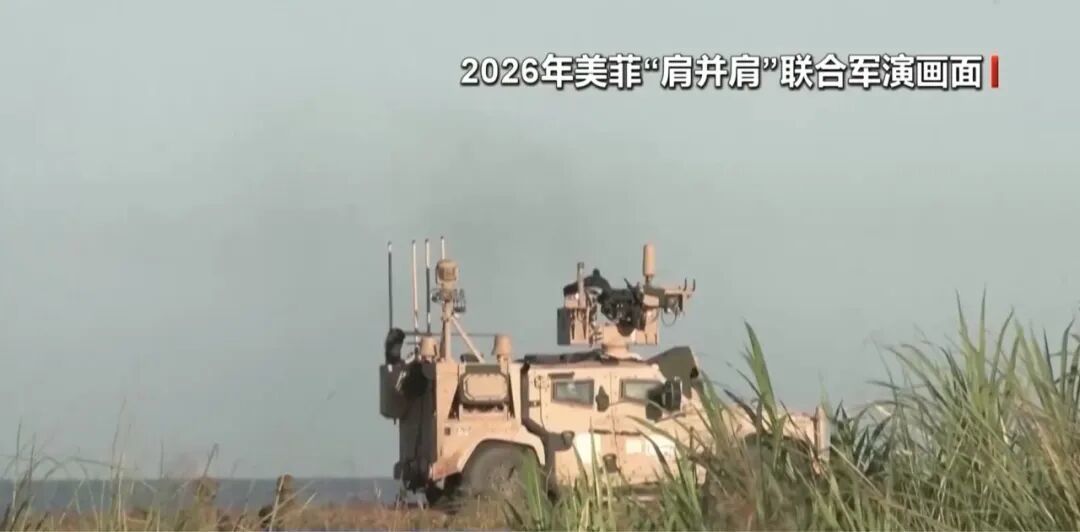
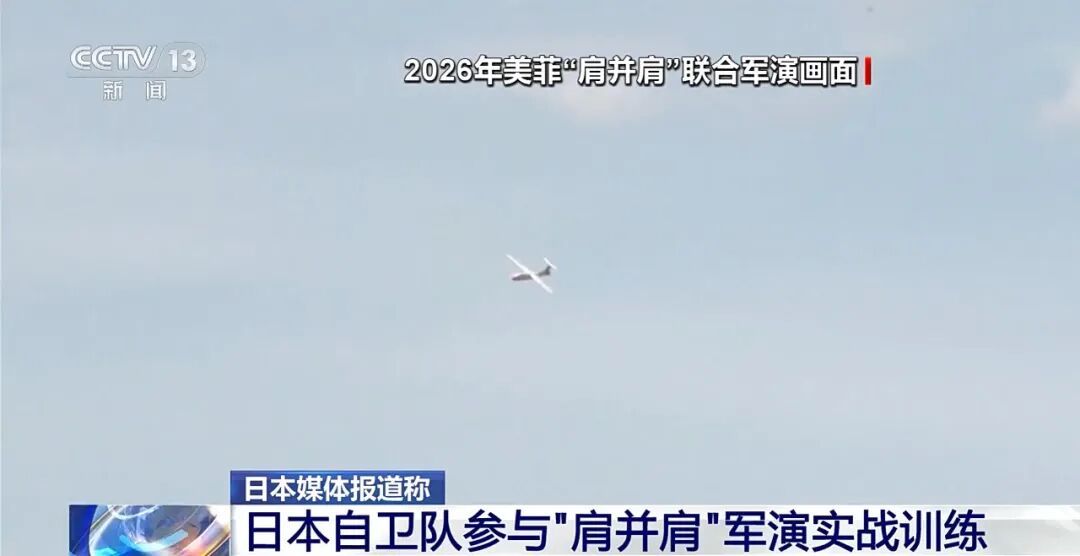
Scenes from the 2026 US-Philippines "Shoulder-to-Shoulder" joint military exercise (Source: CCTV News)
Li Yue:
Although the US and the Philippines claim that the exercise is to "strengthen alliances" and "maintain regional security," attempting to dress the exercise in a "legitimate" guise, the various arrangements of this year's exercise actually expose its essence of raising regional security risks. This exercise not only covers multiple areas in northern Philippines and near the disputed waters of the South China Sea, but also focuses on responding to large-scale airstrikes, missile saturation attacks, and maritime formation confrontations, rather than traditional subjects like island seizure and anti-ship blockades. Professor Yi Nan, how do you view the significant upgrade in the content of the US-Philippines "Shoulder-to-Shoulder" military exercise?
Jin Yi Nan: From the adjustments in the exercise content, we can see the inherent nature of the US, Japan, and the Philippines being fierce on the outside but weak on the inside. Previously, the US-Philippines "Shoulder-to-Shoulder" joint military exercises mainly focused on practicing "island seizure" and "anti-island seizure." However, this year's exercise content has changed, placing greater emphasis on how to gain air superiority, information dominance, and how to prevent long-range large-scale missile attacks. This is clearly aimed at testing survival capabilities when under saturation missile attacks and the ability to conduct effective counterattacks, which is what the US refers to as "area denial capability." On one hand, this exercise has strengthened the targeting of hypothetical enemies. On the other hand, the US, Japan, and the Philippines are increasingly aware that potential adversaries are continuously strengthening their military capabilities, and they must make targeted adjustments to adapt to the increasingly powerful opponents.
Will a new camp confrontation emerge in the Asia-Pacific?
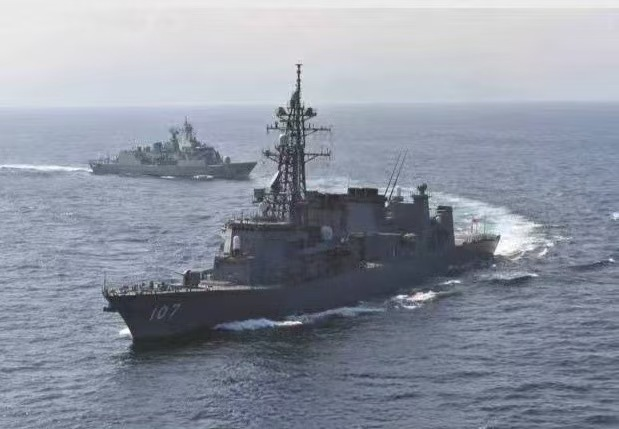
File photo: Japan's "Asahi" destroyer (Source: CCTV News)
Li Yue:
It is worth noting that the US-Philippines "Shoulder-to-Shoulder" military exercise is moving towards multilateralization and institutionalization. Some commentators believe that this kind of "small circle" security mechanism, which draws lines based on ideology and strategic adversaries, once solidified for a long time, is likely to lead to a Cold War-style camp confrontation in the Asia-Pacific region in the future. Professor Yi Nan, based on your analysis, do you think this pattern of camp confrontation will really form?
Jin Yi Nan: I believe that the possibility of this happening is currently low. Previously, NATO continuously expanded eastward, trying to extend its reach to the Asia-Pacific region, which indeed increased the risk of camp confrontation. At that time, Western countries attempted to establish an "Asian version of NATO" to contain China, but this situation is not likely to occur for the time being. Why is that?
First, the US is overwhelmed. In December of last year, the US released a new version of the "National Security Strategy" report, which clearly stated that, in light of the painful lessons of the Ukraine crisis, NATO would no longer expand eastward. It is well known that the Russia-Ukraine conflict is a result of NATO's eastward expansion, and this conflict has nearly dragged all of Europe into war and caused significant depletion for the US and Europe, so the new version of the US "National Security Strategy" report clearly states to stop NATO's eastward expansion.
Secondly, the US is unwilling to act as the "world's police" anymore. Because the costs and consequences are too high, the US has demanded that its allies significantly increase their defense budgets. The underlying message is, "You take care of yourselves; don't expect everything from me." In this broader context, I believe that the possibility of forming a new military alliance in the Asia-Pacific region is extremely low because no one wants to be the "leader." Currently, the Russia-Ukraine conflict and the situation in Iran have already consumed a lot of US energy. The US government's debt has reached $39 trillion, and the US economy is already under significant strain.
Therefore, even if there are unstable factors in the Asia-Pacific region, and some are constantly provoking trouble, attempting to form alliances to confront China, they will ultimately find themselves in a very awkward position. This US-Philippines joint military exercise may seem large and lively, but after the exercise ends, each country will inevitably go its separate ways, which is the inevitable outcome.
Reporter: Li Yue
The U.S. Armed Forces, Philippine Armed Forces, and Japan Self-Defense Forces are conducting joint military exercises in the Philippines and near the South China Sea from April 20 to May 8, 2026, involving over 17,000 troops. This marks Japan's first formal participation in such exercises since World War II, during which they launched Type 88 coastal defense missiles.
- The U.S.-Philippines joint military exercise is taking place from April 20 to May 8, 2026.
- Japan is participating as a formal member for the first time since World War II.
- Over 17,000 troops are involved in the exercises.
- The exercises are occurring in northern Philippines and near disputed areas in the South China Sea.
- Japan launched Type 88 coastal defense missiles during the exercises.