
America requests an Iranian commitment to open Hormuz and 10 F-22 fighters leave Israel
 Ahmed Al-Rashid
America Requests an Iranian Commitment to Open Hormuz as 10 F-22 Fighters Depart Israel
On July 11, 2026, the issue in the Strait of Hormuz was not just another navigation incident. Washington requested Tehran, according to U.S. officials who spoke to reporters, to publicly announce a halt to attacks on ships and to keep all strait passages open without fees or tolls. On the same day, reports indicated that at least 10 F-22 fighters were departing from Ovda Air Base in southern Israel towards Britain, after being deployed during the war phase with Iran. These details may seem scattered, but they actually describe a precise moment in the balance of Gulf deterrence.
The strait is not just a line on a map. Militarily, it is a maritime choke point, and economically, about one-fifth of global oil supplies typically pass through it. Any military personnel who have served in the region know that complete control over it is nearly impossible, but partially disrupting it is much easier than fully protecting it. A fast boat, a suicide drone, a naval mine, or a coastal missile is enough to force insurance companies and tankers to reassess risks.
The Public U.S. Demand
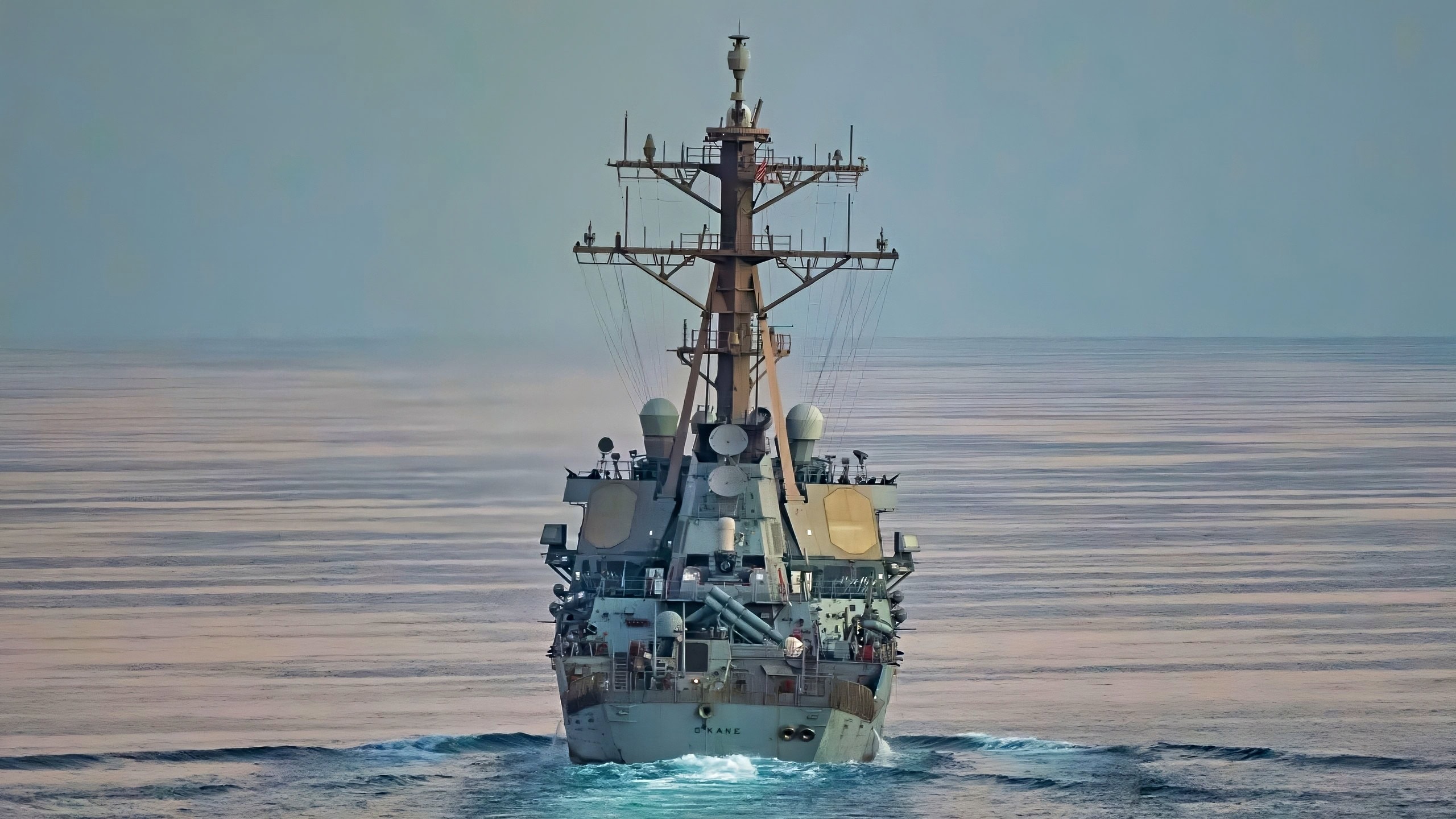
According to a report published by the Times of Israel, the United States wants Iran to issue a public statement saying that all channels of the Strait of Hormuz are open, that ships will not be fired upon, and that no transit fees will be imposed by Tehran. The importance of this demand is not only legal. Washington is not looking for a promise in a closed negotiation room, but for a public commitment that can later be used as a political basis for any military or economic response if Iran violates the pledge.
The U.S. official summarized the situation by saying that the Iranians must either provide this statement, or the outcome will not be good for them.
This kind of language is not quiet diplomacy, but it is also not a declaration of total war. It is a calculated pressure point that Iran knows it has a high ability to annoy without having complete control. Tehran, according to the U.S. narrative, stated that the recent attacks on ships came from a rogue part within its system. If true, it is an indirect acknowledgment that the Iranian leadership itself faces a problem in controlling the tools it has built over the years.
What the Departure of F-22 Means
The departure of 10 F-22 fighters from Israel does not necessarily mean that Washington is reassured about the situation. This aircraft is not designed to escort tankers or chase boats. It is a stealth air superiority platform, and its speed and ability to engage beyond visual range make it a political message as much as a military tool. When Washington deploys it near Iran, it is signaling that the door to aerial escalation is open. And when it withdraws it, it is indicating that the phase of maximum signaling has ended, or that the deployment is being redistributed outside the range of direct political danger.
Practically, the security of Hormuz is not built around the F-22. It is built around maritime patrol aircraft, surface ships, reconnaissance drones, mine warfare, helicopters, and command and control capable of distinguishing the real target from the clutter. But the appearance of the F-22 in the scene and then its departure reminds Gulf countries of an uncomfortable truth. The higher deterrent tools are not owned by them, but by Washington, which uses them according to its own calculations.
Iran Between State and Network
The new factor in the crisis is the state of Iranian leadership following the death of Ali Khamenei and the rise of Mojtaba Khamenei. Other reports on the same day spoke of his absence from his father's funeral, and questions about his health, security, and the role of the Revolutionary Guard in decision-making. I do not treat these details as mere political curiosity, but as a military indicator. When the decision-making center becomes less clear, the value of units that have actual capability on land and sea increases.
The Revolutionary Guard does not need a clear presidential decision every time to create a crisis. It has boats, coastal missiles, drones, and naval units accustomed to operating below the threshold of open war. If Mojtaba Khamenei is weaker than his father or more dependent on the Guard, the risk of calculated or semi-calculated incidents rises. In Hormuz, half a decision may be more dangerous than a full decision.
The Difficult Gulf Lessons
For Saudi Arabia, the UAE, Qatar, and Kuwait, this development brings back the same old question. How much are the Patriot, THAAD, F-15, and Rafale systems worth if the choking of energy exports begins with a small boat or a low-cost drone? I am not saying that these weapons are without value. On the contrary, they are necessary. But they are not enough if Gulf armies continue to treat maritime security as an American proxy issue.
- First, continuous detection capability over the sea is required, not just air defense radars aimed at ballistic missiles.
- Second, a mine warfare and tanker escort force must be built that can operate for days and weeks, not just for short military displays.
- Third, Gulf countries need a real joint maritime operations center, not a seasonal coordination room that appears during crises.
- Fourth, the defense of ports and energy must be linked to civil and insurance mobilization plans, because the war in Hormuz begins in the markets before it begins at sea.
The United States can strike, it can deter, and it can impose a public statement on Iran. But it cannot provide the Gulf with a lasting sense of security if Gulf countries do not build their own tools. Here lies the gap in the triangle of capability that I often return to: the equipment is available, training is progressing slowly, but the joint cross-border institution is still weaker than the threat.
Ahmed's Conclusion
The crisis of July 11 does not say that total war is coming tomorrow. It says something more precise. Iran is discovering that the strait is the last pressure point still understood by everyone, and Washington is trying to turn this point into a public commitment that can be monitored and punished if violated. Meanwhile, the Gulf countries stand between the two sides, possessing the most expensive defense systems in the region, but still waiting for the American phrase that says the sea is open.
The old military adage says that the road you cannot protect is not truly yours. Hormuz today reminds us that possessing weapons does not mean possessing freedom of movement, and that reliance on an ally may deter the enemy, but it does not build independence. This is the paradox that will remain after the statements calm down and after the last F-22 leaves the area near the Gulf.
The U.S. requested Iran to publicly commit to keeping the Strait of Hormuz open while 10 F-22 aircraft departed from Israel to the United Kingdom on July 11, 2026. This request aims to deter Iranian attacks on vessels in the strategic waterway, which is vital for global oil supplies. The situation reflects ongoing military and diplomatic tensions in the region, particularly following recent Iranian actions against shipping.
- U.S. requested Iran to publicly commit to keeping the Strait of Hormuz open without fees or attacks on vessels.
- 10 F-22 aircraft departed from Ovda Air Base in Israel towards the United Kingdom.
- The Strait of Hormuz is a critical maritime chokepoint for global oil supplies.
- Iran's recent attacks on vessels are attributed to a rogue element within its system.
- The departure of F-22s signals a shift in U.S. military posture in the region.