
Iskanders and 121 Drones Over Kyiv Show the Limits of Russian Exhaustion Strategy
 Dmitri Volkov
Iskanders and 121 Drones Over Kyiv Show the Limits of Russian Depletion Strategy
On the night of July 11, the Russian attack appeared impressive only in arithmetic: 12 missiles, including six ballistic "Iskander-M" and S-400, four X-59/X-69, two anti-radiation X-31, as well as 121 strike and decoy drones. According to the Air Forces of Ukraine, Ukrainian air defense shot down 111 drones and two guided missiles, but was unable to intercept ballistic targets over Kyiv. This is not just another night shelling of the capital. It is almost a training demonstration of the current Russian logic: saturating defenses with cheap drones while using expensive and fast missiles to penetrate the most valuable urban and political targets.
What the Numbers of the Night Strike Show
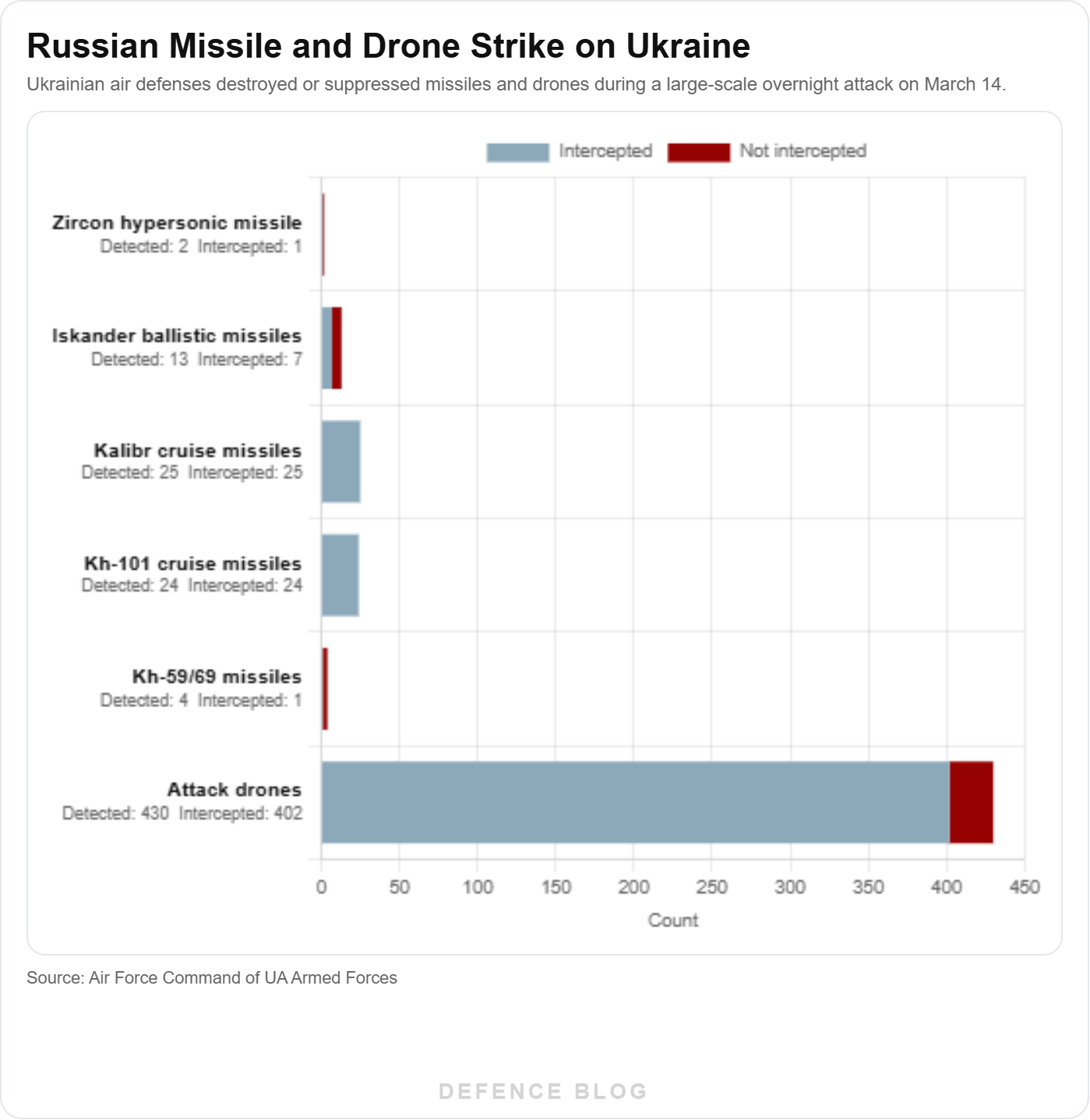
Kyiv was struck not because the Russian command unexpectedly opened a new operational principle. On the contrary, the principle has long been established: the combination of ballistic missiles, cruise missiles, and Shahed-type UAVs is intended to force the Ukrainian side to expend different layers of air defense simultaneously. According to Kyiv Independent on July 11, as a result of the attack on Kyiv, 12 people were injured, including children, and damage was recorded in several areas of the capital. On a broader scale, Russian strikes over the course of a day killed at least 10 people and injured at least 80 across Ukraine. In the Zaporizhzhia region, there were reports of 1,011 strikes on 51 populated areas. This last figure is important: the war has long ceased to be just a struggle of divisions at the front line and has become a battle for the nerve system of the state.
The technical side of the attack indicates a priority for the ballistic component. The "Iskander-M" has a quasi-ballistic trajectory, maneuvering in the final section and a flight time that leaves the defending side with only a few minutes. The use of S-400 surface-to-air missiles against ground targets is less elegant from a military point of view, but quite in the spirit of late Soviet thinking: if the item is in stock and can deliver a warhead, it will be used. This is how a system fights where the cost of a solution is often considered not in rubles, but in the availability of a suitable airframe and engine. For Ukraine, this means a harsh and unpleasant dependence on a limited number of Patriot and SAMP/T missile defense systems. After the attack, Zelensky stated directly that most targets were shot down, but not the ballistic missiles, and again called for accelerating agreements on Patriot and the European anti-ballistic project.
Russian Air Defense Also Enters Overload Mode
Almost simultaneously, the Russian official line provided a mirrored number. TASS, citing the Russian military department, reported that Russian air defense shot down two bombs, two missiles, and 445 Ukrainian UAVs in a day. Even if one approaches this number cautiously, as one should with official military statistics during wartime, the order of magnitude itself is indicative. Moscow demonstrates the ability to repel massive attacks but effectively acknowledges that the Ukrainian long-range campaign has become a constant, rather than an episodic factor. Against 40 or 60 devices, one can build a standby defense. Against hundreds of devices, one must build an industrial defense mode daily, where not only missile defense calculations are important, but also the radar field, mobile fire groups, equipment repair, missile stocks, and operator training.
Here, an institutional problem emerges that Russian military culture usually hides behind the word "scale." Soviet air defense was built against NATO's air armadas, but its late Soviet logic was not designed for thousands of cheap small targets hitting oil refineries, ports, warehouses, and railway hubs. ISW, in an assessment from July 10, linked Ukrainian strikes on Russian oil infrastructure to a reduction in available gasoline production and signs of managerial nervousness in the regions. This does not mean that the Russian economy will stop tomorrow. Russia is too large and too accustomed to inefficiency to collapse from a single UAV campaign. But the margin of war is deteriorating: each new layer of defense for an oil refinery, port, or airfield requires people, radars, vehicles, diesel, ammunition, and command attention.
Why Moscow Chooses Air Depletion
From a military perspective, Russia's bet on night combined strikes is rational, albeit brutal. On the ground, the offensive remains slow and expensive; every kilometer requires infantry, artillery, drones, evacuation, and political explanations for losses. In the air, the Kremlin has the opportunity to show action every day: missiles fly, sirens sound, and Western capitals debate air defense supplies. This is an old Russian habit of substituting operational results with demonstrations of pressure. In the 1940s, Soviet instructions loved the word "continuity." In 2026, continuity has taken the form of night "Shaheds," ballistic strikes, and information reports of hundreds of downed drones.
But this model has its limits. Drones are cheaper than missiles, but they are not free; ballistic missiles are effective, but their production is tied to engines, electronics, and precision mechanics; the S-400, when used against ground targets, is no longer on combat duty against aircraft. If Ukraine, with the support of partners, expands its anti-ballistic layer, Russian effectiveness in night attacks will decrease. If it does not expand, Moscow will continue to exploit the Patriot shortage as a vulnerability, and Kyiv will remain the symbolic number one target.
The main conclusion is unpleasant for both sides: the air war has become not an addition to the front but a separate economy of depletion.
Strategic Forecast
In the coming weeks, one should expect not a decrease but an increase in the density of such strikes. Russia will combine "Iskanders," S-400, X-59/X-69, X-31, and "Shaheds," trying to identify windows in Ukrainian air defense and politically pressuring Kyiv's allies. Ukraine, in turn, will respond with strikes on oil refineries, ports, supply channels, and Russian logistics in Crimea and the Sea of Azov. This is no longer an exchange of symbolic strikes. It is a competition of two production systems, where the winner will not be the one who delivers a spectacular strike once, but the one who can restore damage more cheaply and close vulnerabilities more quickly. The Russian army knows how to live in a mode of expenditure. The question is whether the Russian state can endure when the expenditure begins to be counted not only at the front but also at oil depots, railroads, and in regional budgets.
Russian forces launched a combined attack on Kyiv on July 11, firing 12 ballistic missiles and 121 drones. Ukrainian air defense managed to intercept 111 drones and 2 guided missiles but could not stop the ballistic missiles. The assault resulted in 12 injuries in Kyiv and at least 10 fatalities across Ukraine, highlighting the ongoing intensity of the conflict and the challenges faced by Ukrainian defenses.
- Russian forces launched 12 ballistic missiles and 121 drones at Kyiv on July 11.
- Ukrainian air defense intercepted 111 drones and 2 guided missiles but failed to intercept ballistic missiles.
- The attack resulted in 12 injuries, including children, and damage across several areas of Kyiv.
- Overall, Russian strikes across Ukraine killed at least 10 people and injured at least 80 on the same day.
- The attack reflects a strategy of overwhelming Ukrainian air defenses with a mix of drones and missiles.