
American Rheinmetall wins U.S. Army deal for autonomous supply vehicles
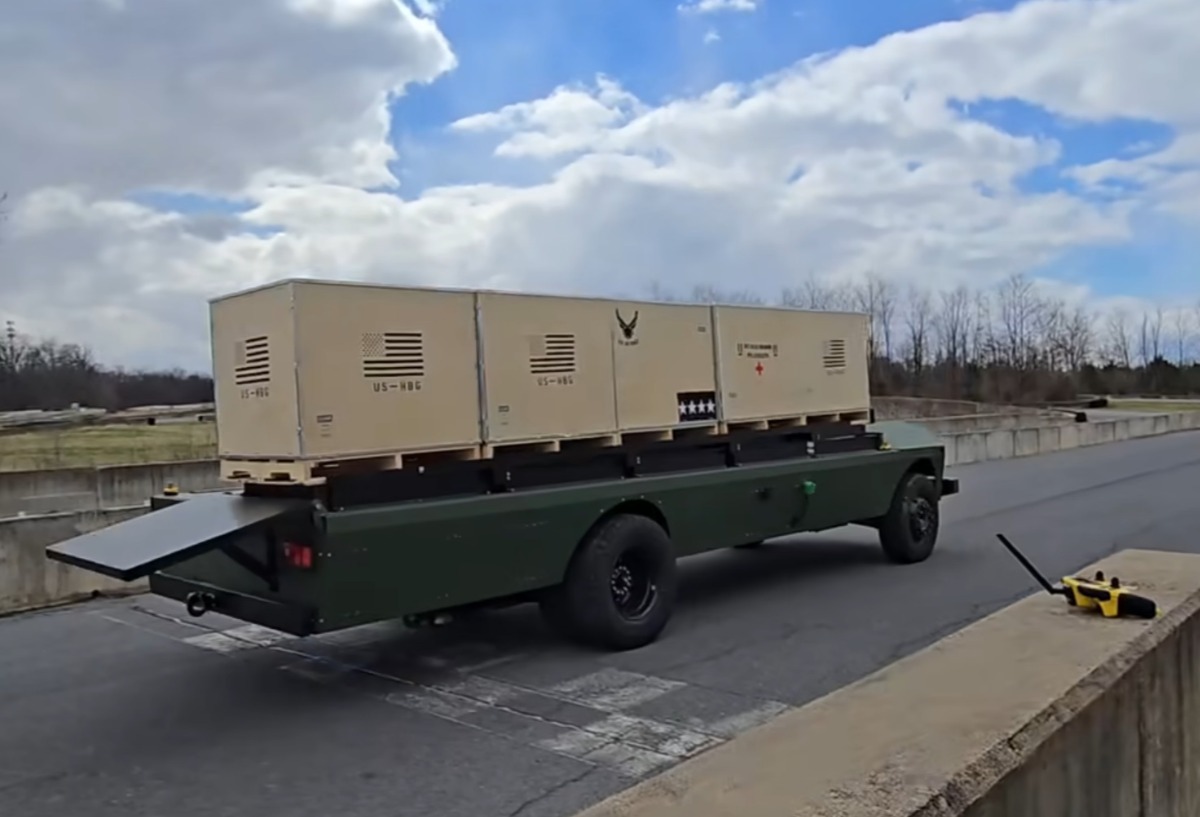
American Rheinmetall announced that the U.S. Army selected Harbinger’s plug-in hybrid vehicle platform as the basis for an autonomous unmanned ground vehicle contract awarded to the company, covering an 18-month effort to develop and deliver uncrewed vehicles under the Army’s Project Sustainment program.
The contract runs through the National Advanced Mobility Consortium, known as NAMC, a government-industry partnership structure that lets the Army fund experimental vehicle technology development outside its traditional, slower acquisition process. American Rheinmetall will serve as the prime contractor overseeing the effort, meaning the company holds primary responsibility for delivering the finished vehicles even though the actual engineering work is split across multiple specialized partners.
Project Sustainment addresses a problem that has grown more urgent as militaries worldwide watch drones and precision weapons increasingly target the unglamorous but essential work of getting supplies to frontline troops. The unmanned ground vehicles built under this contract are designed to autonomously transport supplies to and from what the Army calls the forward line of troops, the point on a battlefield closest to enemy contact, reducing the number of soldiers who need to physically drive a truck loaded with fuel, ammunition, or food through territory where an enemy drone or ambush could strike at any moment.
The vehicle platform itself comes from Harbinger, a Southern California and Texas-based commercial vehicle manufacturer that built its business developing hybrid-electric chassis for delivery trucks and other medium-duty commercial vehicles before pivoting a version of that technology toward military applications. Harbinger’s defense-oriented platform, sometimes marketed under the name Praesidia, is designed to be flexible and up-fit ready, meaning the underlying chassis can be reconfigured with different equipment and mission packages depending on what a specific Army unit needs, rather than requiring an entirely custom-built vehicle for every different mission profile. Earlier reporting from The Defense Post described a related Harbinger hybrid platform capable of supplying up to 350 kilowatts of exportable power, electricity the vehicle can generate and share with other equipment in the field, a capability that could let these supply trucks double as mobile power sources for forward operating positions in addition to hauling cargo.
John Harris, Co-founder and CEO of Harbinger, framed the Army’s selection as validation of a broader strategy built around adapting proven commercial vehicle technology for military use rather than designing an entirely new platform from scratch.
“The Harbinger hybrid vehicle platform exemplifies how proven commercial technologies can be rapidly adapted to meet the evolving needs of the U.S. military,” Harris said. “By partnering with American Rheinmetall, we’re bringing together advanced vehicle platforms, scalable manufacturing, and proprietary battery technology to deliver autonomous-ready vehicles that reduce risk to soldiers while enhancing military operational effectiveness.”
Turning a hybrid delivery truck chassis into an actual autonomous military vehicle required bringing in specialized technology partners beyond Harbinger’s vehicle expertise alone. Forterra supplies the autonomous driving software that lets the vehicles navigate and operate with minimal direct human control, technology the companies describe as enabling distributed, mission-aware, and resilient operations in contested environments, essentially giving the vehicle enough onboard intelligence to keep functioning and making sensible decisions even when communication links back to human operators become unreliable or jammed. Primordial Labs contributes a human-machine interface called Anura, a system that converts natural-language voice commands into instructions the robotic vehicle can execute, letting a soldier direct the vehicle’s actions through spoken commands rather than a complex touchscreen or joystick interface, a design intended to reduce the cognitive burden on troops who already have enough to focus on in a combat environment and to shorten how long it takes to train someone to operate the system effectively.
Jim Schirmer, Vice President of Sales and Marketing at American Rheinmetall, positioned the award as expanding the company’s broader footprint in the ground robotics sector rather than treating it as an isolated, standalone contract.
“This award expands American Rheinmetall’s growing portfolio of uncrewed ground systems within the U.S. market and reinforces our position as a leader in ground robotics and autonomous technologies,” Schirmer said. “Project Sustainment directly supports the Army’s modernization priorities by delivering autonomous load-handling and transport capabilities that increase readiness and reduce the burden on Soldiers.”
This Project Sustainment award builds directly on a partnership American Rheinmetall and Harbinger first announced in May 2026, when the two companies unveiled plans to jointly develop a broader family of robotic and uncrewed ground vehicles for the Department of War. That earlier announcement established the working relationship between the two companies well before this specific Army contract materialized, suggesting American Rheinmetall had already positioned itself and its commercial vehicle partner to compete for exactly this kind of autonomous logistics opportunity once the Army formally opened the Project Sustainment effort for bids.
Content preview only. Full article available at source. View Full Article
The U.S. Army awarded a contract to American Rheinmetall for the development of autonomous unmanned ground vehicles based on Harbinger’s hybrid vehicle platform. This 18-month effort is part of the Army’s Project Sustainment program, aimed at improving logistics by autonomously transporting supplies to frontline troops, thereby reducing risks to soldiers. The project leverages advanced vehicle technology to enhance military operational effectiveness.
- U.S. Army selected Harbinger’s hybrid vehicle platform for autonomous supply vehicles.
- The contract is part of the Army’s Project Sustainment program.
- American Rheinmetall is the prime contractor overseeing the development.
- The vehicles are designed to autonomously transport supplies to frontline troops.
- The project aims to reduce risk to soldiers and enhance operational effectiveness.