
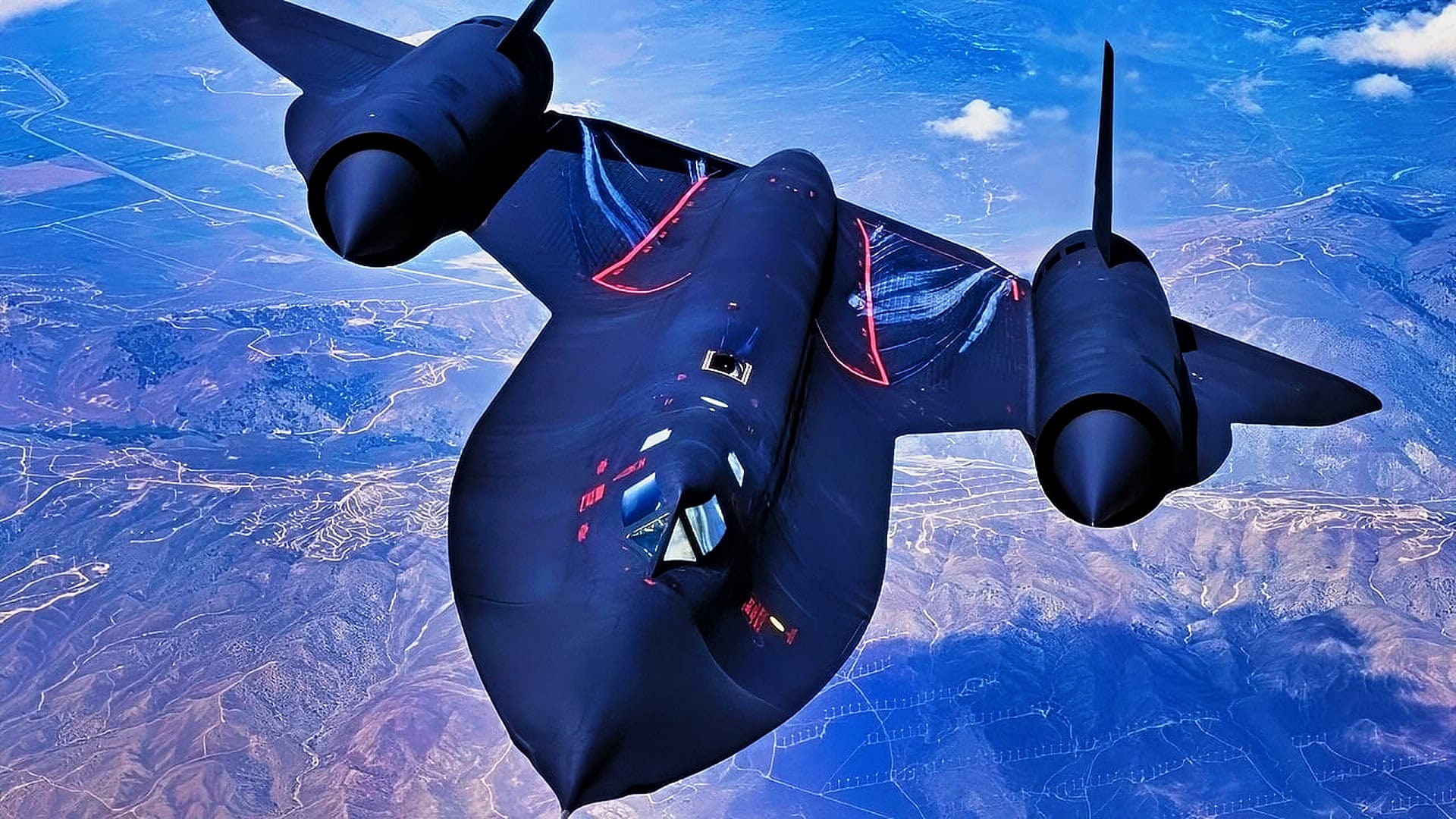
 SR-71 Blackbird High in the Sky USAF Photo
Summary and Key Points: Brandon J. Weichert examines Lockheed’s A-12CB, a proposed carrier-based version of the CIA’s A-12 Oxcart and SR-71 Blackbird that never left preliminary design. Launching the 101-foot Mach 3 jet would have required Rocketdyne boosters from the F-104G zero-length-launch program delivering 130,000 pounds of thrust for 7.9 seconds plus a steam catapult with twin bridle points; recovering it meant a structural tail hook, reinforced gear and airframe, elevator fit problems, and heat-resistant coatings for the deck.
SR-71 Blackbird-style Aircraft From an Aircraft Carrier?
When Lockheed unveiled its SR-71 Blackbird, it was one of the most incredible-looking planes ever conceived.
Despite its covert nature, it became one of the most recognizable military aircraft ever.
The Blackbird could fly more than three times the speed of sound and operate above 80,000 feet.
Not bad for a plane designed in the early 1960s.
The plane was more than just cool (though it certainly was).
It was next-level. Once the military and intelligence services saw what the Blackbird could do, they started wondering how best to use a variant.
Lockheed, sensing opportunity, started drawing up plans for multiple variants.
There was a long-range interceptor variant.
A possible nuclear-bomber variant.
The CIA loved its A-12 Oxcart system.
Multiple Roles?
So, naturally, the United States Navy considered taking a bite at the supersonic apple. Lockheed drew up plans for a carrier-based A-12CB variant.
If the Pentagon had gone for this version of the Blackbird, the Navy might have possessed a Mach 3 reconnaissance aircraft that could launch from a carrier at sea.
It never moved beyond the preliminary design phase.
As Aviation Geek Club, a respected online trade publication, reported, the A-12CB would have needed large solid-fuel rocket boosters to launch from the shortened flight deck of US Navy aircraft carriers.
The Navy would have likely utilized the Rocketdyne RS B-202 motors that were previously part of the experimental zero-length launch systems for the Lockheed F-104G Starfighter.
Blasting Off From an Aircraft Carrier
With these Rocketdyne RS B-202 rocket motors attached, the proposed A-12CB would have blasted off an aircraft carrier deck at unbelievable speeds.
According to the specifications, the rockets would have generated 130,000 pounds of total thrust for 7.9 seconds.
That additional thrust would have helped the carrier’s powerful steam catapult.
Once aloft, the rocket motors would detach from the A-12CB airframe.
That’s a significant design change from what the SR-71 and its CIA sister bird, the A-12 Oxcart, required. But the Navy would have needed more from the A-12CB.
The airframe itself would have needed significant reinforcement to survive the rough launches and landings.
Engineers would have needed to strengthen portions of the fuselage and wings to accommodate the forces generated by the rocket boosters and catapult system.
The naval variant of the A-12 Oxcart would have incorporated two bridle attachment points just beneath the fuselage, near the engine outlets.
Those bridles would have connected the A-12CB to the steam-powered catapult, which would have assisted the bird on carrier launches.
The sketches of the proposed A-12CB apparently include a drawing showing how a specialized, large catapult shuttle would have provided additional support for the forward fuselage during launch.
But these modifications to make the A-12CB carrier-capable would have fundamentally changed the plane’s design and altered its operating characteristics.
If launching the proposed A-12CB would have been hard, recovering it would have been nearly impossible.
The original A-12 Oxcart was meant to operate from long, prepared runways. Its landing speeds were much higher than those of conventional aircraft.
But carrier aircraft must withstand incredible, sudden deceleration when an arresting hook latches onto cables stretched across the flight deck.
Too Many Structural Changes
Thus, the A-12CB proposal incorporated an arresting hook attached to the aircraft’s primary structure. Its landing gear would also have required reinforcement to withstand the impact forces of carrier landings.
In fact, the A-12’s overall dimensions would have created difficulties in the tight spaces of the aircraft carrier. An aircraft measuring around 101 feet long would have taken up significant space on the carrier.
Such a large plane in such a cramped space would have drastically complicated flight deck movements, aircraft storage, and maintenance.
Moving the proposed A-12CB from the hangar area below decks to the flight deck via elevators would have been difficult.
It might not have passed through carrier openings, requiring partial disassembly and reassembly.
As for those rocket boosters that would have provided that extraordinary thrust, their exhaust would likely have damaged the flight deck.
Therefore, the Navy would have had to pay for significant upgrades to ensure the flight deck had heat-resistant protective coatings, and it would have required other structural modifications to protect it from sustained damage.
Some even questioned whether the A-12CB could have launched properly with the rockets providing that much sudden power in such a confined space.
An Interesting Concept
The proposed A-12CB mission would likely have been reconnaissance. But the Navy might also have used it as a strike platform.
By having an A-12CB as a carrier-based reconnaissance platform, the Navy would have had significant intelligence-gathering capabilities independent of overseas airfields.
Then again, as the existing A-12 Oxcart and SR-71 Blackbird programs showed, the Cold War didn’t need carrier-based reconnaissance.
These planes could launch from land and do their jobs just fine.
Lockheed’s A-12CB proposal never took wing.
It was purely theoretical. It was likely best it remained that way.
The money, resources, and time required to procure these birds, maintain them, and upgrade the carriers to sustain them would have been far too onerous.
These birds worked better as a land-based system.
With the limitations of the carrier space, putting Blackbird on a flight deck might have looked great.
But it wouldn’t have been worth the cost.
About the author: Brandon J. Weichert
Brandon J. Weichert is the Senior National Security Editor at 19FortyFive.com. He also manages The Weichert Brief on Substack. Weichert is the co-host for The Mario Nawfal Show on Twitter/X. He is the author of four bestselling national security books, most recently A Disaster of Our Own Making: How the West Lost Ukraine (Encounter Books). His next book, Fortress Americas: A New Monroe Doctrine (Tucker Carlson Books), is due out December 8. Follow him via Twitter/X @WeTheBrandon.