
Anefis besieged in Mali — JNIM and FLA set Africa Corps in the north in 2026
 Marie Dubois
Anefis besieged in Mali — JNIM and FLA pin down Africa Corps in the north in 2026
On July 7, in Anefis, in the Kidal region, shells were still falling around the camp where Malian soldiers and Russian paramilitaries from Africa Corps had entrenched themselves. This was not an isolated skirmish in the desert. Two days earlier, the Support Group for Islam and Muslims (JNIM), affiliated with Al-Qaeda, and the Azawad Liberation Front (FLA) had launched a series of coordinated attacks against at least seven Malian military installations, from Gao to Sévaré, with fighting reported near the Kéniéroba prison, about 60 kilometers southwest of Bamako.
The junta claims to have regained control. The insurgents, on the other hand, assert that they have taken positions in Anefis and continue to fight. Between these two narratives lies the reality on the ground: cut-off routes, halted reinforcements, and a camp that becomes a fixed point around which the adversary imposes its tempo.
A lock between Gao and Kidal
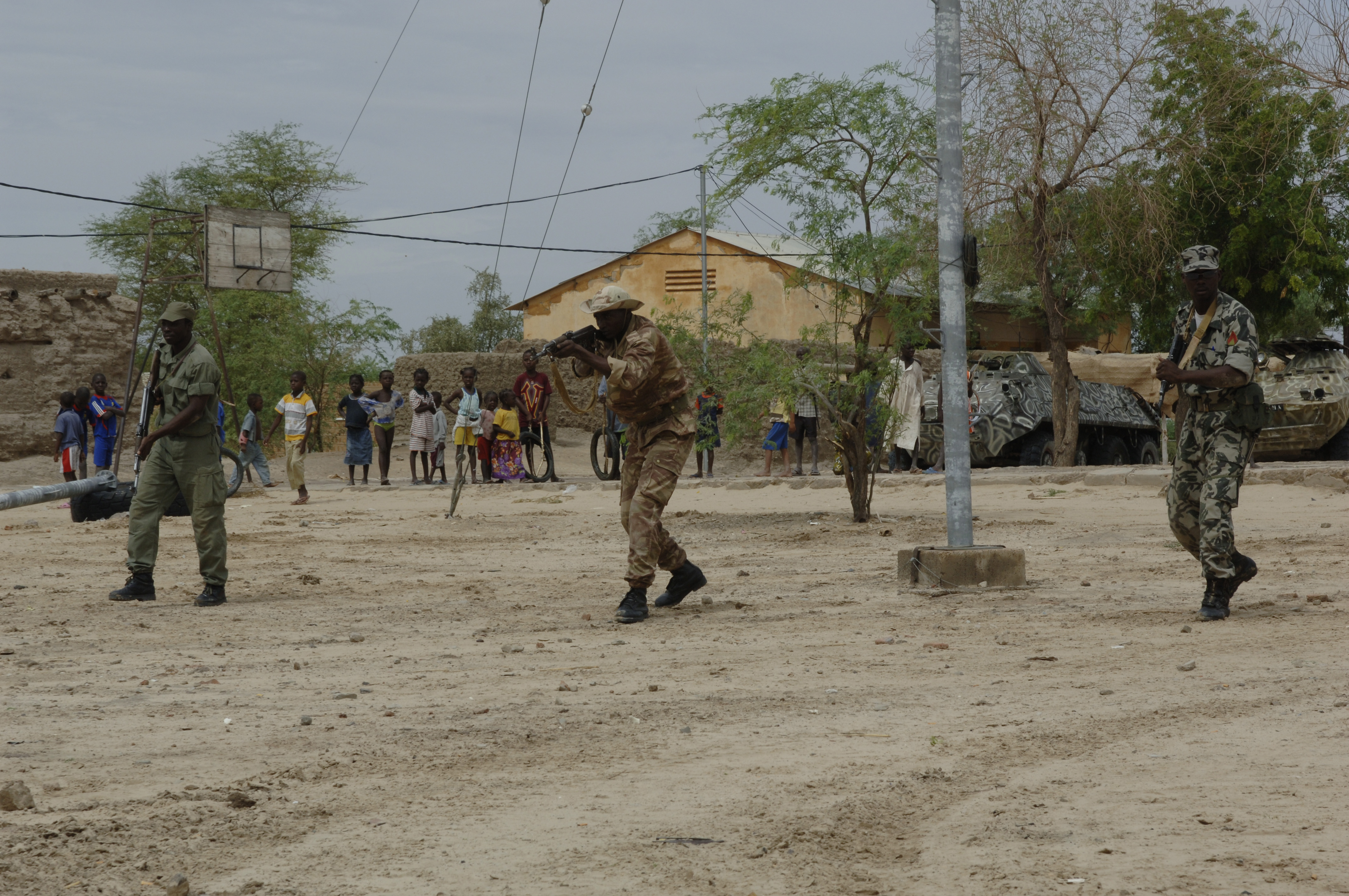
Anefis does not have the symbolic weight of Kidal, but it has very concrete operational value. The locality is located about a hundred kilometers southwest of Kidal, on the axis that connects Gao to northern Mali. For a regular force, holding Anefis means keeping an entry point to Kidal. For the FLA and JNIM, fixing it means preventing Bamako from rebuilding a sustainable presence in the region after the loss of territory in the spring.
According to Africanews, citing AFP, FLA fighters arrived as reinforcements on Monday morning in several dozen armed vehicles. Security sources reported that the rebels and their JNIM allies were firing on the camp where the Russians from Africa Corps and the Malian soldiers were located. Another indication is even more significant: Malian reinforcements coming from Gao reportedly had to turn back after an ambush, with five to eight vehicles destroyed according to the Wamaps collective.
On the map, Gao-Anefis-Kidal appears to be a line. On the ground, it is a succession of empty distances, exposed tracks, and areas where a motorized column is only as good as its prior intelligence and evacuation capability. From experience, a force that cannot get its reinforcements through does not just have a tactical problem. It loses its freedom of maneuver.
The JNIM-FLA alliance changes the nature of the threat
The most concerning point is not just that JNIM is striking. It has been doing so for years. The change comes from the coordination with the FLA, a Tuareg separatist actor whose political objective is not that of the jihadists. The two camps have fought each other in the past. For about a year, according to sources cited by AllAfrica and DW, they have set aside some of their rivalries to strike at the Malian state.
This convergence produces a simple military effect: the FLA knows the networks, the tracks, and the local loyalties in the north; JNIM brings an attack discipline, a culture of claiming responsibility, and experience in asymmetric warfare against camps, convoys, and logistical routes. Together, they can harass in the north, test the center, and create uncertainty near Bamako without needing to hold all the attacked localities.
The attacks on July 5 targeted Gao, Aguelhoc, Anefis, Sévaré, and the surroundings of Kéniéroba. This dispersion matters more than the immediate toll. It forces the Malian army to respond everywhere at once, while its strongest units must already protect major centers, escort fuel flows, and reassure a capital that has seen insurgents approach its operational environment in the spring.
Africa Corps under pressure
The presence of Africa Corps in the Anefis camp gives this battle a political dimension. Moscow and the states of the Sahel States Alliance — Mali, Niger, and Burkina Faso — have recently reaffirmed their willingness to strengthen military cooperation. On paper, this partnership was supposed to replace French support and restore Bamako's coercive capacity. In Anefis, it mainly shows its limits.
The Russians can provide intelligence, drones, strikes, training, and an acknowledged brutality in certain operations. But they cannot conjure up available Malian battalions, nor can they simultaneously secure the northern tracks, the central camps, and the outskirts of Bamako. The reported use of kamikaze drones by the Russians, if confirmed, indicates a tactical adaptation. It also suggests that the camp was under enough pressure to employ close strike means in a defensive logic.
One must remain cautious: neither the exact number of casualties, nor the actual state of the camp, nor the extent of the destruction are independently confirmed. Bamako's communication speaks of a situation "completely under control" and more than twenty assailants killed. The rebels claim that fighting continues. In the Sahel, these two statements can be true just a few kilometers apart.
The immediate risk lies on the axes
The danger for Bamako is not necessarily the spectacular fall of a major city in the coming days. The more likely danger is the erosion of the axes. JNIM has already targeted fuel trucks heading to Bamako, causing shortages around the capital. If the JNIM-FLA alliance combines pressure in the north with attacks on logistics in the center and south, the junta will have to choose between holding symbols and protecting flows.
This is a bad choice for an army that governs. A civilian regime can sometimes acknowledge a partial loss of control and negotiate locally. A junta that has built its legitimacy on the promise of restoring security does not have that flexibility. Every attack becomes a political accusation.
The next area to watch is the Gao-Anefis axis, but also the depth towards Sévaré and the supply routes to Bamako. If Malian reinforcements can no longer move towards Kidal without heavy losses, Anefis will cease to be an incident. It will become the marker of a northern Mali where Africa Corps can fight, but not necessarily regain the initiative.
On July 5-7, 2026, JNIM and FLA insurgents launched coordinated attacks on multiple Malian military installations from Gao to Sévaré, with significant fighting reported near Anefis. Malian forces, supported by Russian paramilitaries from Africa Corps, faced ambushes and logistical challenges, leading to losses in reinforcements. The alliance between JNIM and FLA poses a new threat to the Malian military, complicating their operational capabilities in the region.
- JNIM and FLA launched coordinated attacks on at least seven Malian military installations.
- Malian reinforcements were ambushed, resulting in vehicle losses.
- Africa Corps is present in Anefis, providing support to Malian forces.
- The JNIM-FLA alliance is changing the nature of the threat to Malian forces.
- The situation in Anefis is critical for control over the northern supply routes.