
Army operations center is trying to solve battlefield data problems in real time
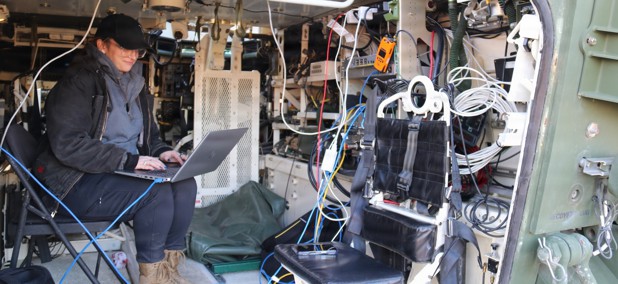
As the Army works to gather and organize data to support battlefield decisions, it has created a task force to help with small, short-term problems—and in the longer term, to shape the service’s overall approach to data management.
The Army Data Operations Center went live on April 3, service officials told reporters on Tuesday, and so far its small team of civilian and soldier data and software engineers have received seven requests from different organizations to help deconflict.
“It used to be about firepower, but it isn't really about that anymore,” said Lt. Gen. Jeth Rey, the Army’s chief of staff for command, control, communications, cyber operations, and network architecture. “It's really about who can get the data to make decisions faster, to dominate.”
The task force might help, say, to get a partner force’s data flowing into the Army’s next-generation command-and-control platform so that a U.S. commander can compare what the two militaries are seeing on one screen.
The ADOC is organized into a “warfighter engagement cell” that that triages requests, then feeds them to data engineers at the “finish cell” to come up with a solution, who then runs that by the “data management cell” to figure out what kinds of policies need to be created or modified to fix the issue in the long-term.
“Those things are actually a lot more difficult than what you think, to be able to do—because it might be different cloud environments, it might be different [areas of operations], data owners— and you need to go through all the access requests,” said Brig. Gen. Michael kaloostian, who heads the Command and Control Future Capability Directorate at Army Transformation
and Training Command.
ADOC has so far been fielding requests from units in training environments, he said, but it’s technically open to responding to troops in combat, and will prioritize those tickets.
“We haven't received anything yet to support those operations, but if there were to be a request, we would surge on that and prioritize that appropriately,” he said.
For the first 180 days, ADOC will respond to requests and track trends to give the Army feedback on which fixes can be incorporated into training or standard operation and whether the help-desk model is necessarily in the longer term.
“The Army will make informed decisions about what the structure should be and whether a centralized capability in the future is even needed, right?” Kaloostian said. “We just aren't mature enough as an Army right now to really, truly become data-centric. We need something that can aid the continuous transition and transformation of the Army to a data-centric force.”
It’s possible that the future looks like a centralized operations center that deals with the “higher-level heavy lifting” of organizing different data formats from their respective systems, so that soldiers on the ground aren’t having to sort through it themselves, said Lt. Gen. Chris Eubank, who heads U.S. Army Cyber Command.
“So I think the cyberspace domain is evolving at such a rapid pace that the organizations involved in that domain must evolve as well, but I think it's a necessary thing right now,” he added. “And the hope is we're creating soldiers that are data-smart more and more, and the heavier lifting is done inside of a central organization, if need be.”
The U.S. Army established the Army Data Operations Center (ADOC) on April 3, 2023, to address battlefield data management issues. The task force has received seven requests to improve data flow for decision-making. ADOC aims to support both training and combat units, prioritizing requests from troops in combat if necessary. The Army is working towards becoming more data-centric in its operations.
- The Army Data Operations Center (ADOC) was established on April 3, 2023.
- ADOC has received seven requests from different organizations to resolve data issues.
- The task force aims to improve data flow for battlefield decision-making.
- ADOC is open to supporting troops in combat if requests are made.
- The Army is transitioning to a more data-centric approach.