
As the Air Force tries to protect its F-35s from drones, former airmen say it highlights the risks for maintenance crews

Source: Task & Purpose
Loading...Strong SignalCredibility: 81%
Report Content
The Air Force is turning to nets to prevent drones from destroying its most sensitive fighter jets. Former aircraft maintainers told Task & Purpose that it highlights the risks that drones also pose to the personnel who fix and sustain them.
In recent months, two Air Force bases with units that fly highly sensitive fighter jets have sought input from private contractors on using nets to protect aircraft and personnel from small drones. The solicitations come as the U.S. figures out how to address a flurry of drone incursions on its bases at home and at installations abroad.
In March, officials at Shaw Air Force Base in South Carolina, where the 20th Fighter Wing flies F-16s, sought to add nets to their aircraft sunshades to “prevent intrusions” from small drones.
Earlier this month, Tyndall Air Force Base in Florida posted a market research solicitation asking private companies to pitch nets for the sunshades shielding their F-35s along the flight line. The objective, according to the Tyndall notice, is to prevent small drones from “penetrating the interior of the sunshade structures to protect aircraft and personnel.”
Chris McGhee, a former F-16 aircraft maintainer, said that although the solicitation highlights force protection, in reality, maintainers are still at risk.
“The aircraft is certainly going to be much safer than if there was no netting and the drone came in direct contact with the hull of the aircraft, the skin of the aircraft. But when I think about the aircraft maintainers working around the aircraft, they are going to be traveling in and out of that netting all the time,” he said. “The netting is to protect our aviation assets, and I think them framing it as its protection for personnel, I think fails the sniff check to me.”
McGhee said the nets, plus recent Iranian attacks on U.S. aircraft at bases, show the risks that maintainers could face as drones are increasingly used to target assets on the ground.
In March, an Iranian missile and drone attack damaged an Air Force E-3 Sentry AWACS command and control plane parked at Prince Sultan Air Base, Saudi Arabia. More than 10 service members were injured in the attack, according to reporting by Air and Space Forces Magazine.
“We lost an E-3. We’re pulling jets out of the f—ing UK because we don’t think we can protect them. We’re now talking about putting up nets in Tyndall,” McGhee said. “This is what happens when you don’t account for a very obvious technological capability of your enemy, and we as a nation, we are grossly misaligned in our defensive posture.”
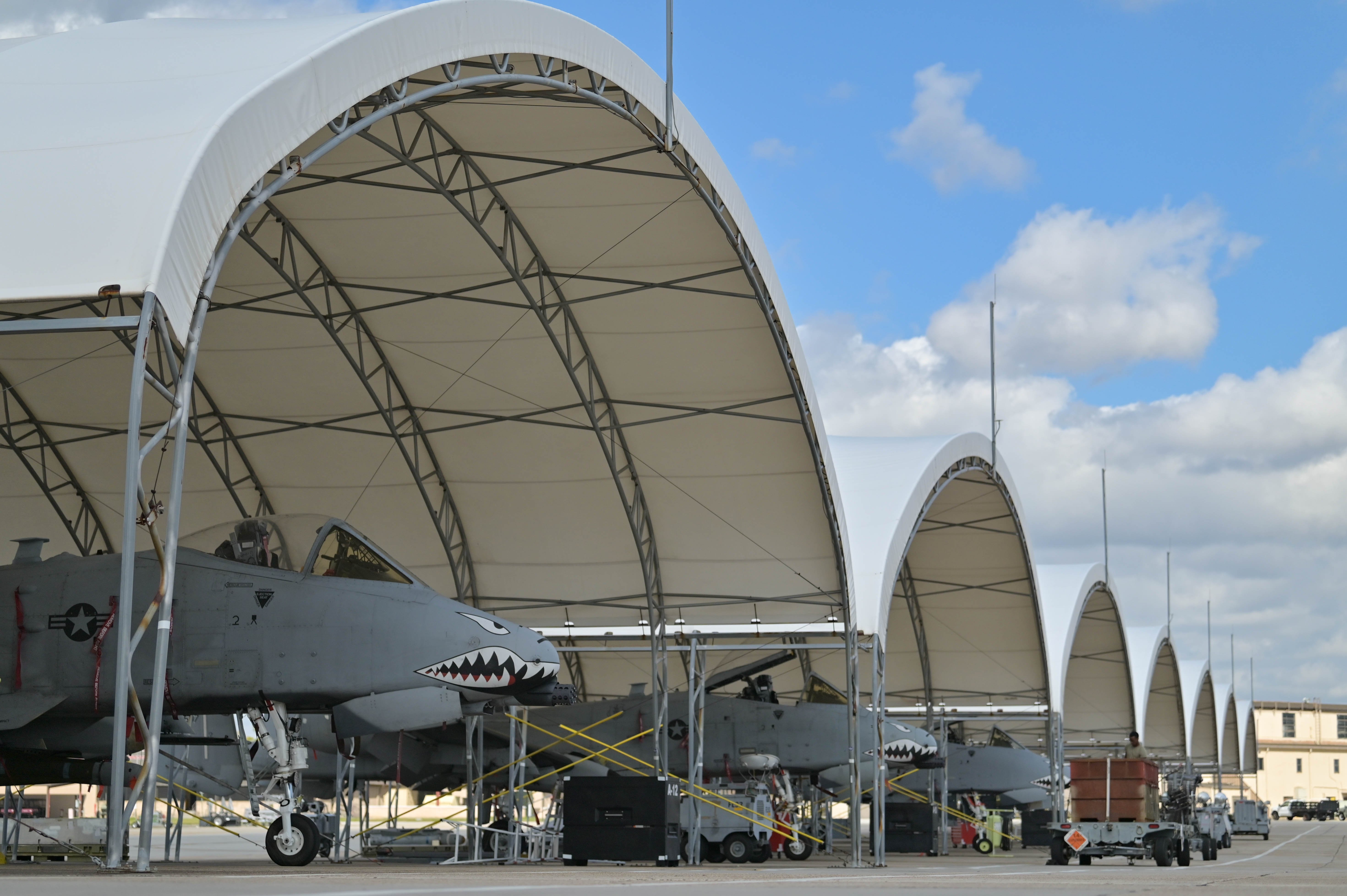 Air Force solicitations show bases are seeking to add nets to sunshades to protect them from small drones. Air Force photo by Senior Airman Rebeckah Medeiros.
Anne Phillips, a retired U.S. Air Force master sergeant who worked on F-15s, B-1s, KC-135s, and KC-46s, has a similar worry. She said when it comes to drone threats, maintainers are an “afterthought.”
“Human capital has always been expendable in aircraft maintenance, an afterthought, a ‘we’ll cross that bridge when we come to it,’” she said. “But even when the bridge is crossed and off in the distance behind us, we still haven’t even so much as had a discussion.”
Phillips was deployed as an aircraft production expediter to a base in the Middle East in 2017 when airmen further down the flightline reported a drone hovering overhead.
“When we called security forces, we were told there was nothing that could be done. Now, this drone wasn’t capable of attack and appeared to be doing [reconnaissance] but it struck me how nonchalant the response was to a drone following my guys around,” Phillips said. “This was nearly 10 years ago and obviously the landscape has changed, but the threat remains the same.”
An Air Force official told Task & Purpose that the service is “actively” developing base defense capabilities to improve security and protect airmen, including maintenance personnel. The official pointed to its Point Defense Weapon System, which uses kinetic and nonkinetic capabilities for air base defense. In September, the Air Force also announced it was creating a new career field for airmen to man the system responsible for thwarting drone and missile attacks on bases.
“Protecting Airmen, infrastructure, and other critical assets from unexpected [small drone] activity is a critical focus area for Department of the Air Force leadership,” the official said.
‘We assumed none of them would ever die in combat ever’
McGhee warned that the military’s recent challenges retaining an experienced workforce could be exacerbated by losing maintainers in combat.
“We have been cut to the bone as far as manpower for the last 15 years, and I think it has never accounted for: what if people can blow up our technicians? We are at the peacetime bare minimum for this population. It’s not like the infantry where they go, ‘We know we’re going to lose 10% during this surge in 2008,’” McGhee said. “We are so fat and bloated with complacency for this workforce population, which is why we have the gall to cut it so deep, because we assumed none of them would ever die in combat ever.”
Top Stories This Week
Kelly Grieco, a senior fellow at the Stimson Center, said destroying aircraft before it actually gets up in the air is a relatively old strategy. What’s new about the drone threat now, Grieco said, is that it highlights newer vulnerabilities to bases which had been considered more or less a “sanctuary” for U.S. forces for the last 30 or so years.
Known as the father of air power theory, Giulio Douhet, an Italian Army general, theorized in the early 20th century that attacking an enemy’s “nests and eggs on the ground” is more effective than hunting “his flying birds in the air.” Grieco said Iran is using drones as a means to interrupt U.S. air power on the ground by making operations more “costly.”
“If you can find a weak point, say on the ground, like maintainers, and disrupt that link in that system, and I think that’s what Iran understands,” she said. “If you look at what it struck on these bases, it went after [air]-refueling aircraft, airborne early warning communications, radars, all of the things that are enablers. And if you look at Chinese military writings, in particular, they specifically talk about U.S. air power as a system, and they recognize explicitly the base as being a core vulnerability.”
The post As the Air Force tries to protect its F-35s from drones, former airmen say it highlights the risks for maintenance crews appeared first on Task & Purpose.
Classification
Region
North America, West Asia
Analytical Domain
Operational
Primary Category / Secondary Categories
Weapons & Equipment / Military Operations
Subcategory
Drone/UAV
SALUTE Report
Size
Not specified
Activity
The Air Force is seeking to protect its aircraft and personnel from drone incursions by implementing netting systems at bases.
Location
Shaw Air Force Base · Tyndall Air Force Base · Prince Sultan Air Base
Unit
U.S. Air Force
Time
Recent months
Equipment
F-35F-16E-3 Sentry AWACSdronesnets
Summary
The U.S. Air Force is implementing netting systems at Shaw and Tyndall Air Force Bases to protect aircraft, including F-35s and F-16s, from drone incursions. Former maintainers have raised concerns about the risks to personnel, citing recent drone attacks, including an Iranian strike that damaged an E-3 Sentry in Saudi Arabia. The Air Force is actively developing new defense capabilities to address these threats and enhance security for its personnel and assets.
Key Facts
- The Air Force is implementing netting systems to protect aircraft from drones.
- Former maintainers express concerns about the risks to personnel from drone threats.
- Recent drone incursions have prompted the Air Force to seek private contractors for protective measures.
- An Iranian missile and drone attack damaged an Air Force E-3 Sentry in Saudi Arabia, injuring over 10 service members.
- The Air Force is developing new defense capabilities to enhance security against drone threats.