
Australia's 90 HIMARS Will Matter Only If Canberra Can Feed Them in 2026
 Marcus Chen
Australia's 90 HIMARS Will Matter Only If Canberra Can Feed Them in 2026
Australia has received a second batch of High Mobility Artillery Rocket Systems (HIMARS) roughly two years ahead of its original schedule. The program is now moving toward as many as 90 launchers in two regiments, with the 10th Fires Brigade in Adelaide taking the new vehicles. That is a meaningful increase in Australia's long-range fires capacity. It is not yet a war-winning capability.
The important development is the combination of early delivery and a domestic ammunition plan. Australia is also preparing to produce Guided Multiple Launch Rocket System (GMLRS) rounds locally. If both pieces arrive on schedule, Canberra will have something more useful than a procurement headline: a mobile force that can contribute to sea denial and land-based strike across the northern approaches.
The launcher count is only the visible part
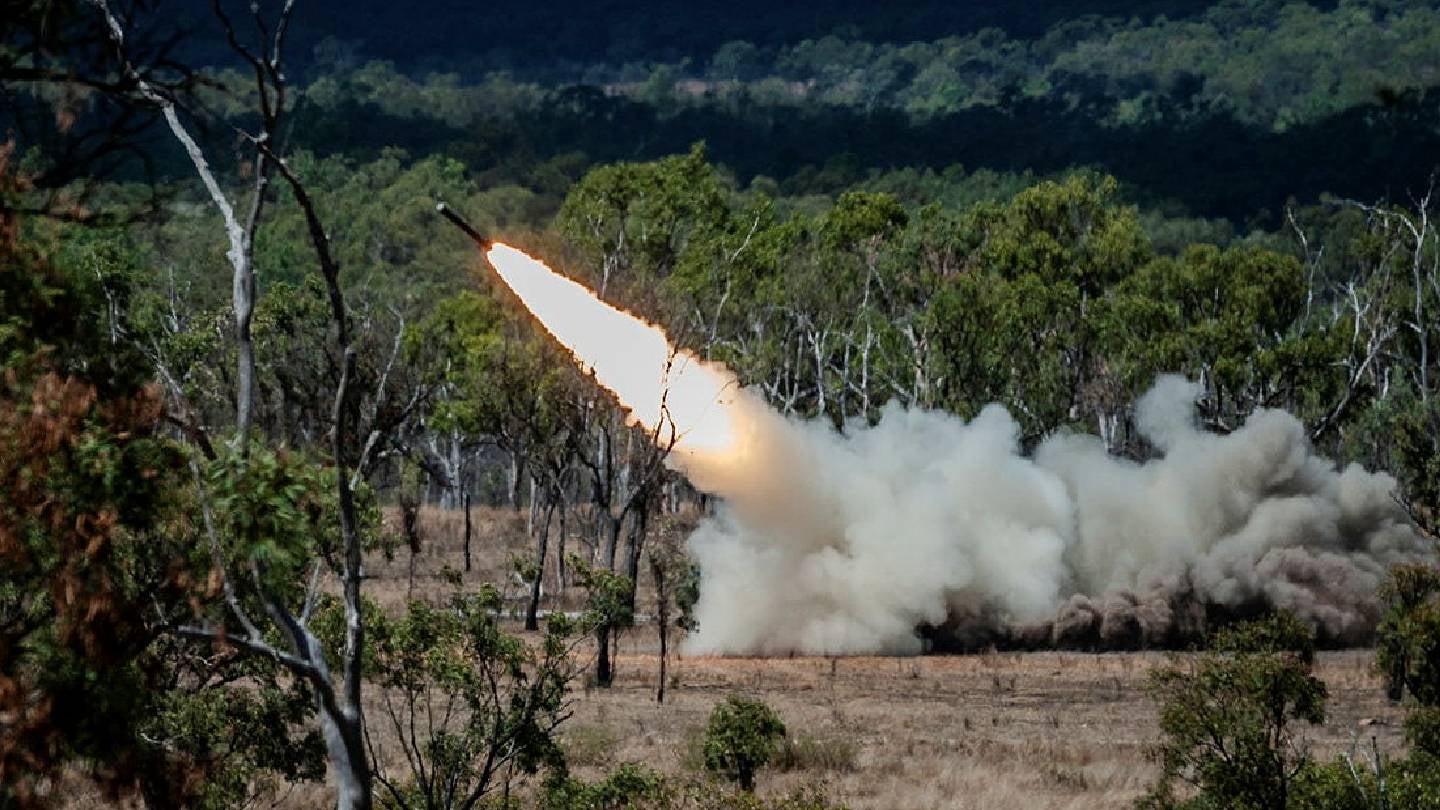
A HIMARS launcher carries either one six-round pod of 227-millimeter GMLRS rockets or a single Army Tactical Missile System (ATACMS) missile, depending on the loadout. GMLRS gives the system a range of roughly 70 kilometers in its standard form, while newer extended-range variants go farther. ATACMS reaches approximately 300 kilometers. The launcher itself is road-mobile, air-transportable and designed to move after firing.
Those specifications matter in Australia's geography. A battery operating from northern bases could threaten maritime chokepoints, airfields and logistics nodes without needing to put a surface combatant inside a missile engagement zone. But a launcher is not a firing unit. It needs targeting data, reload vehicles, protected fuel, maintenance, air defense and a reliable stream of pods. In a high-end fight, the number of launchers is less important than the number of complete fire missions they can sustain.
Australia is buying reach, not automatic sea control
Canberra's 2023 Defence Strategic Review identified long-range strike and northern infrastructure as urgent priorities. The HIMARS expansion fits that logic. It gives the Australian Defence Force a way to impose costs on an adversary approaching the island continent, and it can complicate the use of ports, airfields and staging areas across the archipelago to Australia's north.
It also supports the United States without pretending that Australia can reproduce the U.S. military. Australian launchers could contribute to a distributed fires network linking aircraft, ships, submarines and allied sensors. In a Taiwan contingency, that might mean attacking selected logistics targets or protecting allied movement through the eastern Indian Ocean and western Pacific. The value is in the network, not in a standalone Australian rocket brigade.
That distinction is essential. HIMARS cannot find targets by itself. Its radar, drone and intelligence links must survive jamming and attack. A launcher that cannot receive a precise target-quality track is a truck carrying expensive rockets. Australia is therefore buying a command-and-control problem at the same time it is buying a missile system.
The ammunition question will decide the program
Early delivery creates pressure on Canberra to solve the less visible industrial problem. Lockheed Martin describes HIMARS as a mature, interoperable system, and the U.S. Army has used GMLRS extensively. Maturity lowers technical risk; it does not guarantee Australian stockpiles. A two-regiment force could expend a large share of its available rockets in days if it were used against air defense, artillery and logistics targets in a serious campaign.
Domestic GMLRS production would improve resilience, but “local production” should not be confused with independence. Australia would still depend on American design authority, specialized components, energetic materials and a secure supply chain. The test is not whether a factory opens. The test is whether it can replenish combat expenditure faster than a crisis consumes it.
Canberra should publish three numbers: the planned war reserve, the annual production rate and the number of launchers that can be supported simultaneously. Without those figures, the 90-launcher goal describes potential firepower rather than available firepower.
What this means for the U.S.-Australia alliance
The United States gains a partner that can hold more of the northern theater at risk without requiring an American ship or aircraft for every mission. That is useful as Washington tries to distribute forces across the Indo-Pacific. Australia gains political leverage and a more credible contribution to combined planning.
But the alliance should avoid turning HIMARS into another symbol of burden sharing. The system will matter only if Australia can protect its launchers, connect them to allied sensors, move them through contested logistics routes and replace the rounds they fire. Those are hard tasks. They are also exactly the tasks that determine whether a fires capability survives the first week of a war.
The launcher count is impressive. The reload count is the real measure.
Bottom line
Australia's early HIMARS delivery is one of the more practical developments in the country's defense buildup. It offers mobile range, fits the geography and can plug into American and Japanese operating concepts. Yet 90 launchers will not create deterrence by themselves. If Canberra cannot produce and stockpile enough GMLRS, build resilient targeting networks and protect the force on the ground, the number will be mostly administrative.
Australia is buying the right kind of weapon. Now it has to prove that it can feed the weapon after the first salvo. In a Pacific war, that is where the math starts.
Sources
- Australian Department of Defence, Defence Strategic Review
- Lockheed Martin, HIMARS system overview
- U.S. Army public information on HIMARS and GMLRS operations
- Defense Blog reporting on Australia's early second-batch delivery, published October 11, 2026.
Australia received a second batch of 90 HIMARS launchers in 2026, enhancing its long-range strike capabilities. The 10th Fires Brigade in Adelaide will operate these systems, which are complemented by plans for local production of GMLRS. However, the effectiveness of these systems hinges on logistical support and the ability to maintain a reliable supply of ammunition and targeting data.
- Australia received a second batch of HIMARS ahead of schedule.
- The country aims to produce GMLRS locally to support its HIMARS.
- 90 HIMARS launchers will enhance Australia's long-range strike capacity.
- The effectiveness of HIMARS depends on logistical support and targeting data.
- Australia's HIMARS will contribute to a distributed fires network with allies.