
Iran announces the downing of an MQ-9 drone over Qeshm Island and the Hormuz escalation tests American deterrence in 2026
 Ahmed Al-Rashid
Iran Announces Downing of MQ-9 Drone Over Qeshm Island and Hormuz Escalation Tests U.S. Deterrence in 2026
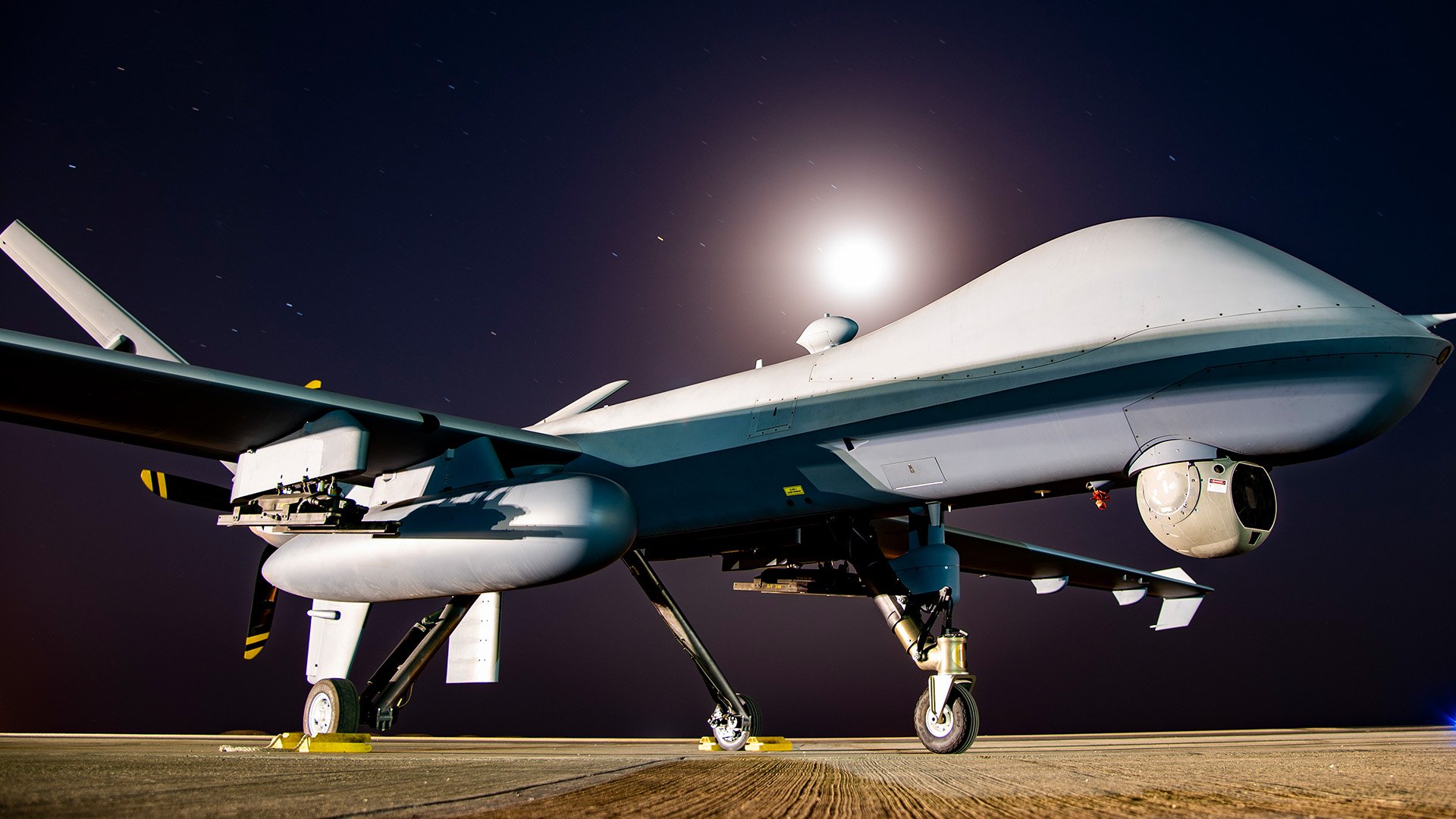
In the early hours of November 7, 2026, Iran announced that its air defenses had shot down an American MQ-9 drone over Qeshm Island at the eastern entrance of the Strait of Hormuz. The announcement coincided with reports of limited American strikes on the island, making the incident more significant than merely losing a drone. The Iranian narrative has not yet been independently confirmed by Washington, and some circulating reports confused the MQ-9 with the MQ-1, so the type of aircraft and the circumstances of its downing should be treated as information pending verification.
Qeshm is Not a Transitory Location
Qeshm is located alongside the maritime routes connecting the Gulf to the Gulf of Oman, providing those who monitor it the ability to track air and maritime movements in the narrowest parts of Hormuz. For this reason, Iran does not need to possess an ideal air defense network to impose costs on American reconnaissance. It suffices to integrate coastal radars, electro-optical surveillance, and mobile missile systems, along with precise knowledge of the routes used by American aircraft.
Militarily, the MQ-9 is neither a stealth fighter nor a platform designed to penetrate a dense air defense zone. Its true value lies in its ability to remain airborne for long hours, gather information, and provide a continuous picture of targets. Its downing, if confirmed, does not mean that Iran has defeated American air power, but it does indicate that Washington can no longer assume that reconnaissance over Hormuz is a low-risk activity.
Between the Iranian Announcement and the American Response
Middle East Eye and Anadolu Agency reported that Iran attributed the downing of the drone to its air defenses over Qeshm, while reports from Jerusalem Post and Al Jazeera indicated that the island experienced explosions and American strikes during the same period. So far, there is no independent image of the wreckage or American statement explaining the loss of the aircraft. This gap is significant, as Tehran needs to demonstrate deterrent capability, while Washington needs to prevent a tactical incident from turning into an acknowledgment of lost operational freedom.
If American strikes did indeed occur in response to the downing of the drone, the message is not to destroy all Iranian defenses; that is a much larger goal than a limited strike. The closer message is that the United States will pay a limited price to reopen the reconnaissance space. However, this type of response carries a known problem in the region: each side describes its step as defensive, and then the other side interprets it as readiness for escalation.
Testing Triad Capability
The incident reveals once again that military capability is not measured by the number of platforms displayed in parades. As I often reiterate in evaluating Gulf armies, there is a triangle of equipment, training, and institutions. Iran does not possess the best early warning aircraft or the latest Western missile, but it has extensive experience in operating an air defense network under pressure, linking it to geography and means of jamming and deception. These are elements of training and institutions, not just purchasing elements.
The United States, on the other hand, possesses tremendous superiority in satellites, electronic reconnaissance, manned aircraft, and precision strikes. However, superiority does not eliminate friction. When a relatively slow drone flies near an island controlled by local missiles and radars, the matter becomes a calculation of time and rules of engagement. The cheaper aircraft may be a valuable information-gathering tool, but its downing could be the cheapest means for the adversary to force the greater power to reveal its intentions.
What This Means for Saudi Arabia and the UAE
Riyadh and Abu Dhabi will watch the incident with concern that goes beyond the American-Iranian file. Both countries have purchased advanced air defense systems and aircraft, but they know that the security of navigation in Hormuz does not rely solely on national systems. If Washington needs strikes on Qeshm to regain freedom of flight, it clarifies that purchasing Patriot or THAAD does not automatically grant independent capability to manage a complex air-sea battle.
The practical Gulf lesson is the necessity of building a joint warning and command network, rather than adding a new platform to the procurement list. Additionally, the protection of facilities should be separated from monitoring maritime routes; defending a refinery or base is different from tracking a drone over crowded waters. Money exists in the Gulf, but the problem remains in unifying training, data, and decision-making rules. As always, it is easy to buy radar, but harder to agree on who presses the button.
Hormuz Between Reconnaissance and Deterrence
The downing of a single drone should not be interpreted as the beginning of a comprehensive war, nor should it be downplayed as a technical incident. The Strait of Hormuz today operates as a testing ground for mutual deterrence. Iran wants to convey that the corridor is not an open American space, while the United States wants to prove that Iranian threats do not grant Tehran the right to close the air or maritime space.
The most likely outcome is the continuation of a signaling war below the threshold of direct conflict, with increased sorties, jamming, decoy aircraft, and limited strikes. However, the closer aircraft get to Qeshm, the smaller the margin for error becomes. If the downing of the MQ-9 is confirmed, the structural problem will be clear: Washington has the greater superiority, but it needs to take risks to maintain the image of superiority; Tehran is much weaker, but it can use geography to force the stronger power to pay a price for every step. In Hormuz, it is not enough to possess the weapon; the question is who can continue to use it when every flight becomes a political declaration.
Sources
- Anadolu Agency, November 7, 2026, regarding Iran's announcement of downing an American drone over Qeshm.
- Middle East Eye, November 7, 2026, regarding the Iranian air defense narrative.
- Al Jazeera, November 7, 2026, regarding the strikes and explosions on Qeshm Island.
- Jerusalem Post, November 6 and 7, 2026, regarding American strikes and reports about the aircraft.
Iranian air defenses shot down an American MQ-9 drone over Qeshm Island on November 7, 2026, coinciding with reports of limited U.S. strikes in the area. This incident underscores the strategic significance of Qeshm in monitoring the Strait of Hormuz and reflects ongoing tensions between Iran and the U.S. regarding aerial reconnaissance operations.
- Iran announced the downing of an MQ-9 drone over Qeshm Island.
- The incident coincided with reports of limited U.S. strikes on the island.
- There is no independent confirmation of the drone's downing from U.S. sources.
- The incident highlights the strategic importance of Qeshm Island in monitoring maritime and aerial movements.
- Iran's air defense capabilities are being tested against U.S. reconnaissance activities.