
BAE Systems test-fires new deck launcher for U.S. Navy
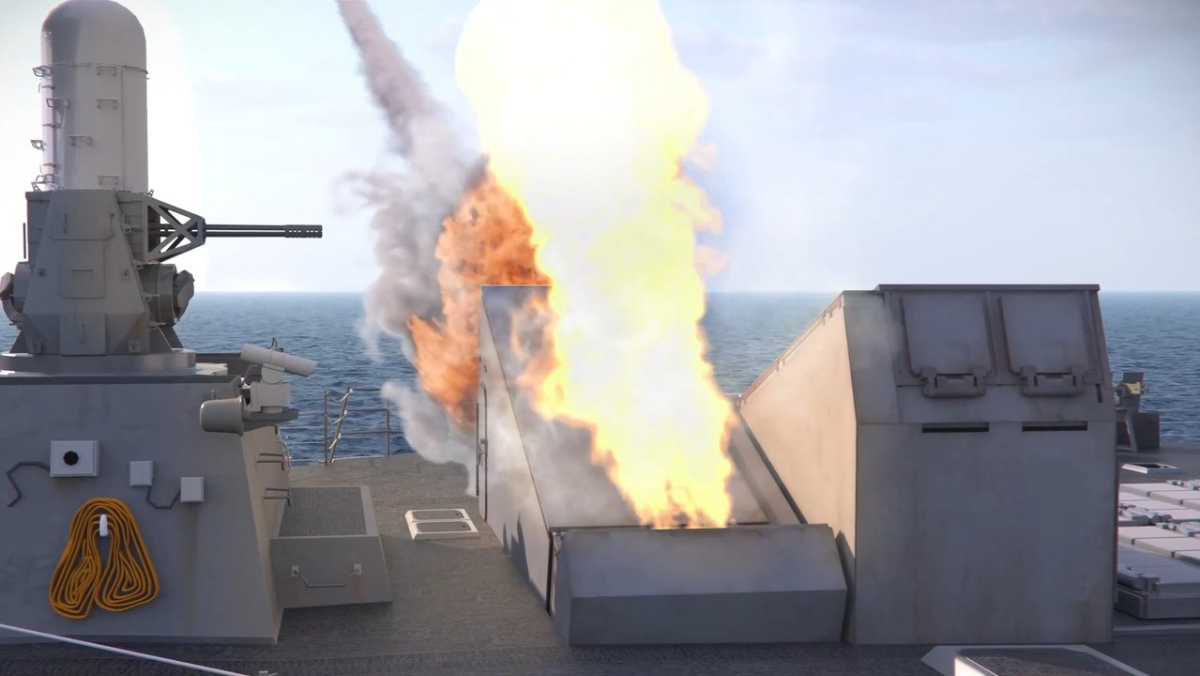
BAE Systems has completed the first live-fire test of its Adaptable Deck Launcher, a deck-mounted missile launcher that lets U.S. Navy and allied ships carry more Evolved SeaSparrow air defense missiles and reload them at sea with standard shipboard equipment.
The company announced the test on Oct. 27 from China Lake, California, home of the U.S. Navy’s main weapons test range in the Mojave Desert. BAE developed the launcher under a U.S. Department of War contract for the NATO Seasparrow Project Office, the multinational program that manages the Evolved SeaSparrow Missile, or ESSM, and it has not released details such as how many missiles were fired or which ESSM version was used.
The launcher sits on a ship’s deck and fires from fixed-angle canisters, so it does not need the deep below-deck wells required by the Mk 41 Vertical Launching System, the standard missile launcher on U.S. Navy cruisers and destroyers. It still uses the Mk 41’s electronics and logistics suite, which BAE says keeps operating costs low and gives it the same reliability as a vertical launcher. The ADL is fully compatible with the Mk 25 Quad-Pack canister, which holds four ESSM interceptors, the missiles ships use to defend themselves against supersonic anti-ship missiles, aircraft and other aerial threats.
Reloading is the main selling point. Because the canisters sit above deck, crews can replace spent ones at sea using normal shipboard equipment, so a ship can keep firing without returning to port to rearm.
“The successful demonstration of the Adaptable Deck Launcher is a major milestone in our commitment to enhancing the Navy’s combat effectiveness and readiness,” said Jason Casciotti, vice president of Weapons Systems at BAE Systems.
BAE designed the launcher for aircraft carriers, amphibious ships and other surface combatants, and it offers compact configurations for medium unmanned surface vessels, the smaller robotic ships the U.S. Navy has been testing as additional missile carriers. On carriers and amphibious ships, which were built without large vertical launch systems, the ADL could add air defense missiles without new below-deck construction.
The launcher grew out of the U.S. Navy’s Next Generation Evolved SeaSparrow Missile Launch System program. In 2023, BAE received a $37 million contract to design prototype deck launchers for the NATO Seasparrow Project Office based on its ADL concept, with the goal of fielding the newer ESSM Block 2 on carriers and other large-deck ships. ESSM Block 2 adds an active radar seeker, letting the missile guide itself to a target in the final phase of flight.
BAE serves as the mechanical design agent for the Mk 41 family and builds the canisters used in it, work that has included recent production contracts for Mk 41 canisters for the U.S. Navy and allied navies, including those of Australia and Japan. That role gave the company a ready supply chain and a common canister design for the new deck launcher.
Content preview only. Full article available at source. View Full Article
BAE Systems completed the first live-fire test of its Adaptable Deck Launcher at China Lake, California, on October 27, 2023. This new deck-mounted missile launcher enhances the U.S. Navy's capability to carry and reload Evolved SeaSparrow missiles at sea. The system is designed for aircraft carriers and amphibious ships, allowing for efficient air defense without the need for extensive below-deck construction.
- BAE Systems test-fired the Adaptable Deck Launcher on October 27, 2023.
- The launcher allows for more Evolved SeaSparrow missiles to be carried and reloaded at sea.
- It is designed for aircraft carriers and amphibious ships without large vertical launch systems.
- The launcher is compatible with the Mk 25 Quad-Pack canister, holding four ESSM interceptors.
- BAE received a $37 million contract for prototype deck launchers for NATO Seasparrow Project Office.