
Both sides suffer heavy casualties, school attack raises concerns, Russia retaliates against Kyiv with "Hazel" missiles.
【Global Times Special Correspondent in Russia Sui Xin and Zheng Zhen】On the 24th, the Russian Ministry of Defense stated that in response to Ukraine's terrorist attacks on Russian civilian infrastructure, the Russian military launched a large-scale strike on military command facilities, air force bases, and defense industrial enterprises within Ukraine using "Zircon" hypersonic missiles, "Iskander" air-launched ballistic missiles, "Dagger" hypersonic air-launched ballistic missiles, "Zircon" cruise missiles, as well as air-based, sea-based, and land-based cruise missiles and attack drones. The Ukrainian side reported that the Russian attacks resulted in at least 4 deaths in Ukraine, with the attacked locations including schools. Two days prior, a school in the Luhansk region of eastern Ukraine, controlled by Russia, was attacked by drones, resulting in 21 deaths. Russia accused Ukraine of being responsible for this attack and vowed to retaliate, which Ukraine denied. On the 22nd, China's permanent representative to the United Nations, Fu Cong, spoke at an emergency public meeting of the Security Council on the Ukraine issue, calling for both parties in the Russia-Ukraine conflict to cease attacks on civilians and civilian infrastructure.
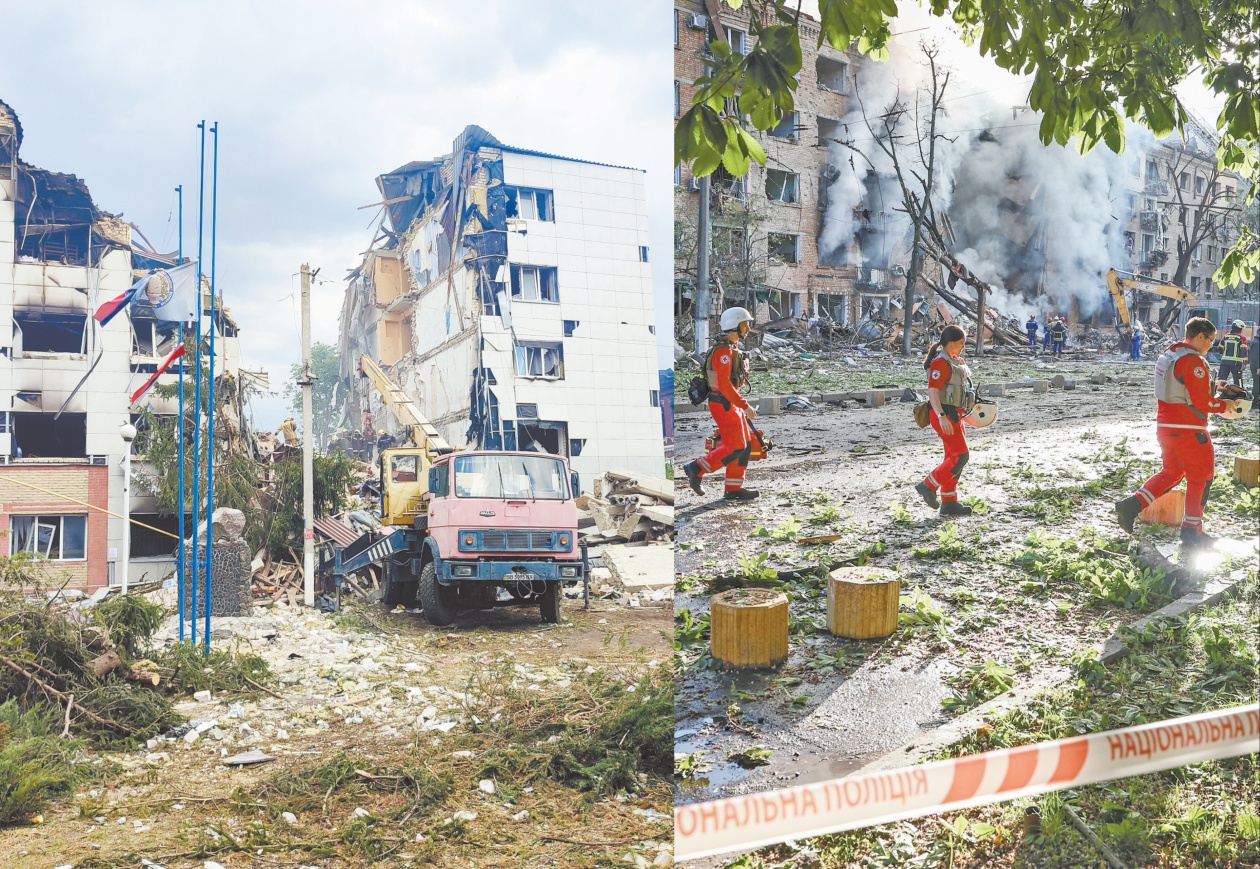
Russia condemns Ukraine for attacking schools
Russia's permanent representative to the United Nations, Nebenzia, stated that on the 22nd, the Ukrainian military used 4 drones to attack the teaching building and student dormitory of a vocational school in the city of Stary Bilokurakyne in the Luhansk region. At the time of the attack, there were 86 students aged between 14 and 18 and one staff member in the dormitory. The leader of the Luhansk region appointed by Russia, Pasechnik, announced on the 24th that the search and rescue operation had concluded, and the attack resulted in 21 deaths.
The BBC reported that news footage from Russian state television showed a five-story building in Stary Bilokurakyne reduced to rubble. This incident triggered condemnation from Russia, denial from Ukraine, an emergency meeting of the United Nations Security Council, and a vow of retaliation from the Kremlin.
Russian President Putin stated after the incident that it was important to note that there were no military facilities or special department facilities near the attacked school, and there was no evidence that the drones were shot down or deviated from their flight path, which led to the dormitory being hit. He tasked the Russian Ministry of Defense with submitting a plan for retaliatory strikes.
The General Staff of the Ukrainian Armed Forces stated on social media on the evening of the 22nd that the Ukrainian military strictly adheres to international humanitarian law and the laws of war, only targeting military facilities. They did indeed carry out an attack near Stary Bilokurakyne on the night of May 21 to 22, but insisted that the target was a Russian military unit.
Russian Foreign Ministry spokesperson Zakharova stated on the 24th that more than 50 foreign journalists from 19 countries had gone to the tragedy site in Stary Bilokurakyne, where they would communicate with rescue workers, students and their parents, city officials, and witnesses. She noted that BBC reporters refused to participate in this interview activity; CNN stated that its reporters were on vacation; and the Japanese government prohibited Japanese reporters from participating in this interview.
Ukraine: Detected 90 missiles
According to the Moscow Komsomolskaya Pravda on the 24th, the Russian military submitted a large-scale joint strike plan against Ukraine to the president in about 36 hours in response to the "collective massacre of teenagers" that occurred in Luhansk. The report stated that from the evening of the 23rd to the early morning of the 24th, Russian missiles targeted the center of Kyiv without prior drone reconnaissance.
The report indicated that the Russian military's strike on the Ukrainian capital Kyiv began at 1:20 AM local time on the 24th. The Russian "Iskander-M" ballistic missiles were the first to reach Kyiv, and five minutes later, residents heard the explosions of "Zircon" hypersonic missiles. Subsequently, Kyiv was hit by several waves of missile attacks.
Russian newspaper Vedomosti reported on the 24th, citing military bloggers, that within the first hour of the Russian military's strike, Kyiv was attacked by 10 missiles. Multiple logistics facilities, defense industrial warehouses, and air defense positions in Kyiv were struck by Russian "Iskander" missiles. The city of Bilatserkva in Kyiv Oblast was hit by Russian "Zircon" missiles, targeting an aircraft repair plant, a thermal power plant, and a transportation hub servicing Western equipment.
The Russian Ministry of Defense confirmed on the 24th that it had launched retaliatory strikes on military facilities, including the Ukrainian Army General Staff and the Main Intelligence Directorate of the Ministry of Defense, using weapons including "Zircon" missiles, stating that "the strike objectives have been achieved, and all designated targets have been destroyed."
The BBC reported that the Ukrainian Air Force stated that from 6 PM local time on the 23rd to the 24th, they detected 90 missiles and 600 drones. Ukrainian President Zelensky stated that since the early morning of the 24th, the number of casualties from the large-scale strikes by Russian forces had risen to 83. Ukrainian Foreign Minister Kuleba stated that the Ukrainian Foreign Ministry building was also damaged in the attacks.
Third use of "Zircon" missiles
According to RIA Novosti, Dmitry Medvedev, Deputy Chairman of the Russian Security Council, stated on the 24th that the Russian military must carry out "strikes like today, and even more intense." Konstantin Kosachev, Chairman of the International Affairs Committee of the Federation Council, stated that the Russian military's strike on Kyiv was a "preventive strike" aimed at forcing Ukrainian authorities to "stop shelling civilians and civilian facilities within Russian territory."
The use of "Zircon" missiles in this attack has drawn attention. The BBC reported that this missile flies at speeds exceeding ten times the speed of sound and is impossible to intercept. This is the third time Russia has used "Zircon" missiles in the Russia-Ukraine conflict. French President Macron and German Chancellor Merz both condemned Russia's use of "Zircon" missiles to attack Ukraine on the 24th. The EU's High Representative for Foreign Affairs and Security Policy, Borrell, stated the same day that Russia's use of "Zircon" missiles in Ukraine is a "political intimidation tactic and reckless nuclear adventurism."
Fu Cong stated on the 22nd that the prolonged Ukraine crisis and escalating battlefield situation have caused immense suffering for ordinary people, which is something that all parties, including China, do not wish to see. Recently, the parties have frequently conducted large-scale drone and missile strikes, with an increasing number of residential areas, schools, and civilian infrastructure being attacked, which is deeply concerning. China calls on the parties to remain calm and restrained, strictly adhere to international humanitarian law, effectively protect civilian safety, cease attacks on civilians and civilian infrastructure, and promote a rapid de-escalation of the battlefield situation, striving for hope for an early realization of peace.
On October 24, 2023, Russian Armed Forces launched a large-scale retaliatory strike against Ukraine, utilizing Zircon, Dagger, and Iskander missiles, as well as drones. The attacks targeted military command facilities and resulted in at least 83 casualties. This operation followed a previous drone attack on a school in Luhansk that killed 21 people, escalating tensions between the two nations.
- Russia used Zircon, Dagger, and Iskander missiles in the strikes against Ukraine.
- At least 83 casualties reported in Ukraine due to the missile attacks.
- The strikes targeted military command facilities and defense industrial enterprises in Ukraine.
- Ukraine reported detecting 90 missiles and 600 drones during the attacks.
- The incident has drawn international condemnation and calls for restraint.