

The Second World War is renowned for its extraordinary acts of personal bravery, its horrors, and its technological marvels.
When the war started, Hitler’s Germany possessed a small but potent navy.
Among its fleet was the German battleship Tirpitz, which displaced more than 40,000 tons when underway, carried 15-inch guns, and was well defended.
But this mighty warship was attacked–and ultimately sank–by four British sailors in an X-class midget submarine that came in at barely 51 feet long.
Defending the Tirpitz
Tirpitz used the geography of the Norwegian Kaafjord fjord in northern Norway to insulate itself from the mighty British Royal Navy.
German naval engineers further defended the Tirpitz by surrounding the great warship with a minefield.
Patrol craft routinely protected the mighty German warship. She had powerful anti-aircraft guns, smoke generators that could shroud the great vessel from aerial attack, and multiple layers of anti-submarine and torpedo nets.
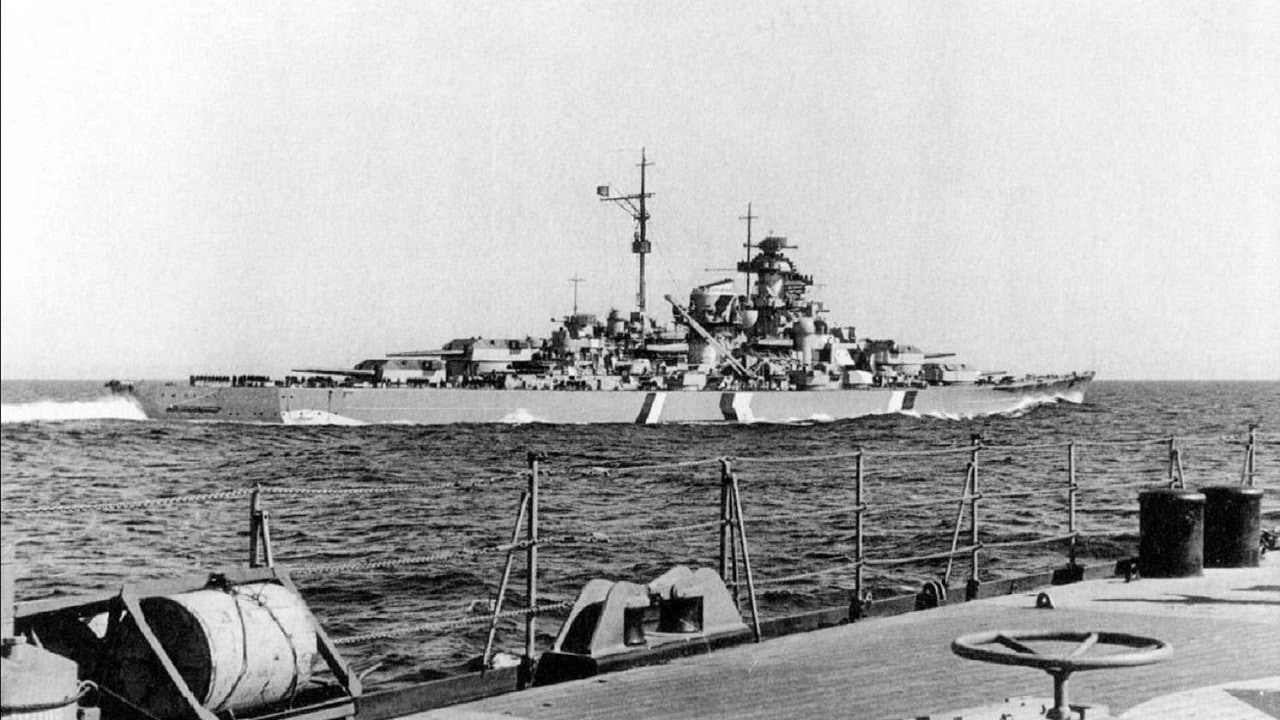
Battleship Bismarck. Image Credit: Creative Commons.
Germany wanted to make their iconic battleship as impregnable as possible to the prowling Royal Navy. So, some enterprising British naval planners concocted a new scheme. Rather than going big against the mighty Tirpitz, the British would
X-class midget submarines of the British Royal Navy slipped into the fjord on September 22, 1943. Silently, these tiny submarines installed powerful explosive charges beneath the mighty battleship.
Shortly thereafter, powerful explosions rocked the Tirpitz.
No, the explosions did not sink the great warship.
The explosions did, however, take the German warship out of the war for many months after the attack. That was more than enough for the British.
After all, the Royal Navy had already sunk the Tirpitz’s sister ship, the Bismarck, in May 1941.
And unlike the Bismarck, the Tirpitz’s threat to Allied shipping was more theoretical than real.
That’s because the Germans didn’t want to lose their prized asset in another humiliating row at sea with the British Royal Navy, as they had with the Bismarck.
Plus, the mere presence of the Tirpitz in a northern Norwegian fjord was enough to tie down sizable elements of the Royal Navy fleet tasked with keeping the Arctic supply routes open between the United States and the rest of the Allies in Europe.
At all times, the Royal Navy kept at least two battleships, a fleet carrier, and some escorts in case Germany deployed the Tirpitz.
Fear drove the British strategic rationale.
As long as Tirpitz remained in fighting form, well protected in that Norwegian fjord, the British had no way to let their hair down.
They would always commit a sizable portion of their fleet to deter the Tirpitz’s deployment.
What’s more, the British risked scattering their essential supply convoys in the Arctic for fear that the Tirpitz was about to deploy, making those convoy ships harder to protect at sea and easier prey for the U-boats waiting to sink them.
Turning to Unconventional Warfare
Because the conventional attacks on the Tirpitz had failed, the British looked to submarines. But anti-submarine defenses made such an attack dangerous at best.
So, the Royal Navy turned to midget submarines.
The aforementioned torpedo nets protecting the Tirpitz made attacking with conventional submarines tricky for the Royal Navy, even if their submarines could get through all the other defenses surrounding the German battleship.
But those midget submarines could slip through defenses not primed to defend against such tiny vessels, attach explosive charges along the Tirpitz’s sides, and slip out unnoticed.
Even if they were noticed, the chances that they’d be sunk were slim–or if they were destroyed, the loss of life would be limited, and the cost to the British Royal Navy would be relatively low.
The British X-class midget submarine attack targeted the Tirpitz and some of the ships assigned to protect it.
Six conventional British Royal Navy submarines launched from Scotland on September 11, 1943, with the X-class midget submarines in tow.
One midget submarine was lost with its crew during the cruise to Norway.
Another experienced serious mechanical problems and was scuttled. Another had to abort its mission.
So, only the tiny X-class submarines assigned to hit the Tirpitz made it to the attack. The mission continued despite the losses because the Tirpitz was the main target. If they could still hit it, the British pushed on.
The End of the Tirpitz?
The British midget subs made it through the nets (mostly) and reached the Tirpitz in the early morning hours. They installed the charges. At 8:12 am local time, the charges detonated.
The explosion was so powerful that it lifted the Tirpitz out of the water momentarily.
That caused massive internal damage to the mighty ship.
In fact, the explosions knocked two of the 2,000-ton main gun turrets off their tracks.
Unfortunately, the British escape plan didn’t go as well in reality as they had planned. Six of 12 surviving British sailors were captured and held as prisoners of war by the Germans.
Tirpitz was out of the fight, though.
The great ship wasn’t ready for operations again until spring 1944; by then, the war was not going Hitler’s way.
About the Author: Brandon J. Weichert
Brandon J. Weichert is the Senior National Security Editor at 19FortyFive.com. He also manages The Weichert Brief on Substack. Weichert also hosts “National Security Talk” on Rumble. He is the author of four bestselling national security books, most recently A Disaster of Our Own Making: How the West Lost Ukraine (Encounter Books). Follow him via Twitter/X @WeTheBrandon.