

Heat is the one thing a stealth fighter can’t hide. Beijing wants the world to believe it has finally figured out how to exploit that. According to a recent article, Chinese researchers have reportedly developed a lightweight, low-cost artificial intelligence (AI) system for missile-mounted infrared imaging that is designed to help heat-seeking air-to-air missiles recognize the infrared signatures of the F-22 Raptor and F-35 Lightning II in flight.
The headline numbers are eye-catching. The team claims up to 97.1 percent accuracy in lab testing, with a separate evaluation landing around 90 percent, per Aviation A2Z.
Chinese Claims Would Make Flares And Decoys Obsolete
Researchers from the Beijing Institute of Technology and the China Airborne Missile Academy created this new AI system.
Instead of relying on radar, which stealth aircraft are designed to evade, the system uses infrared sensors to track thermal emissions from engine exhausts, hot surfaces, and aerodynamic friction.
The SCMP post claims that because a fighter’s exhaust and skin-friction heat look different from a decoy flare, this kind of AI could make flares useless.
That’s the kind of claim that gets clicks in Washington and nods in Beijing.
However, before anyone writes the obituary for American stealth, it’s worth looking at what was actually tested.
The Targets Weren’t Real Jets
The model was trained on 3,245 infrared images gathered by a missile-borne scanning system.
Those images covered three categories of airborne targets, and the F-22s and F-35s among them were simulated. Mock-ups.
“Lightweight recognition models could become widely used in future air-to-air missiles because they can provide high-speed recognition while maintaining strong identification capabilities,” said An Jiangshan, lead researcher of the study.
To be fair, the team did pull off something useful from an engineering standpoint.
They shrank the model to 16.1 percent of the parameters used by earlier methods and cut the computing load to 19.2 percent.
That matters on a missile, where every ounce of weight and every watt of power gets fought over.
However, the most important line in the Chinese claim is in the caveat, and typically understated.
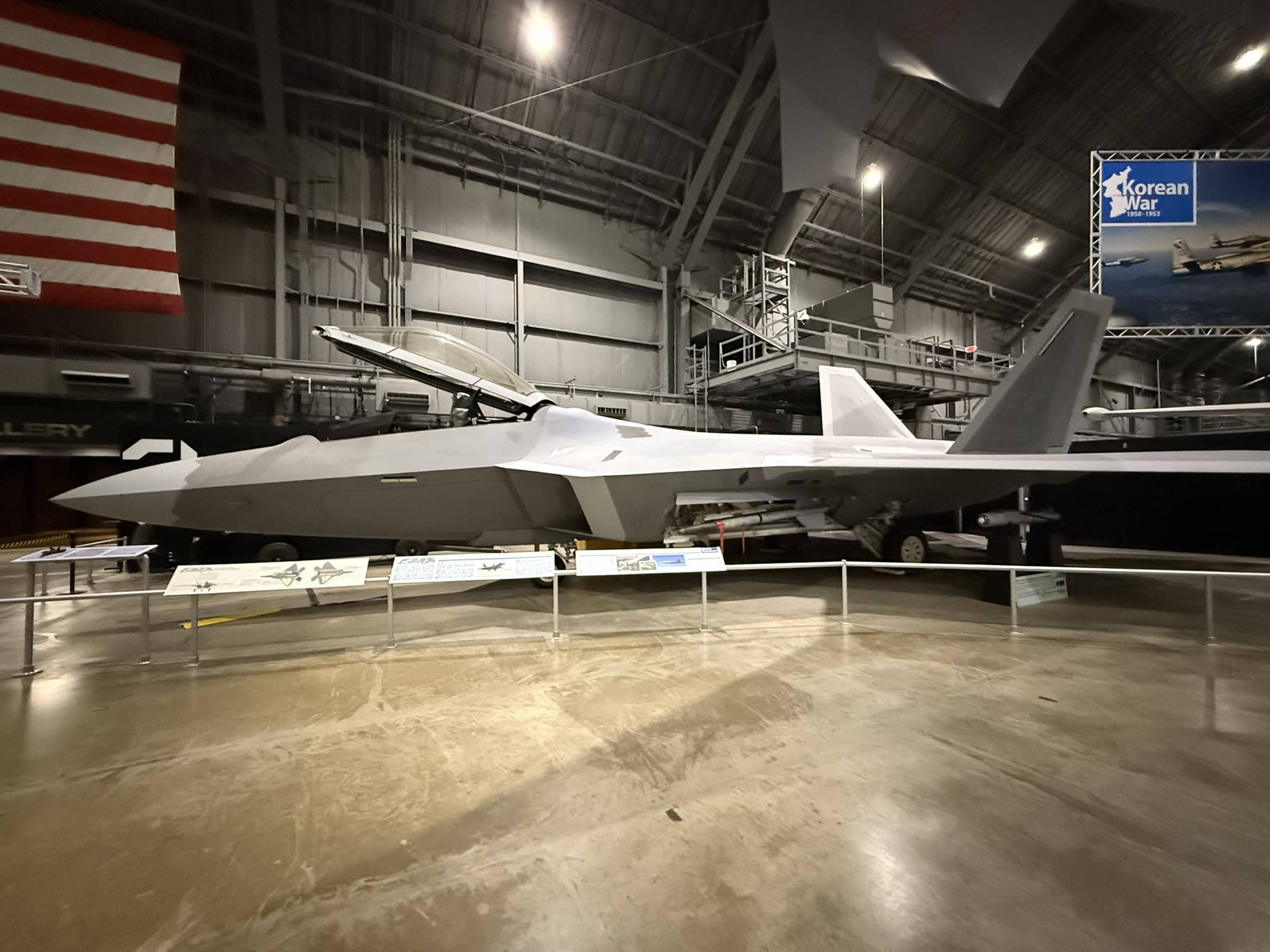
F-22 Raptor. Photo Taken for 19FortyFive.com by Harry J. Kazianis on July 19, 2025.
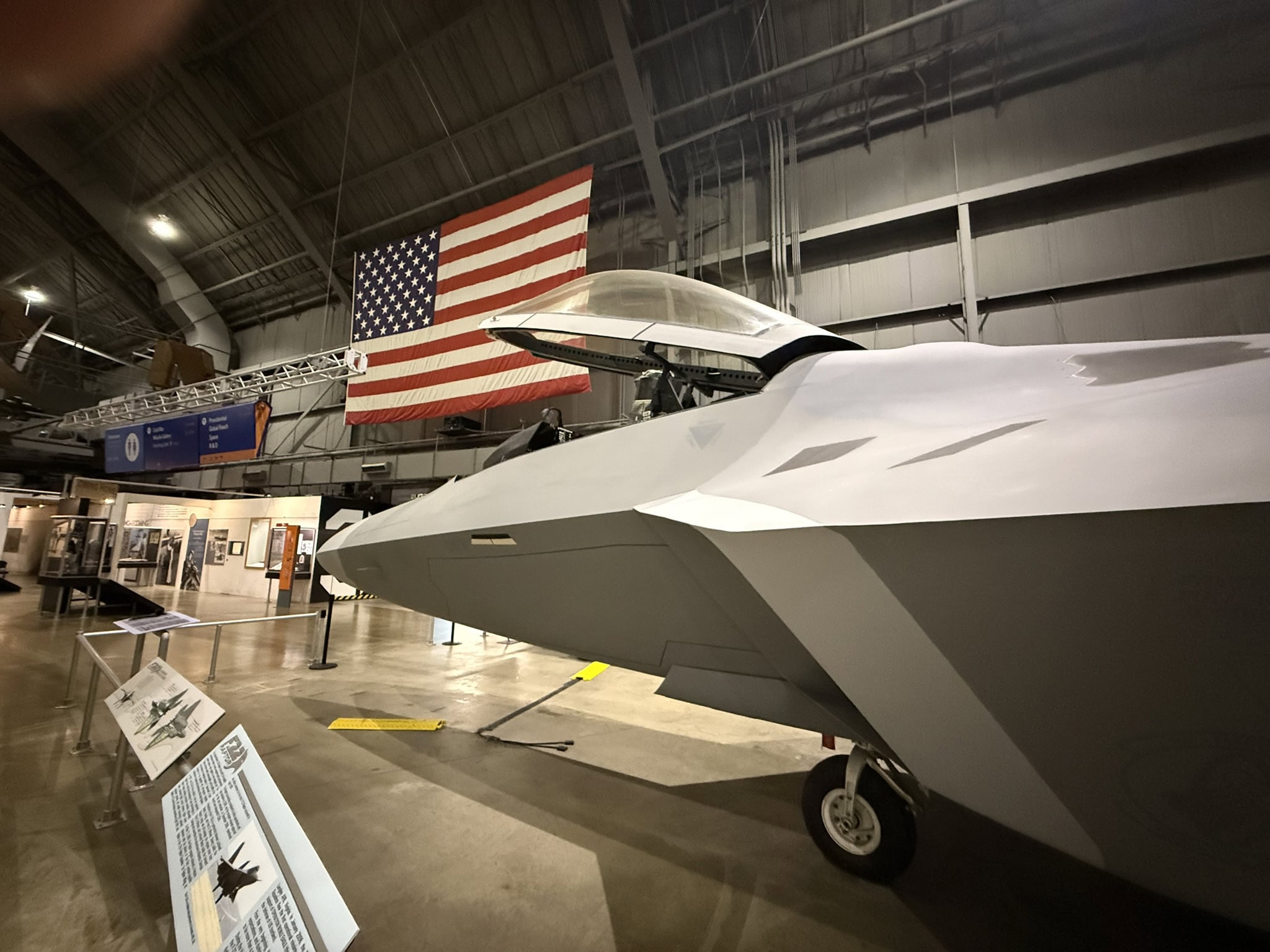
F-22 Raptor Photo Take At the National Museum of the U.S. Air Force. 19FortyFive.com Photo. Taken on July 20, 2025.
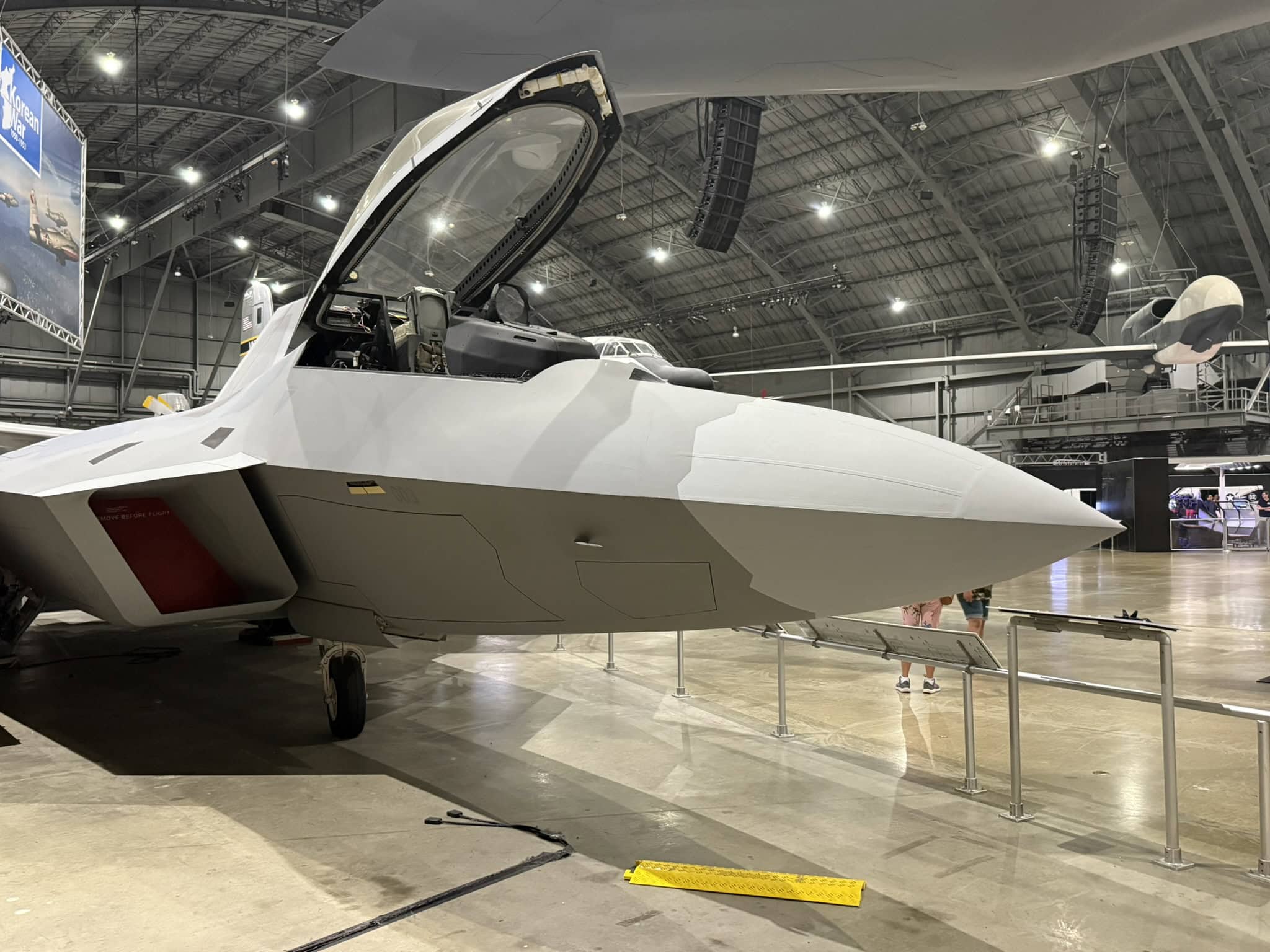
F-22 Raptor Photo Take At the National Museum of the U.S. Air Force. 19FortyFive.com Photo.
An Jiangshan said the data on how the system performs against actual aircraft is confidential and can’t be disclosed.
Even TechRadar’s write-up concedes the research doesn’t establish that the system can reliably track operational F-22s or F-35s in combat, because actual aircraft generate thermal patterns that change under different speeds, altitudes, maneuvering conditions, and environmental circumstances.
So what did China actually prove? That an AI can sort pictures it was trained on, in a lab, under controlled conditions. That’s a long way from a Raptor at 40,000 feet.
Lockheed Martin Didn’t Ignore The Heat Factor
The premise making the rounds on social media is that the F-22 and F-35 were built to beat radar and simply punted on infrared. That’s nonsense.
The Raptor’s flat, two-dimensional thrust-vectoring nozzles exist partly to spread and cool the exhaust plume and shield the engine’s hot sections from view, as a post from last August in the National Security Journal laid out.
The jet also wears coatings that cut emissivity.
Supercruise helps too.
An F-22 cruising at Mach 1.5 without afterburner is a far cooler target than a legacy fighter lit up in full burner trying to keep pace.
The F-35 went a different route. Pratt & Whitney’s F135 uses a round nozzle with serrated, overlapping flaps meant to break up and shorten the plume, and the engine is buried deep in the fuselage, wrapped by fuel.
Its higher bypass ratio helps at subsonic cruise.
None of that makes either aircraft invisible to infrared. Physics still wins.
An engine pushing roughly 40,000 pounds of thrust generates heat, and air friction warms the skin at speed.
However, the signature is smaller, dimmer, and harder to classify than anything a fourth-generation jet puts out. That’s precisely the real-world data China says it can’t share.
The Real World Is Messier Than The Lab
Here’s where the laboratory claim meets the real world. An infrared seeker has to find its target first.
Against a stealth fighter, that’s the hard part.
China’s PL-10, the imaging infrared missile that rides in the J-20’s side bays, was expected to match the AIM-9X’s reach of roughly 20 to 22 kilometers.
An F-22 or F-35 doing its job is trying to kill the shooter well outside that bubble with an AIM-120D.
If the J-20 pilot can’t see the American jet on radar, he has to lean on his passive IRST and electro-optical sensors to close the distance, as The War Zone has detailed.
Then factor in aspect.
A fighter’s infrared picture changes dramatically with the viewing angle. Tail-on, you see hot engine parts.
Nose-on, you mostly see airframe and inlets.
Clouds, humidity, and the sun muddy everything.
A Raptor pulling hard and punching out decoys isn’t a static image in a training set, and the researchers still need to test against different aspects, weather, and countermeasures.
The US Has Developed Ways To Counter Infrared Seekers
Flares are also only one tool in the box.
The obvious counter to a smarter imaging seeker is directed energy that blinds it, and the U.S. has been going down that road for years.
Widely known as Directional Infrared Countermeasures (DIRCM), a high-speed, compact turret rotates to track the incoming missile.
The turret fires a concentrated, invisible, multi-spectral infrared laser beam directly into the missile’s optical seeker head (its “eye”).
The laser “dazzles,” confuses, or completely fries the missile’s internal infrared sensors.
This overloads the missile’s guidance computer, causing it to lose its tracking lock and tumble harmlessly away from the aircraft.
Heat Management Remains A Priority
Say what you will about Chinese state-run research and its habit of announcing “stealth killers.” Shrinking AI target recognition into a package small enough to ride on a missile is real progress, and the PL-10 is already a capable weapon.
Marrying the two capabilities and you get a seeker that’s harder to fool with flares.
That’s not something that can be easily ignored.
However, the smart takeaway for the Pentagon is the one TechRadar hinted at.
Upgrades to the F-22 and F-35, and the B-21 and F-47 coming behind them, have to treat heat management as seriously as radar cross-section.
Stealth was never an absolute cloak of invisibility.
It’s about delaying detection long enough to shoot first and move before the enemy can lock on.
A lab test against simulated jets doesn’t change the math, but it is a step in that direction, and it shouldn’t be ignored.
Heat is still the one thing a stealth fighter can’t hide. But the enemy still has to find it first.
About the Author: Steve Balestrieri
Steve Balestrieri is a National Security Columnist. He served as a US Army Special Forces NCO and Warrant Officer. In addition to writing on defense, he covers the NFL for PatsFans.com and is a member of the Pro Football Writers of America (PFWA). His work was regularly featured in many military publications.