
Bulgaria orders five IRIS-T systems for 2026 and turns the Black Sea into a NATO test site
 Dr. Klaus Weber
Bulgaria orders five IRIS-T systems in 2026 and makes the Black Sea a NATO test
As of November 1, 2026: Bulgaria is voting for a new president while the country's security policy reality has long detached from the election campaign stage. Since early October, commercial ships in the Bulgarian and Romanian Exclusive Economic Zone have repeatedly been hit by drones. Sofia's parliament responded by approving five additional German IRIS-T air defense systems. This increases Bulgaria's stock to six systems. However, the crucial question is not whether Sofia will buy more air defense. It is whether a single NATO member on the Black Sea can fill a gap that is actually a collective alliance task.
Five systems as a political response to a maritime threat
The decision is directly linked to the new threat situation. On October 6, according to Bulgarian reports, two commercial ships east of the coastal town of Byala were hit by air and sea drones. A ship flying the Togolese flag sank, and eleven crew members went missing; another ship, flying the flag of Palau, caught fire. A few days later, Romanian authorities reported seven missing persons after attacks on ships. The exact origin of the drones has not been conclusively proven in several cases. This is militarily and politically relevant: Bulgaria and Romania must strengthen their defense without hastily deriving a direct NATO confrontation with Russia from circumstantial evidence.
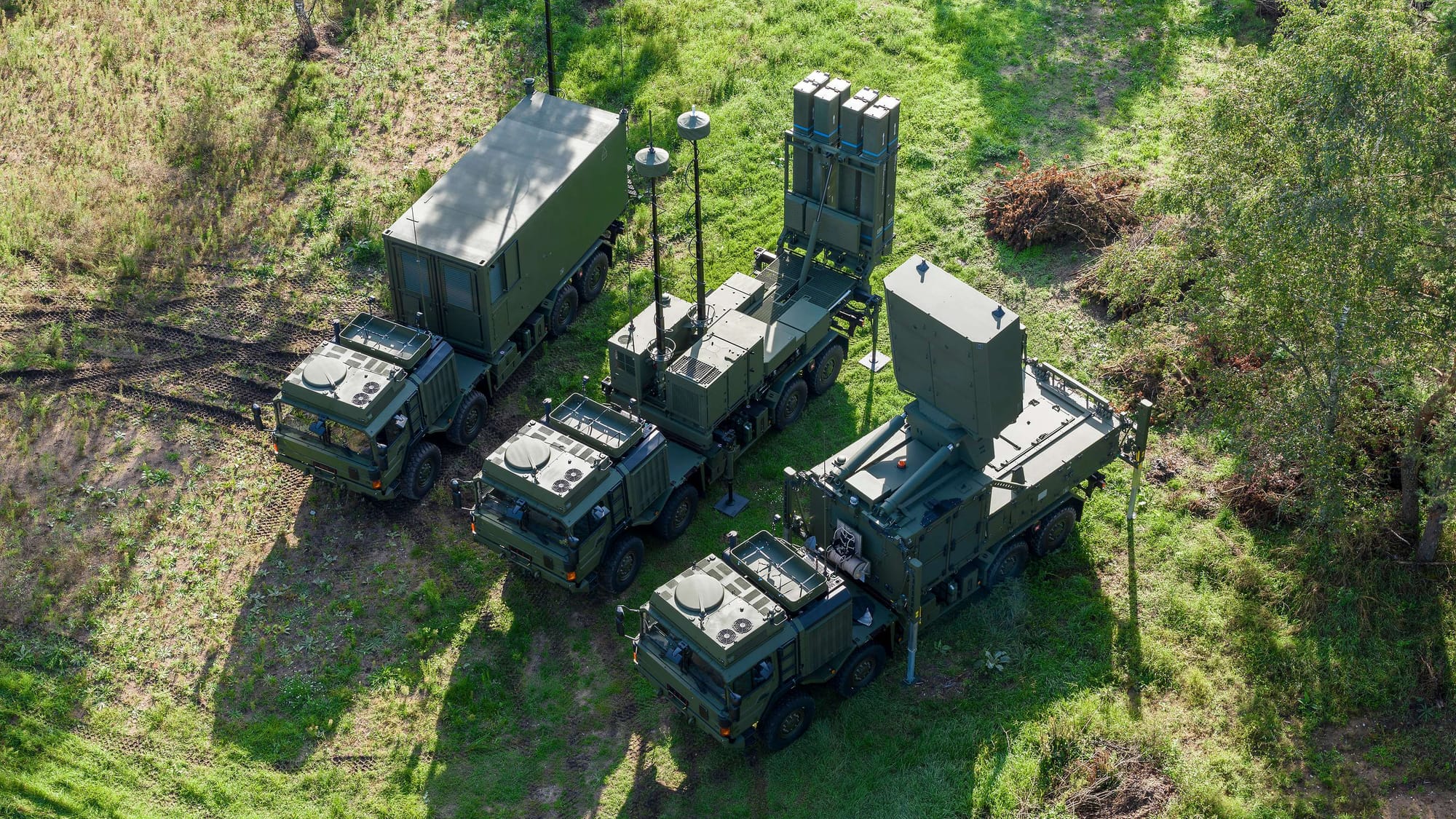
IRIS-T SLM is fundamentally a plausible system for this purpose. The ground-based variant uses the IRIS-T missile, a mobile radar, and a command post. It is designed to counter aircraft, helicopters, cruise missiles, and certain drone threats. Its strength lies not in a single spectacular range figure but in the networked, mobile defense of a limited area. However, this is also where the limitation lies: a system that protects a port, an airfield, or a critical corridor cannot automatically cover the entire western Black Sea region.
Geography exposes the illusion of national security
The Bulgarian government described attacks on ships in its own economic zone as unacceptable. EU Commission President Ursula von der Leyen also referred to it as an extremely disturbing development. Romanian President Nicosur Dan stated after a meeting with NATO Secretary General Mark Rutte that the problem must be resolved. Rutte promised to adjust the alliance's deterrence and defense posture in the Black Sea if necessary. These are necessary statements, but not yet a common capability.
The Black Sea is not a closed national operational area. Drones can launch from great distances, ships move through international sea routes, and the crucial sensors must connect coastal radar, civilian ship tracking, aerial reconnaissance, and military data fusion. Bulgaria lacks both the geographical depth and the resources to organize this entire chain alone. Six IRIS-T systems improve local protection. However, they do not replace a permanent NATO air presence, maritime reconnaissance, or a common response rule for attacks on civilian ships.
This is precisely why the Bulgarian decision is a test for European defense integration. The EU can talk about SAFE and European preferences; NATO can fill its summit declarations with the word "resilience." In the end, however, what matters is whether a recognized target can be classified within minutes, assigned to a responsible party, and engaged with the right effect. More hardware without a common command and reconnaissance architecture remains national symbolic politics.
The presidential election reveals the dilemma
The runoff election on November 1 confronts voters with two opposing political interpretations. Incumbent Iliana Iotova stands for dialogue with Moscow and rejects further military aid for Ukraine. Her opponent Andrey Gyurov is supported by the pro-Western opposition. In the first round, Iotova received 35 percent, Gyurov 32 percent; voter turnout was only 23 percent. The security issue is thus not an abstract foreign policy dispute. It is tied to Bulgarian ports, insurance premiums, fishing, and the safety of seafarers.
This explains why the attacks have a political impact, even if their perpetrators are not definitively identified. Russia is already strategically benefiting from an insecure shipping environment, regardless of whether each individual drone attack was directly controlled from Moscow. The costs are socialized: higher insurance rates, more dangerous trade routes, and additional pressure on NATO states to purchase air defense. This is a form of coercion that remains below the threshold of an open attack.
Europe's response must not end with orders
Bulgaria has made a reasonable national decision with the IRIS-T order. The real misjudgment would be to sell it as a sufficient strategy. According to the Turkish maritime chamber IMEAK, at least 163 civilian and commercial ships were hit in the Black Sea in the first eight months of this year. This number no longer describes a local disturbance but a regional security problem.
NATO must therefore connect three levels: first, a common maritime situational awareness for Bulgaria and Romania; second, coordinated air defense and drone defense corridors; third, a robust political rule on how the alliance responds to repeated attacks on civilian shipping. The burden of proof must not be replaced by political impatience. Deterrence loses its credibility if it either escalates blindly or remains without consequences.
The irony of the Bulgarian decision is obvious. Sofia is purchasing German systems because the threat has become European; yet the capability remains initially organized nationally. Europe has thus turned money into equipment again, but not yet into a common defense. Six IRIS-T systems can protect Bulgaria. They can only protect the Black Sea if NATO creates a common system from six national batteries.
Sources
- France 24 with AFP, November 1, 2026 – Bulgaria's presidential election and the security debate in the Black Sea
- France 24 with AFP, October 15, 2026 – NATO consultations after drone attacks on ships
- France 24 with AFP, October 6, 2026 – Attacks on two ships in Bulgaria's economic zone
- Reuters, November 1, 2026 – Bulgaria's runoff election after a tight first round
Bulgaria ordered five additional IRIS-T air defense systems, raising its total to six, in response to recent drone attacks on commercial ships in the Black Sea. The attacks, which occurred on October 6, resulted in one ship sinking and eleven crew members missing. The Bulgarian government views these maritime threats as unacceptable and is taking steps to bolster its defense capabilities. This procurement reflects broader security concerns in the region and the need for NATO's coordinated response.
- Bulgaria orders five additional IRIS-T air defense systems, increasing total to six.
- Maritime drone attacks have targeted commercial ships in Bulgarian and Romanian waters.
- Two ships were attacked on October 6, resulting in one sinking and eleven crew members missing.
- The Bulgarian government considers these attacks unacceptable and is enhancing defense capabilities.
- The geopolitical context involves NATO's response to threats in the Black Sea region.