
Leopard 2A8 Is Turning Norway and Germany Into NATO's Northern Anchor
 Alexandra Reeves
Leopard 2A8 Is Turning Norway and Germany Into NATO's Northern Anchor
The tank order is the least interesting part
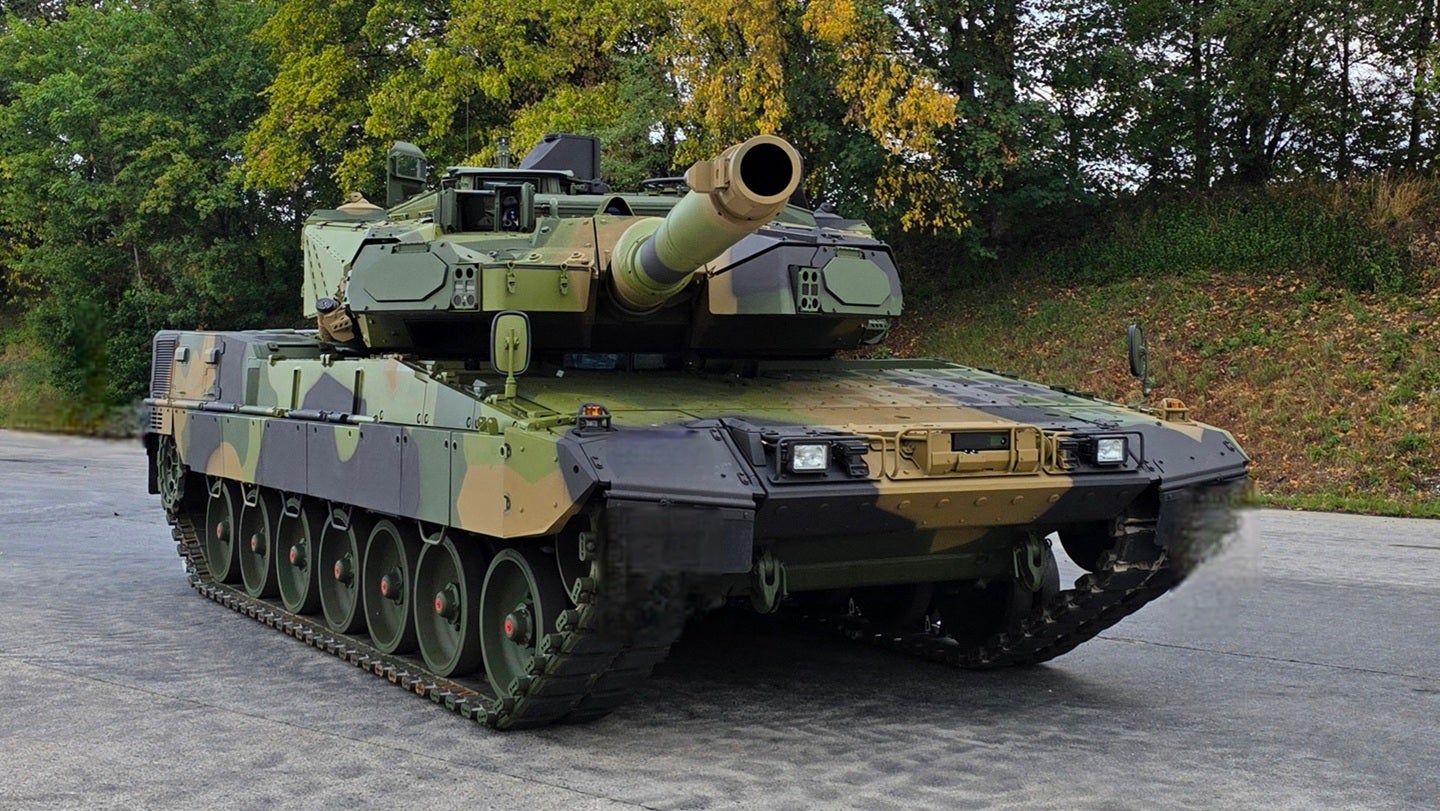
Europe likes to describe defence cooperation as a procurement story. Norway and Germany are quietly proving that it is really a geography story. The first Norwegian-built Leopard 2A8 tanks are now coming together in Levanger, but the industrial milestone matters because it sits inside a much larger northern security bargain. Two countries are aligning armour, submarines, maritime strike, air operations, and space surveillance around the same map: the North Atlantic and the approaches to the Arctic.
According to Defense News, production began on October 15. KNDS and Norway's Ritek will build 37 of Norway's 54 new Leopard 2A8s locally, at a facility with a stated capacity of up to 36 tanks a year. The site took 18 months to establish. Those numbers are useful, but they should not be mistaken for a new Norwegian rearmament announcement. The purchase already existed. What is new is the decision to make part of the fleet inside Norway, with the industrial skills and maintenance relationships that implies.
Why the Leopard 2A8 matters in the north
The Leopard 2A8 is not a magic solution to the High North's military problems. It is a modern main battle tank designed for protected mobility, direct fire, and networked combined-arms operations. Norway's choice gives its army a common platform with Germany and several other European users, which simplifies training, ammunition planning, maintenance, and reinforcement. Interoperability is not glamorous. It is what prevents a coalition from becoming a collection of national equipment parks once the shooting starts.
Norway's terrain makes the local production decision more than a jobs programme. Long distances, harsh weather, limited roads, and a small population all punish an army that depends on a distant supply chain. A Norwegian facility cannot manufacture every spare part or solve every wartime bottleneck. It can, however, reduce the political and logistical distance between the fleet and the people responsible for keeping it operational. In a war, that margin matters.
There is also a hard operational point. Tanks alone do not defend northern Norway. They need surveillance, engineers, air defence, artillery, fuel, and protected communications. The Leopard programme is therefore valuable less as a standalone capability than as a visible piece of a wider force structure. It gives Norway a credible heavy ground component while allied aircraft, ships, and submarines work across the same theatre.
Hansa is a military relationship, not a slogan
The February Hansa Arrangement between Berlin and Oslo is the important development. Norway's Defence Ministry describes priorities that include maritime operations, combined-arms land warfare, rapid reinforcement, defence industry, and space-based surveillance, targeting, and communications. That is an unusually broad package. It links the battlefield close to the Russian border with the ocean routes that connect Europe to North America.
The submarine partnership shows why this matters. Germany and Norway plan to operate six identical Type 212CD submarines each, supported by shared training and new maintenance infrastructure near Bergen. They are also cooperating on the 3SM maritime strike missile. These are not isolated purchases. Common platforms create recurring habits: crews train together, technicians solve the same problems, and commanders learn what the other force can actually do rather than what a ministerial communiqué claims it can do.
Germany's growing northern role is equally important. Berlin contributed roughly 1,800 troops to Norway's Cold Response exercise in March, according to the German government, and discussions have included German equipment pre-positioning in Norway. German P-8A Poseidon aircraft are also intended to operate from Norwegian and Icelandic bases to monitor the GIUK gap, the maritime corridor between Greenland, Iceland, and the United Kingdom. That is the route Russian nuclear submarines must navigate to reach the wider Atlantic. The tank assembly line and the patrol aircraft are part of the same strategic argument: the northern flank cannot be treated as a niche problem.
Space turns bilateral cooperation into alliance infrastructure
Oslo and Berlin are also discussing a joint imaging-reconnaissance satellite constellation, while a bilateral space working group is examining launch capabilities, surveillance, and secure communications. Norway's Andøya spaceport is particularly well placed for polar-orbit launches. The implications are obvious. A northern defence partnership that can see, communicate, and cue forces across the High North is more valuable than one that simply stores more armour in a warehouse.
This is where the arrangement challenges NATO's traditional division of labour. The United States remains indispensable for strategic intelligence, long-range fires, air power, and reinforcement. But European allies are being pushed to provide more of the regional mass and infrastructure. Germany and Norway are responding by building a small, tightly integrated northern subsystem rather than waiting for an abstract European army to appear.
The limit is political will
There is a danger in celebrating every industrial partnership as proof of European strategic autonomy. A production line with a capacity of 36 tanks annually is useful, not transformative. Six submarines each still require crews, munitions, maintenance, and a command architecture that can survive disruption. Space cooperation remains a programme until satellites are launched, linked, and protected. And Norway's army cannot defend the entire northern flank by itself.
Still, this is the right direction. Hansa connects procurement to geography, geography to reinforcement, and reinforcement to deterrence. It also gives Germany a role in the North Atlantic that is more concrete than speeches about taking responsibility for European security. The test will come when Berlin and Oslo must fund the enablers that make their hardware usable: air defence, resilient communications, stockpiles, transport, and the ability to replace losses.
What to watch next
- Whether Norwegian Leopard 2A8 production expands beyond the initial 37 tanks and develops genuine wartime repair capacity.
- Whether German equipment is actually pre-positioned in Norway, rather than remaining a planning document.
- Whether the Type 212CD and 3SM programmes produce a shared operational effect in the North Atlantic.
- Whether the proposed satellite and secure-communications cooperation moves from working groups to funded systems.
My judgment is straightforward. Norway and Germany are not building a northern alliance inside NATO; they are building the kind of regional capability NATO has always needed but rarely assembled coherently. The Leopard 2A8 is the visible symbol because tanks are easy to photograph. The real strategic shift is the network behind it. If Berlin and Oslo follow through, Russia will face a more connected northern flank. If they stop at procurement announcements, the tanks will be expensive symbols parked at the end of a very long road.
Sources: Defense News, 30 October 2026; Norwegian Ministry of Defence readout on the Hansa Arrangement, February 2026; German government reporting on Cold Response 2026 and northern maritime aviation.
Norway is producing 37 Leopard 2A8 tanks locally in Levanger, enhancing its military capabilities alongside Germany. This production is part of a broader defense cooperation under the Hansa Arrangement, which aligns military operations in the North Atlantic and Arctic. Germany has contributed troops to joint exercises and is involved in shared submarine and missile programs with Norway. Discussions are ongoing regarding joint satellite reconnaissance and secure communications.
- Norway is producing 37 of its 54 Leopard 2A8 tanks locally in Levanger.
- Germany and Norway are enhancing military cooperation through the Hansa Arrangement.
- Both countries are aligning their military capabilities in the North Atlantic and Arctic regions.
- Germany contributed 1,800 troops to Norway's Cold Response exercise in March 2026.
- Plans for joint satellite reconnaissance and secure communications are being discussed.