
China's Coast Guard Patrols Turn Taiwan's East Coast Into a Blockade Test
 Marcus Chen
China's Coast Guard Patrols Turn Taiwan's East Coast Into a Blockade Test
Two Chinese Coast Guard ships operating east of Taiwan are not a blockade. They are something more useful to Beijing: a low-cost rehearsal for one. Taiwan's Coast Guard said on November 1 that the patrol was harassing shipping and asserting jurisdiction China does not possess. Taipei sent its own ships to monitor the operation.
The immediate incident was small. The operational message was not. China's coast guard has increased activity off Taiwan's east coast since June, an area that matters because it is the island's least protected maritime flank and the most plausible route for wartime resupply from Japan and the United States. The question is no longer whether Beijing can send vessels around Taiwan. It is whether it can make that presence routine enough that commercial traffic, allied logistics, and Taiwan's own command decisions begin to adjust around it.
What Happened at Sea
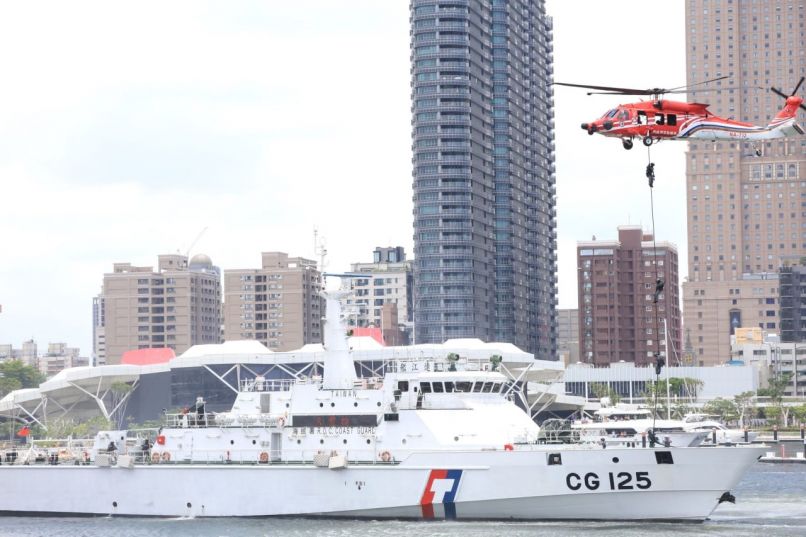
According to Reuters reporting carried by gCaptain, Taiwan responded late Saturday to China's announcement of an east-coast patrol involving two Chinese Coast Guard ships. Chinese state media showed one ship broadcasting a law-enforcement message and offering assistance to an unidentified fishing vessel. Taiwan described the radio activity as an attempt to harass ships and expand Chinese power through a fabricated jurisdictional claim.
China also sent another Coast Guard ship close to the Taiwan-controlled Pratas Islands at the northern edge of the South China Sea. Taiwan said it had expelled Chinese Coast Guard vessels from Pratas waters 13 times this year. The islands are more than 400 kilometers, or roughly 250 miles, from Taiwan and have no permanent civilian population. That distance makes them exposed, but it also makes them useful as a pressure point between Taiwan's southern approaches and the main island.
The details matter. This was not a massed naval exercise, a missile launch, or a declared exclusion zone. It was a law-enforcement operation backed by radio messaging and repeated presence. Those are precisely the characteristics that make gray-zone activity difficult to answer without escalating.
Why the East Coast Matters
Taiwan's west coast faces the Chinese mainland and is the obvious axis for an invasion or quarantine. Its east coast faces open ocean. That geography creates the island's strategic depth, but only if allied ships and aircraft can use it. A conflict that cut Taiwan off from the Pacific side would force resupply into a narrower set of ports, airfields, and offshore routes while exposing every movement to Chinese surveillance.
In a real blockade, the People's Liberation Army Navy would provide the high-end combat power. Coast Guard cutters, maritime militia, fishing vessels, and commercial ships would provide volume, legal ambiguity, and a constant stream of contacts. The coast guard does not need to sink a merchant ship to impose costs. It can board, delay, redirect, challenge, broadcast warnings, or force Taiwan and foreign operators to decide whether a routine voyage is worth a confrontation.
That is why two cutters are enough for a meaningful test. They allow Beijing to measure Taiwan's response time, the number of ships Taipei commits, the language used on maritime radio, and whether commercial vessels alter course. Each patrol also gives Chinese crews a better chart of the operating environment and a clearer picture of which local authorities respond first.
The Military Value Is in the Pattern
A single patrol has limited combat value. Two coast guard ships cannot close Taiwan's ports, defeat the island's navy, or stop a determined U.S. carrier strike group. Treating the event as proof that China has already established a blockade would be bad analysis.
The cumulative value is different. Regular patrols normalize Chinese presence on the eastern side of the island. They also create a legal and bureaucratic record that Beijing can cite later: Chinese ships were already conducting “law enforcement,” Chinese crews were already issuing instructions, and Taiwan was already forced to shadow them. The next step could be a longer patrol, a larger formation, a temporary safety notice, or an inspection campaign around a selected route. None requires Beijing to announce that it has begun a blockade.
There is a second advantage. Taiwan must spend scarce hulls and crews on monitoring missions rather than training, maintenance, and preparation for the first hours of a war. The patrols impose a readiness tax before any shooting begins. If Taipei responds too aggressively, Beijing gets a propaganda case for escalation. If Taipei responds too lightly, the new presence becomes routine.
What Washington and Taipei Should Measure
The useful metric is not the number of Chinese ships on a particular day. It is the amount of friction China can generate with a small force. Taiwan and its partners should record patrol duration, radio instructions, approaches to commercial traffic, support from maritime militia, and the time required to coordinate coast guard, navy, air force, and civilian shipping authorities.
For the United States and Japan, the eastern route should be treated as a logistics problem, not a map location. A wartime resupply plan that assumes uncontested access to Taiwan's Pacific ports is incomplete. Allied planners need alternate anchorages, dispersed fuel and ammunition stocks, protected communications, and procedures for escorting commercial traffic without turning every encounter into a naval confrontation.
Taiwan also needs a response ladder that separates routine shadowing from acts that genuinely threaten navigation. Coast guard ships are appropriate for a gray-zone patrol; naval forces may be required if the formation begins to coordinate with missile units, aircraft, or amphibious vessels. That distinction preserves Taiwan's ability to impose costs without giving Beijing an easy excuse to jump from law enforcement to military escalation.
Beijing Is Practicing the Hard Part of a Blockade
China is not demonstrating that it can isolate Taiwan today. It is practicing the less visible part of isolation: presence, paperwork, radio control, and the steady erosion of the assumption that Taiwan's surrounding waters are uncontested. That work is cheap compared with warships and difficult to deter with slogans.
The operational math is straightforward. Two cutters create a minor tactical problem. Repeated patrols create a surveillance burden, a legal narrative, and a readiness bill. Add Pratas, civilian vessels, aircraft, and naval forces during a crisis, and the pattern becomes a potential blockade architecture.
Taiwan's east coast is not being blockaded. It is being measured. If Taipei and its partners wait for a large fleet to appear before treating these patrols as a military problem, they will have missed the phase when the problem was still small enough to manage.
Sources
Two Chinese Coast Guard ships patrolled east of Taiwan on November 1, 2026, asserting jurisdiction and harassing shipping. Taiwan's Coast Guard responded by monitoring the operation, which is part of China's increased activity in the region since June. This presence is viewed as a rehearsal for a potential blockade, impacting Taiwan's maritime operations and logistics.
- Chinese Coast Guard ships are patrolling east of Taiwan.
- Taiwan's Coast Guard is monitoring these patrols.
- China has increased its Coast Guard activity since June.
- Taiwan expelled Chinese vessels from Pratas waters 13 times this year.
- The patrols are seen as a rehearsal for a potential blockade.