
China Coast Guard's 2026 East Taiwan Patrols Are a Blockade Rehearsal
 Marcus Chen
China Coast Guard's 2026 East Taiwan Patrols Are a Blockade Rehearsal
Thirteen Chinese military aircraft, seven People’s Liberation Army Navy ships, and two official vessels were operating around Taiwan by the morning of October 31, according to Taiwan’s Ministry of National Defense. The same day, the China Coast Guard announced a law-enforcement patrol by the Hushi-led Tiger Lion fleet east of Taiwan. Beijing calls this routine. It is better understood as a rehearsal for controlling the water Taiwan needs most in a crisis.
The east coast is the island’s operational back door. Taiwan’s major naval facilities and most of its population face west toward the Taiwan Strait, but the Pacific side is where reinforcements, fuel, and aircraft could move if Chinese missiles made the western ports dangerous. A coast guard presence there does not need to sink anything to create military effect. It needs to make every merchant captain, naval planner, and allied commander calculate the risk of crossing.
The Patrol Is Small in Legal Terms and Large in Operational Terms
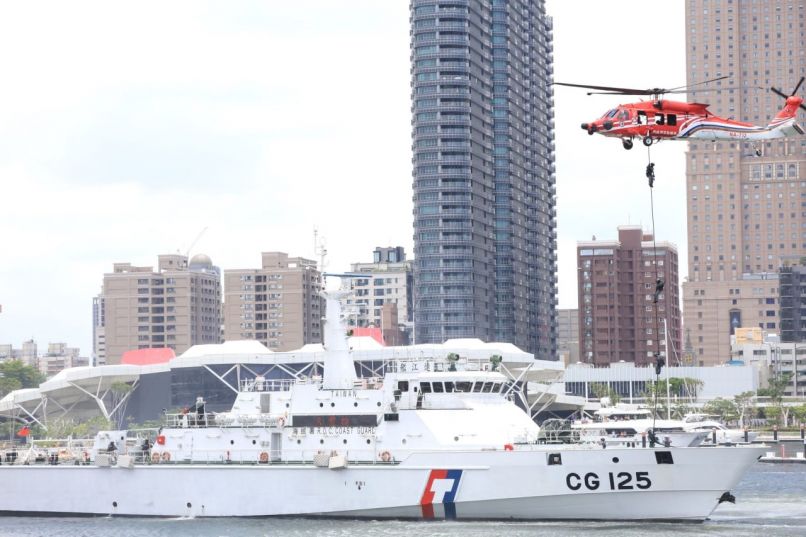
Reuters reported that the October 31 mission was described by Chinese state media as a routine patrol to protect the rights and safety of Chinese people, including Taiwan residents. That language matters. A navy conducting “law enforcement” announces military pressure. A coast guard conducting “law enforcement” attempts to establish jurisdiction. The second message is harder for Taiwan and outside navies to answer without appearing to escalate.
Beijing has also said that it has strengthened control of the relevant waters since the beginning of October. This is not one isolated cutter appearing on a chart. It is a pattern of repeated presence, backed by the assumption that Chinese maritime law applies where Taiwan and most other governments reject that claim. The legal narrative is the weapon; the ships are the delivery system.
Taiwan’s defense ministry reported the patrol alongside the daily air and naval activity around the island. That combination is the point. Coast guard ships can remain below the threshold of armed attack while the People’s Liberation Army provides surveillance, air cover, and escalation options. The resulting force is not a conventional blockade yet. It is a layered access-control system that can become one quickly.
Why the Pacific Side Matters in a War
Any Taiwan contingency would be decided partly by the ability to keep maritime and air routes open. Taiwan’s west coast is closest to the mainland and most exposed to missile attack. The east coast offers depth, but depth only helps if ships and aircraft can use it. A persistent Chinese patrol makes that depth politically and operationally uncertain before the first missile is fired.
Consider the arithmetic. A coast guard ship does not need the range or magazine of a destroyer. It needs communications, a boarding team, a helicopter or drone, and an escorting information network. One vessel can challenge traffic; several vessels can rotate through patrol boxes; military ships can wait over the horizon. Taiwan must then decide whether to shadow, warn, board, or drive them away. Every response consumes crews and creates an incident Beijing can label an attack on law enforcement.
This is sea denial by administrative pressure. It is cheaper than deploying a carrier group and more difficult to deter with a freedom-of-navigation transit. A U.S. or Japanese warship can defeat a coast guard cutter in a tactical fight. That is not the relevant test. The test is whether commercial shipping, insurers, and civilian crews believe the route remains usable under fire and under legal harassment.
The Taiwan Coast Guard Cannot Solve This Alone
Taiwan has invested heavily in its coast guard, but its problem is not simply hull count. The service must watch the approaches, protect offshore islands, support maritime law enforcement, and now monitor Chinese survey vessels, fishing boats, and coast guard formations. The U.S.-China Economic and Security Review Commission has previously noted that China’s coast guard is larger and heavier than Taiwan’s, with access to additional maritime-security forces and a vast maritime militia.
That imbalance becomes more serious east of Taiwan, where the patrol area is open ocean and the distances are long. A Taiwanese cutter can signal resolve, but it cannot maintain continuous coverage without fuel, maintenance, aircraft, and a reliable common operating picture. If the People’s Liberation Army controls the air and electromagnetic environment, a coast guard confrontation becomes a targeting problem for Taiwan.
Taipei therefore needs a division of labor. The coast guard should document and contest jurisdictional intrusions. The navy should provide protected command, surveillance, and escalation control. Allies should make clear that a quarantine enforced by “civilian” ships is still an attempt to change access by force. Waiting for a formal blockade declaration would mean waiting until the gray zone has already succeeded.
What Washington and Tokyo Should Measure
The wrong metric is whether the October 31 patrol produced a collision or a dramatic confrontation. The right metrics are persistence, location, communications, and coordination. How many days can Chinese vessels remain east of Taiwan? Do they patrol the same routes used by resupply traffic? Are military aircraft and naval ships adjusting their positions around the cutters? Are Chinese survey ships collecting seabed data that would improve later submarine or missile operations?
These questions connect the coast guard activity to the wider maritime campaign. A patrol is useful to Beijing if it normalizes a presence, maps responses, and forces Taiwan to spend readiness on routine encounters. It becomes more valuable when combined with air sorties, naval patrols, maritime militia, and information operations. None of those actions individually proves an invasion is imminent. Together, they build the access architecture an invasion, quarantine, or coercive inspection regime would require.
China’s east-of-Taiwan patrol is therefore not a declaration of war. It is more consequential than a headline-grabbing drill because it tests whether control can be established gradually, under a legal label, and without giving Taiwan a clean military target. The patrol is a rehearsal for the first day of a blockade—and for the weeks before it, when everyone is still arguing about whether one has begun.
Sources: Reuters, October 31, 2026; Taiwan Ministry of National Defense, PLA activity report for October 31, 2026; U.S.-China Economic and Security Review Commission, Taiwan chapter.
On October 31, 2026, the China Coast Guard and People’s Liberation Army Navy conducted patrols around Taiwan, involving thirteen military aircraft and seven navy ships. This operation is viewed as a rehearsal for establishing control over maritime access to Taiwan, particularly on its eastern coast. The patrol aims to exert jurisdiction and create uncertainty for maritime traffic, complicating Taiwan's defense strategy.
- Thirteen Chinese military aircraft and seven navy ships were operating around Taiwan on October 31, 2026.
- The China Coast Guard announced a law-enforcement patrol east of Taiwan.
- The patrol is seen as a rehearsal for controlling maritime access to Taiwan.
- Taiwan's defense ministry reported daily air and naval activity around the island.
- China's coast guard is larger and heavier than Taiwan's, complicating Taiwan's maritime security.