
China Liaoning Carrier Drills 170 Flights East of Luzon and Shrinks the Philippine Cushion
 Marcus Chen
China Liaoning Carrier Drills 170 Flights East of Luzon and Shrinks the Philippine Cushion
One hundred seventy carrier takeoffs and landings in three days is not a parade statistic. It is a deck cycle. Japan said the Chinese aircraft carrier Liaoning and its escorts operated east of the Philippines between May 26 and May 28, with carrier aircraft and helicopters repeatedly launching and recovering while the group moved through the western Pacific.
The geography matters more than the raw count. East of Luzon is the outside shoulder of any Taiwan fight. It is the water behind the northern Philippines, below Japan southwest islands, and near the routes US and allied forces would use to move aircraft, submarines, tankers, and logistics into the first island chain. If the People Liberation Army Navy can keep a carrier group there for days, even with an older ski-jump carrier, the problem for Washington and Manila changes from coastal defense to rear-area sea control.
The Formation Was Built for More Than Signaling
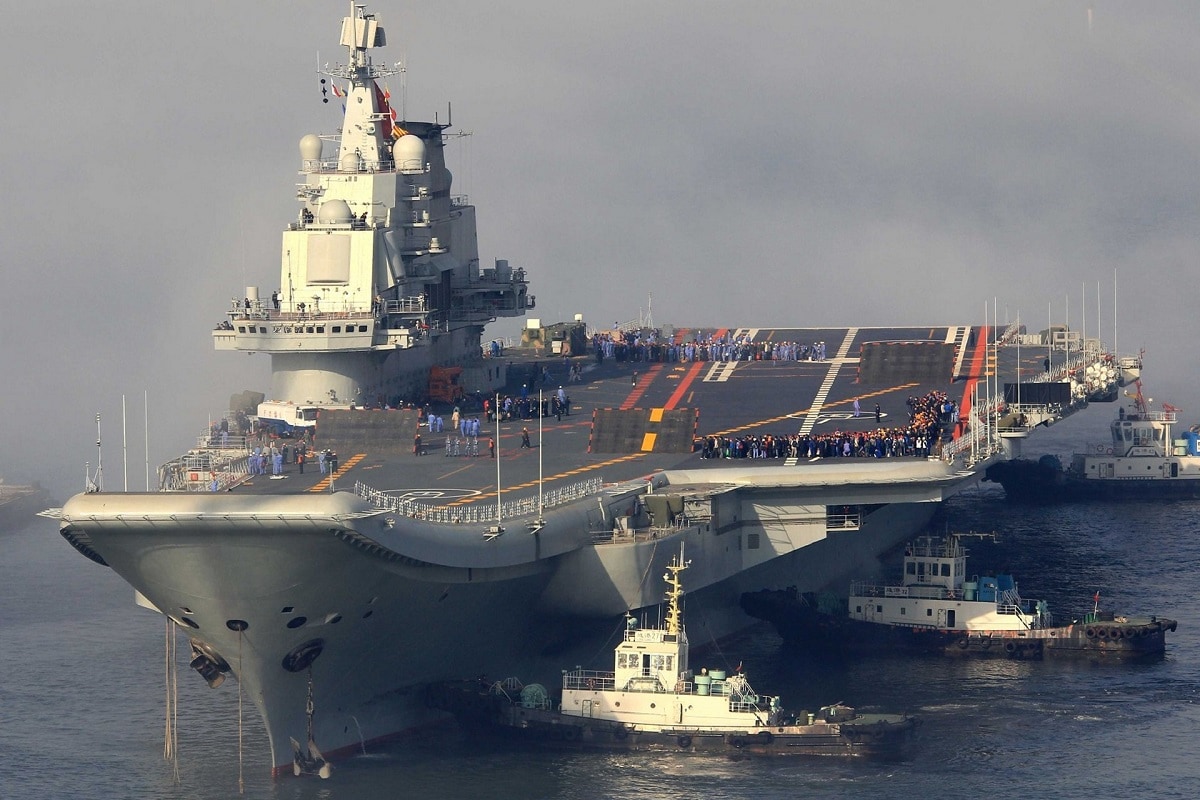
Japan Joint Staff reporting gives the useful part of the picture. On May 25, the Japan Maritime Self-Defense Force spotted five Chinese vessels about 880 kilometers southwest of Okinotori-shima: Liaoning, a Renhai-class Type 055 destroyer, a Luyang III-class Type 052D destroyer, a Jiangkai III-class Type 054B frigate, and a Fuyu-class Type 901 fast combat support ship. Reuters later reported that the group was east of Luzon from May 26 to May 28, conducted roughly 170 takeoff and landing drills, and came as close as 590 kilometers southeast of Miyakojima.
That order of battle is the point. Liaoning is still a limited carrier. Its J-15 fighters launch from a ski jump, which means tradeoffs in fuel and weapons load compared with a catapult carrier. It is not a Chinese Nimitz. But the escort package around it is getting closer to what a real far-seas combat group needs: area air defense from the Type 055, layered surface combatant coverage from the Type 052D, a newer frigate class for screening and anti-submarine work, and an oiler to keep the formation moving.
Anyone who has served on a destroyer knows the carrier is only one part of the machine. The harder problem is not sending the big deck outside the first island chain once. The harder problem is keeping the screen, fuel, aviation rhythm, and command links together long enough that the other side must plan around it.
East of Luzon Is the Bad Place to Be Surprised
The northern Philippines have become central to US operational planning because they sit beside the Luzon Strait and below Taiwan. USNI News reported last month that Balikatan 2026 brought 17,000 troops into the Philippines, including 1,400 from Japan, and Adm. Samuel Paparo called the exercise a mission rehearsal for defense of the Republic of the Philippines. Those words were not accidental. The exercise put long-range fires, Marine littoral forces, and allied command links into terrain that would matter in a Taiwan crisis.
Liaoning operating east of Luzon is Beijing answering the same map. A carrier group there can pressure the rear of the Luzon Strait, complicate maritime patrol aircraft patterns, and force the US Navy to allocate submarines, P-8 coverage, electronic surveillance, and surface combatants to a sector that American planners would prefer to use as a logistics and fires corridor. The group does not need to win a decisive carrier battle. It only needs to make the Philippine rear area contested enough that throughput slows.
Do the simple math. If 170 launches and recoveries are spread across three days, that is roughly 57 deck events per day. A US nuclear carrier can generate far more under surge conditions, but that comparison misses the operational question. The relevant comparison is to what the Chinese Navy could do five years ago in the same water. A PLAN carrier group that can cycle aircraft daily, hold a formation together, and move east of Luzon has crossed from demonstration into useful rehearsal.
The US Cushion Is Thinner Than the Speeches Admit
This is where the American side has a bad habit. Washington talks about distributed operations as if dispersal solves the targeting problem by itself. It does not. Dispersal creates more nodes to fuel, defend, connect, and resupply. The more the United States depends on Philippine access, the more it must defend airfields, ports, magazines, radars, and communications links across islands that sit inside Chinese missile range and now increasingly near Chinese naval aviation training areas.
CSIS warned in May that the US military would struggle in a protracted war with China because of shortages in long-range munitions, air defense interceptors, and unmanned systems. The same study put the Taiwan arms backlog around $32 billion and noted that systems such as Harpoon coastal defense missiles, NASAMS, PAC-3 MSE interceptors, and Altius drones remain part of the delivery problem. That is not an abstract procurement complaint. If Liaoning and follow-on Chinese carrier groups can push into the Philippine Sea, then the United States needs more of exactly those weapons and sensors at exactly the time the inventory is already stressed.
Defense Secretary Pete Hegseth told the Shangri-La Dialogue that allies need more combat power and that the United States needs partners, not protectorates. Fair enough. But Manila can provide geography; it cannot manufacture American SM-6s, Tomahawks, PAC-3s, or maritime patrol capacity. Japan can add surveillance and naval depth; it cannot make the US industrial base move at wartime speed. Burden sharing helps only if the American side brings enough magazines to make the shared plan executable.
The Carrier Is Not the Main Threat
The wrong takeaway is that Liaoning is suddenly a peer of a US carrier strike group. It is not. The ship is old, the air wing has limits, and a high-end fight east of Luzon would expose it to submarines, land-based aircraft, anti-ship missiles, and long-range fires. In wartime, China would have to decide whether the political and military value of risking a carrier justified the exposure.
The right takeaway is that China is training the geometry of a Taiwan and Philippines contingency. The carrier group is a moving sensor, fighter, helicopter, escort, and logistics package. It forces the defenders to widen the map. It turns the waters east of Luzon from a presumed support area into a contested flank.
That is the uncomfortable part. US planning in the Philippines depends on time, access, and stockpiles. Liaoning is showing that China intends to attack all three without waiting for the first shot. The deck cycle was only 170 events, but the message was larger: the Philippine cushion is no longer a cushion if the Chinese Navy can train on top of it.
The Chinese aircraft carrier Liaoning conducted 170 flight operations east of Luzon from May 26 to May 28, accompanied by a group of escort vessels. This operation is viewed as a strategic maneuver to enhance China's naval presence and challenge US military logistics in the region. The drills signify a shift from demonstration to practical rehearsal for potential conflicts involving Taiwan and the Philippines.
- China's Liaoning carrier conducted 170 flight operations east of Luzon from May 26 to May 28.
- The carrier group included various escort vessels, enhancing its operational capability.
- The drills are seen as a strategic move to challenge US and allied forces in the region.