
China Put a Laser on Its Landing Ships and the Drone Math Just Broke
 Marcus Chen
China Put a Laser on Its Landing Ships and the Drone Math Just Broke
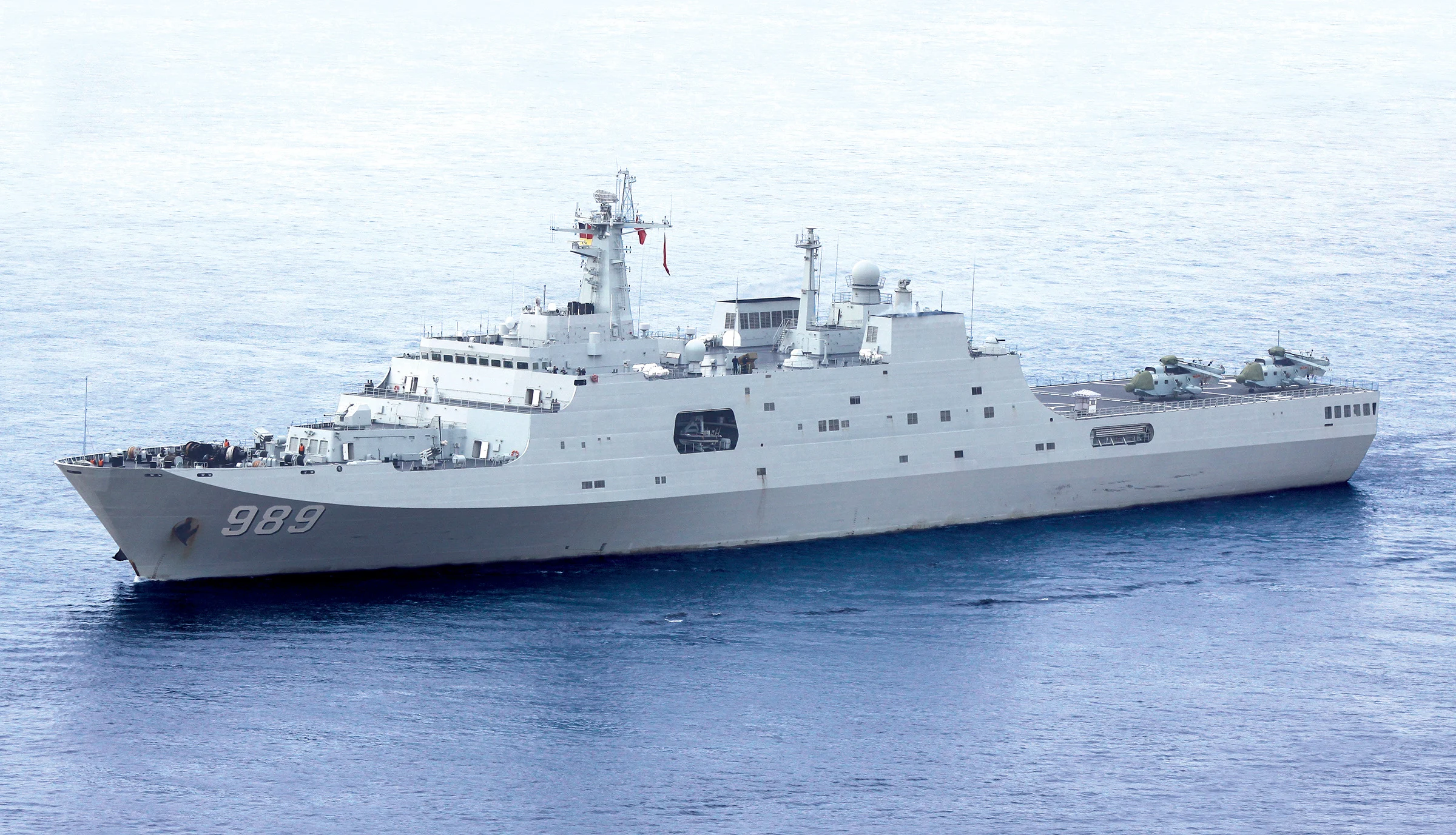
During the PLA's August 1 joint air and naval drill at Scarborough Shoal, state broadcaster CCTV released footage of the Type 071 amphibious landing ship Qilianshan — and sitting right behind its 76mm main gun was a rectangular housing that should make every amphibious planner in the Pacific take a second look. Analysts have identified it as the LY-1 Liaoyuan-1, China's most advanced shipborne high-energy laser weapon. This is no parade-ground mockup. The LY-1 is operational, it's on at least two Type 071s, and it changes the defensive calculus for any force that plans to operate drones against PLA amphibious formations in contested littorals.
What the LY-1 Actually Is
The LY-1 is a directed-energy weapon operating in the 180 to 250 kilowatt range, with some assessments putting its output in the 200 to 300 kilowatt class when plugged into a platform with sufficient electrical capacity — which a 20,000-ton amphibious transport dock certainly provides. It uses spectral beam combining to merge multiple fiber-laser modules into a single output beam, with adaptive optics correcting for platform vibration and atmospheric turbulence. The turret aperture is assessed to be nearly twice the diameter of the U.S. Navy's HELIOS laser, which matters because a larger aperture maintains tighter beam focus at longer ranges.
In PLA doctrine, the LY-1 sits at the innermost layer of a four-tier defensive architecture: HHQ-9C long-range missiles, HQ-16C medium-range, HQ-10A short-range, and finally the laser for terminal interception. Its job is to burn through electro-optical sensors, heat infrared seekers, or degrade airframe structures through sustained illumination — engaging targets that have already leaked through the outer rings. Against small drones and loitering munitions, assessed engagement range extends into the tens of kilometers under favorable atmospheric conditions.
The Qilianshan (hull 985) is now the second Type 071 confirmed to carry the system, following its sister ship Simingshan (986). But there's a telling detail in the imagery: the Qilianshan carries a rigid rectangular enclosure, replacing the soft protective dome seen on the earlier installation. That's not cosmetic. It's the engineering signature of a system maturing from experimental fit to standardized configuration — ruggedized for sustained maritime operations rather than trial conditions.
Why the Amphibious Ships Get It First
Anyone who has planned an opposed landing understands the problem immediately. Amphibious ships don't sit 200 nautical miles offshore lobbing Tomahawks. They close to within visual range of the beach. That puts them inside the threat envelope of every cheap, proliferated system an adversary can field — quadcopters with grenades, loitering munitions, reconnaissance drones cueing shore-based anti-ship batteries. A Type 071 with 500 Marines and their equipment aboard is a high-value target that presents itself at close range for hours during offload.
Lu Li-shih, a retired Taiwanese navy lieutenant commander, put it directly to the South China Morning Post: "Once these ships are close to the adversary's nearshore waters, they could be attacked by unmanned aerial or surface drones. So compared with destroyers and frigates, amphibious ships need the high-energy weapon more." He's right. A Burke-class destroyer can stay at standoff range. A landing ship, by definition, cannot.
Then there's the math that makes any operations analyst uncomfortable. An HHQ-10 short-range missile costs something in the high six figures per shot. A Shahed-136 clone or a converted commercial quadcopter costs somewhere between $20,000 and $50,000. You don't need a PhD in defense economics to see which side runs out of interceptors first when a swarm of 30 or 40 drones arrives simultaneously. A laser shot costs electricity. The magazine depth isn't limited by VLS cell count — it's limited by the ship's fuel and generator runtime. That arithmetic fundamentally breaks the cost-imposition strategy that drone warfare is built on.
The Comparison No One in Washington Wants to Make
The U.S. Navy installed its first experimental laser — the 30-kilowatt LaWS — on USS Ponce in 2014. Twelve years later, the operational deck-mounted laser on a U.S. warship is HELIOS, a 60-kilowatt system fitted to the destroyer USS Preble. It's a real capability. But 60 kilowatts against a subsonic cruise missile or a fast inbound drone is a marginal engagement. You need dwell time. You need exquisite tracking. You need to hope atmospheric conditions cooperate.
China's LY-1 is four to five times more powerful, on a ship type that needs close-in defense more urgently than any destroyer, and it's already on two hulls with signs of standardization. Beijing skipped the decade-long demonstration phase. It went from parade ground in September 2025 to operational drill footage in August 2026 — ten and a half months. That timeline says something about how the PLA acquisition system prioritizes capabilities it considers warfighting essentials rather than research projects.
This isn't an argument that the U.S. Navy is failing. HELIOS is producing real data, and the service has plans for higher-power follow-ons. But the gap between what the U.S. is testing and what China is deploying operationally is narrowing in a category where the U.S. was supposed to have a permanent lead.
What Changes in the First Island Chain
Consider the scenario the PLA is clearly rehearsing: a large-scale amphibious operation in the South China Sea, or more consequentially, across the Taiwan Strait. In either case, the defender's cheapest, most scalable response is drones — commercial and military, surveillance and strike, air and surface. Taiwan is investing NT$210 billion in exactly this approach: mass drone swarms designed to complicate and disrupt a landing.
The LY-1 doesn't make drones irrelevant. Rain, fog, smoke, and aerosol concentrations degrade beam quality — the system can't shoot through a monsoon. Ship motion, multiple simultaneous threats, and the sheer physics of dwell time mean a single laser mount can only engage so many targets per minute. But it reduces the threat volume reaching the kinetic interceptors. That preserves HHQ-10s and 30mm CIWS ammunition for the threats the laser can't handle. In a saturation scenario, that margin matters.
The real signal here isn't the laser itself. It's what the PLA chose to put it on. Directed-energy weapons demand serious electrical power and cooling — requirements that make them hard to retrofit onto existing combatants. The PLA put its first operational naval laser on amphibious ships, not destroyers, because it assessed that those are the ships most likely to face the drone swarm problem in a real fight. That assessment tells you more about PLA war planning than any white paper.
The drone equation in the littorals just got more complicated. A laser with effectively unlimited ammunition changes the cost curve that made drone swarms attractive in the first place. The U.S. Navy has been working on this problem since 2014. China just fielded an answer.
China deployed the LY-1 Liaoyuan-1 laser weapon on its Type 071 amphibious landing ship Qilianshan during a joint drill at Scarborough Shoal on August 1, 2026. This advanced directed-energy weapon enhances the PLA's defense against drone threats, marking a significant evolution in their military capabilities. The LY-1 is operational and represents a shift in the PLA's approach to amphibious operations, prioritizing close-in defense against unmanned aerial systems.
- China has deployed the LY-1 laser weapon on Type 071 amphibious landing ships.
- The LY-1 operates in the 180 to 250 kilowatt range, with potential outputs of 200 to 300 kilowatts.
- The Qilianshan is the second Type 071 confirmed to carry the LY-1 system.
- The laser weapon changes the defensive calculus against drone threats in contested areas.
- The PLA's rapid deployment of the LY-1 indicates a shift in military strategy.