
China-Russia Joint Aerial Patrol: PLA H-6K and Y-20 Enter Western Pacific Training Chain
 Li Minghui
China-Russia 11th Joint Aerial Patrol: PLA H-6K and Y-20 Enter Western Pacific Training Chain
On June 27, this joint aerial strategic patrol between China and Russia was summarized in a few sentences in the official press release: Japan Sea, East China Sea, and the western Pacific, the 11th time. However, what is truly interesting is not these geographical names, but the combination of aircraft types revealed in the PLA Air Force's public video.
This Time It's Not Just About Showing Bombers
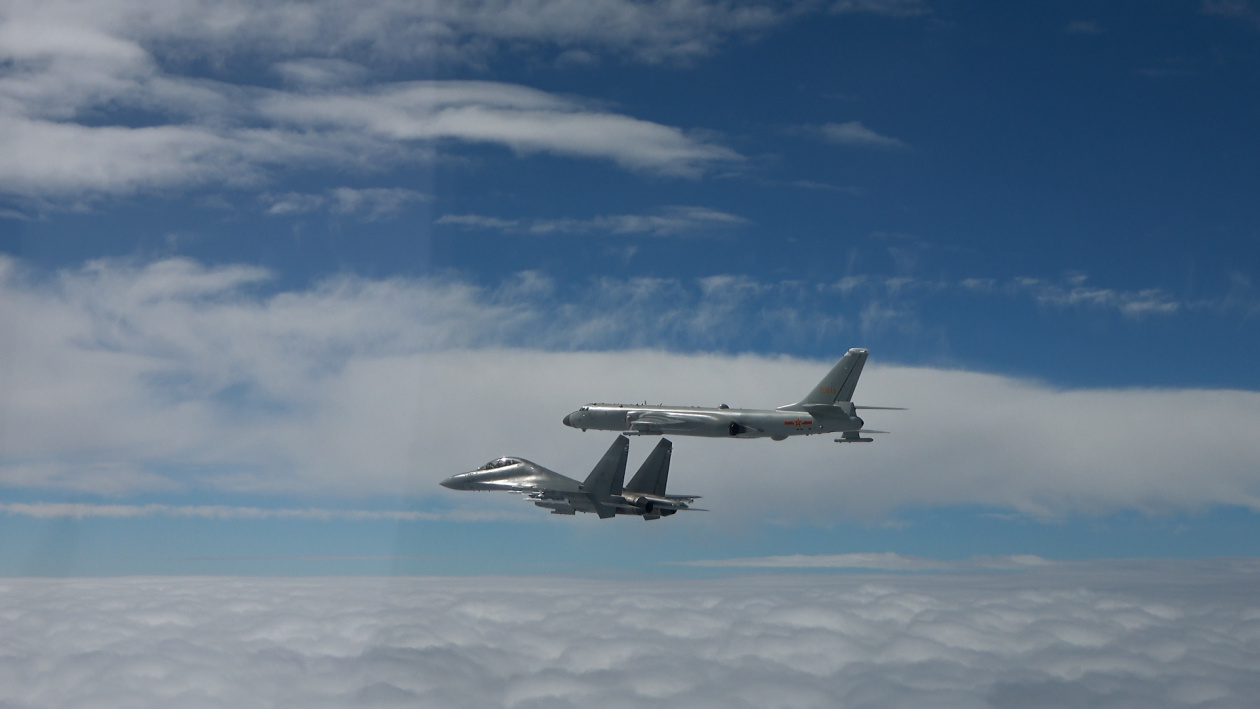
The China Daily quoted the PLA Air Force as saying that the Chinese aircraft participating in the operation included J-10C, Su-30MKK, Y-20, KJ-500A, and H-6K, while the Russian side had the Tu-95 strategic bomber. This list is more significant than the phrase "bomber patrol," as it indicates that the Chinese Air Force is advancing from showcasing single aircraft types to a systematic aerial formation for long-range training.
The H-6K itself is not a new platform. Its value lies in its ability to carry long-range cruise missiles, which can push the strike line beyond the first island chain; its shortcomings are also clear: subsonic speed, large airframe, and limited penetration capability, which rely on escort, early warning, refueling, and route planning. In simple terms, whether the H-6K can form a reliable deterrent in the western Pacific depends not only on what munitions it carries under its belly and wings but also on whether there is a complete aerial support chain around it.
The Y-20 and KJ-500A Are More Worth Watching Details
The appearance of the Y-20 in this type of patrol indicates that the PLA Air Force is no longer satisfied with merely proving its range by "flying there and back," but is practicing sustained presence. The number of large tankers remains a hard constraint for the Chinese Air Force, and the U.S. Air Force's decades of global deployment experience cannot be made up for in just a few years. However, with the Y-20 joining the long-range formation, the operational radius and loitering flexibility of platforms like the H-6K, J-10C, and Su-30 will significantly increase.
The significance of the KJ-500A is similar. The far sea airspace is not a transparent space that can be fully covered by land-based radars; bomber formations need airborne early warning aircraft to supplement visibility, manage formations, and allocate targets to avoid becoming "targets that others can see clearly, but they cannot see far enough." Public information does not show the depth of the data link between the aircraft this time; I do not believe that China and Russia have formed a joint air combat network similar to NATO; it is more likely that they are sharing flight paths, time windows, and identification rules, gradually increasing tactical cooperation.
Different Pressures on Japan and the East Side of Taiwan
This flight path crosses the Japan Sea, East China Sea, and western Pacific, which on the surface appears to be a political display by China and Russia against the U.S. alliance system, but militarily it resembles a three-part pressure test: the Japan Air Self-Defense Force must track long-range bombers and escort aircraft, the east side of Taiwan must consider the possibility of the PLA deploying forces from outside the island chain, and U.S. bases in Japan and Guam must recalculate early warning times.
However, this patrol should not be interpreted as "the Chinese and Russian air forces have integrated." The Russian Tu-95 is part of the nuclear strategic bomber system, while the H-6K is more focused on regional conventional strikes, with different mission cultures and command chains. Joint patrols can demonstrate political mutual trust and basic cooperation, but they do not automatically equate to joint operational capabilities. This distinction is important.
The Real Change Lies in Repeatability
Since 2019, the China-Russia joint aerial strategic patrol has reached its 11th iteration. One patrol can be seen as a gesture, but 11 consecutive ones begin to transform into a training system. For the PLA, the real progress is not that the H-6K has flown over the western Pacific again, but that fighter jets, tankers, early warning aircraft, and bombers can be integrated into the same long-range process for repeated refinement.
Reports indicate that on June 27, the air forces of China and Russia organized and implemented the 11th joint aerial strategic patrol in the airspace of the Japan Sea, East China Sea, and western Pacific, demonstrating their determination and capability to jointly maintain regional peace and stability.
I am more concerned about whether the next step will include electronic warfare aircraft, anti-submarine patrol aircraft, and search and rescue support forces entering the same training chain. Only by filling in these less visible links can the presence of the H-6K in the western Pacific be more than just a line on a flight path map.
On June 27, the Chinese People's Liberation Army Air Force and the Russian Air Force conducted their 11th joint air strategic patrol across the Sea of Japan, East China Sea, and Western Pacific. The operation involved multiple aircraft types, including H-6K bombers and Y-20 tankers, showcasing enhanced military cooperation and capabilities. This patrol serves as a pressure test for regional adversaries, particularly Japan and Taiwan, while demonstrating the growing operational integration of Chinese and Russian air forces.
- China and Russia conducted their 11th joint air strategic patrol on June 27.
- The patrol included various aircraft types from both nations.
- The operation aimed to test military capabilities and demonstrate political trust.
- The presence of Y-20 tankers indicates a shift towards sustained operations in the region.
- The patrol route crosses strategic areas, increasing pressure on Japan and Taiwan.