
China Uses Electronic Warfare Against Dutch De Ruyter Near Paracels
 Marcus Chen
China Uses Electronic Warfare Against Dutch De Ruyter Near Paracels
The useful number in this incident is not one frigate. It is 300 kilometers, the approximate distance from Hainan to the Paracel Islands, and it explains why Beijing treated a Dutch air-defense ship as more than a diplomatic nuisance on May 27.
China's Southern Theater Command said it used naval and air forces, verbal warnings, and what it called warning electronic interference against HNLMS De Ruyter, a De Zeven Provincien-class air-defense and command frigate operating near the Paracels. The command accused the ship and its embarked helicopter of entering Chinese-claimed waters and airspace. Dutch reporting, drawing on the Ministry of Defence, framed the deployment as a five-month Indo-Pacific mission intended to support freedom of navigation and military cooperation with partners.
The tactical detail matters. This was not a coast guard cutter pushing a fishing boat. De Ruyter is built around sensors, command systems, and area air defense. If the PLA chose to highlight electronic interference, the message was aimed at the mission system as much as at the hull.
A Frigate Built to See First
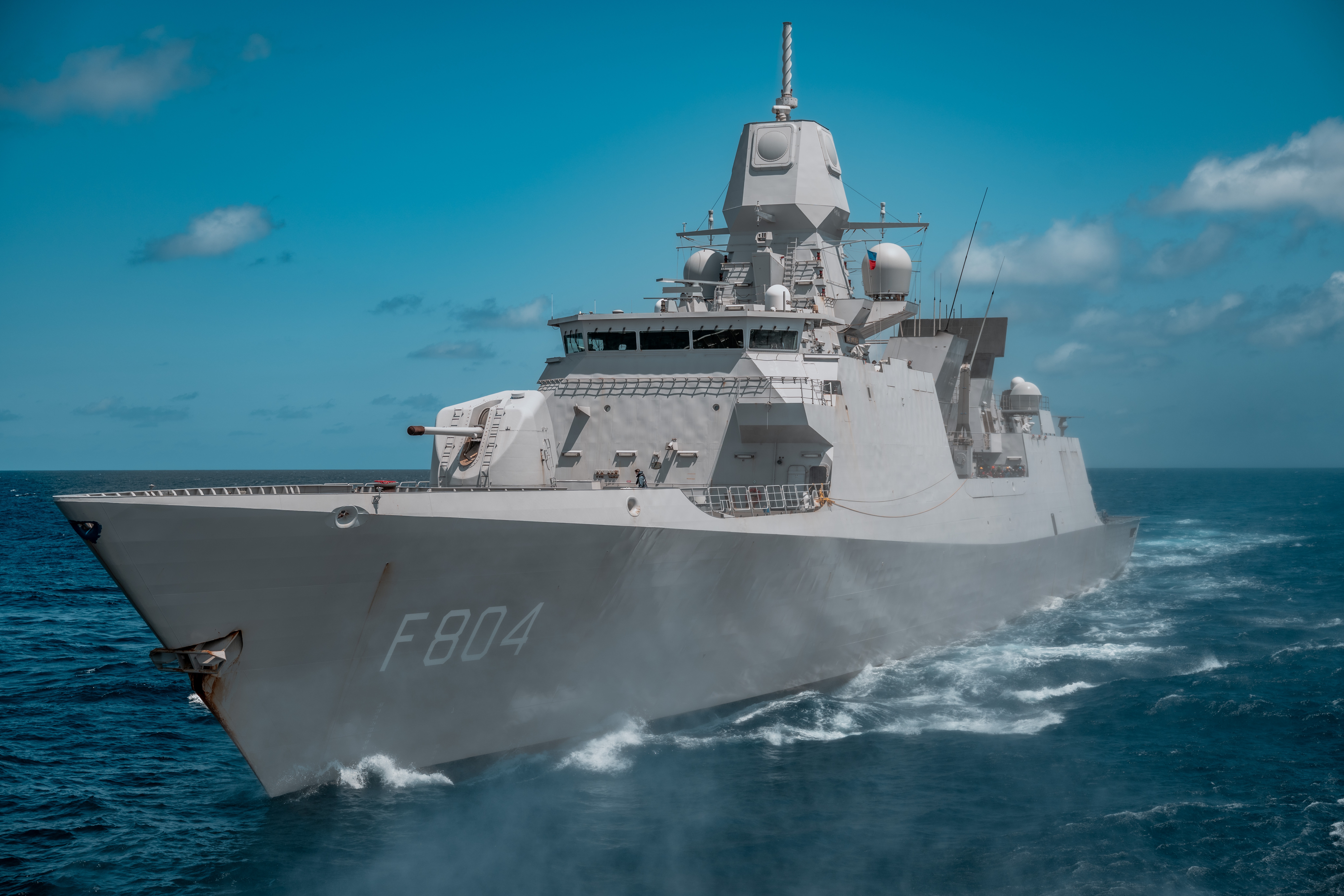
The Royal Netherlands Navy lists the De Zeven Provincien-class frigates at 6,050 tons, 144 meters long, with a speed of 30 knots and a crew of 174, or 202 with staff embarked. The class carries the SMART-L early-warning radar, a Mark 41 vertical launch system for ESSM and SM-2 Block IIIA missiles, Harpoon anti-ship missiles, Mark 46 torpedoes, a Goalkeeper close-in weapon system, and an NH90 maritime helicopter.
Those specifications make De Ruyter a useful test case for China. The ship is not an American destroyer, but it is also not a symbolic patrol vessel. Its value lies in sensing, command, and coalition integration. Dutch defense material describes SMART-L as able to look hundreds of kilometers beyond the horizon and track multiple targets while the ship still defends itself and a wider force. In a crisis, that sort of ship helps build the air picture for a multinational task group.
Anyone who has served on a destroyer knows that electronic attack is not an abstract threat. It turns the combat information center from a picture into a question. Is the track real? Is the helicopter link stable? Is the radar being deceived, saturated, or merely warned? The difference between those options is the difference between holding formation and backing away.
The Paracels Are Becoming a Sensor Zone
The Paracel Islands are controlled by China, claimed by Vietnam and Taiwan, and sit roughly 190 miles from Hainan. Beijing has turned the island chain into a forward operating belt. USNI News noted that China controls the Paracels through about 20 outposts and support forces from the mainland. It also linked the incident to China's wider network of electronic warfare capabilities across the South China Sea.
That is the operational point. A Dutch frigate passing near the Paracels is not simply challenging a legal claim. It is entering a battlespace China is trying to wire for detection, disruption, and political control. Warnings are the visible layer. Electronic interference is the more important layer because it tests whether a European ship can collect, communicate, and operate under pressure without an American carrier strike group next to it.
The timing is not accidental. The Asia Maritime Transparency Initiative reported in March that new Chinese dredging and landfill at Antelope Reef had produced roughly 1,490 acres of reclaimed land, close to the scale of Mischief Reef. If Antelope Reef becomes a larger logistics, radar, or aviation node, the Paracels stop looking like a disputed island cluster and start looking like the northern anchor of a South China Sea operating grid.
Europe Is No Longer Outside the Problem
De Ruyter sailed in April with about 200 personnel for a five-month deployment. The Dutch Ministry of Defence said the ship would move through the Red Sea, Southeast Asia, sanctions-monitoring operations related to North Korea, and then participate in Rim of the Pacific and Pacific Dragon around Hawaii. That is a serious route. It links European maritime security, Indo-Pacific presence, North Korea enforcement, and US-led high-end naval exercises into one deployment.
China understands that route. Beijing does not need to stop every European deployment. It only needs to raise the cost enough that smaller European navies start treating South China Sea presence as episodic diplomacy rather than operational habit. The Netherlands can send one air-defense frigate every other year. It cannot maintain a persistent destroyer-size presence in the western Pacific. France and Britain face the same arithmetic.
That is why the De Ruyter incident is more important than its scale. China was not deterring the Dutch fleet. It was testing the political will and electronic resilience of the European contribution to Indo-Pacific sea control.
The Firepower Math Is Still Thin
There is also an uncomfortable Dutch-specific detail. The Ministry of Defence said in April that De Ruyter's 127 mm gun was not working while awaiting replacement, though it argued the ship retained sufficient self-defense options and did not need the gun for the Indo-Pacific voyage. That is probably true for presence operations. It is less comforting in a gray-zone encounter where every non-missile option matters.
The frigate still has SM-2, ESSM, Harpoon, torpedoes, sensors, and an NH90. But a ship with an inactive main gun and a limited missile magazine is not built to trade escalation ladders indefinitely near Chinese air and naval bases. The operational problem for European navies is not courage. It is depth. One ship can show the flag. One ship cannot sustain sea control if the other side owns the nearby airfields, radars, coast guard stations, and electronic warfare sites.
Washington should read the incident the same way. European deployments help politically, and in a coalition they add sensors, command capacity, and legitimacy. But they do not solve the first-island-chain math. If China can pressure a Dutch frigate near the Paracels with localized electronic interference, then US planners should assume the same tactics will be applied at scale against Japanese, Philippine, Australian, and American networks in a Taiwan or South China Sea contingency.
Sources
- USNI News on the May 27 De Ruyter incident
- South China Morning Post on PLA claims and electronic interference
- NL Times on Dutch reporting and prior Chinese encounters
- Dutch Ministry of Defence specifications for De Zeven Provincien-class frigates
- Dutch Ministry of Defence on De Ruyter's 2026 Indo-Pacific deployment
- CSIS AMTI on Antelope Reef reclamation
That is the warning from May 27. The next South China Sea crisis will not start with missiles. It will start with sensors going uncertain, helicopters being boxed in, and commanders deciding whether a distorted picture is good enough to hold position. The side that has practiced that ambiguity will move first.
China used electronic warfare against HNLMS De Ruyter near the Paracel Islands on May 27, 2023. The Chinese Southern Theater Command accused the Dutch frigate of entering Chinese-claimed waters, employing naval and air forces along with electronic interference. This incident underscores China's efforts to assert control in the South China Sea and test the operational resilience of European naval forces.
- China used electronic warfare against HNLMS De Ruyter near the Paracel Islands.
- The incident occurred on May 27, 2023.
- HNLMS De Ruyter is a De Zeven Provincien-class frigate.
- China's Southern Theater Command accused the Dutch ship of entering Chinese-claimed waters.
- The incident highlights China's electronic warfare capabilities in the South China Sea.