
China Warship Blockade Tests the Philippines at Second Thomas Shoal
 S.W
S.WChina Warship Blockade Tests the Philippines at Second Thomas Shoal
A Philippine resupply mission to Second Thomas Shoal was blocked on September 25 by Chinese coast guard cutters and warships, according to USNI News. The immediate question is whether Manila got food and water to the marines aboard the BRP Sierra Madre. The larger question is whether Beijing has turned a recurring harassment pattern into a controllable blockade mechanism.
The Incident Was About Access, Not Tonnage
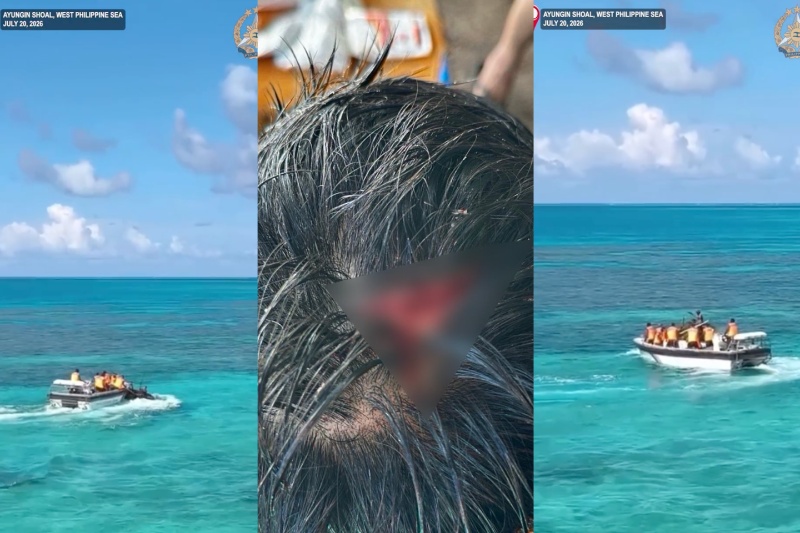
Second Thomas Shoal, known in the Philippines as Ayungin, is not a conventional naval base. It is a submerged feature occupied by a small Philippine detachment living on a deliberately grounded amphibious transport. That makes the logistics problem brutally simple: the outpost survives only if Manila can move supplies through a contested sea lane on a predictable schedule.
China does not need to sink a Philippine vessel to change that equation. Coast guard ships can impose delays, force course changes, surround a convoy, or create an incident that Manila decides is not worth repeating. The presence of larger naval combatants behind the cutters adds a second layer of pressure. It signals that the coast guard screen is not operating alone, while preserving Beijing preferred argument that this is a law-enforcement operation rather than a military blockade.
This is gray-zone sea denial. The objective is not to win a fleet engagement. It is to make routine access expensive, politically risky, and eventually negotiable.
Why the Sierra Madre Matters
The Sierra Madre is a rusting World War II-era landing ship, but its operational value is disproportionate to its condition. It is the physical marker of the Philippines claim and the post from which Manila can observe activity around the shoal. Replacing it with a modern platform would be politically explosive; abandoning it would remove the most visible Philippine presence from a feature that sits inside Manila claimed exclusive economic zone.
The 2016 South China Sea arbitration rejected China expansive historic-rights claims as a legal basis for maritime entitlements, while finding that Second Thomas Shoal is a low-tide elevation and generates no territorial sea of its own. Beijing rejected the ruling. The legal dispute therefore does not prevent close-range coercion. It gives both sides a framework for public messaging while ships do the practical work.
USNI News has documented the pattern in operational terms: Chinese coast guard and maritime militia forces have repeatedly challenged Philippine missions, including through dangerous maneuvers and water-cannon use in earlier confrontations. The September 25 episode matters because the reported participation of Chinese warships raises the ceiling of the pressure campaign.
The Military Math Favors the Blocker
In a conventional fight, the Philippines would have no credible path to force Chinese surface combatants away from the shoal without outside support. Manila has patrol vessels and aircraft, but it does not possess the mass, air defense, or anti-ship magazine depth required to establish local sea control against a larger Chinese force. A resupply mission is therefore a narrow operation: protect a few ships for a few hours, keep the convoy moving, and avoid escalation.
China can rotate cutters, maritime militia, and naval escorts from nearby bases. The Philippines must assemble a mission, coordinate its coast guard and navy, decide how much risk to accept, and then explain every collision or confrontation to the public. The asymmetry is not just in hull numbers. It is in persistence. A state that can keep pressure on station for weeks will usually beat a state that must treat every sortie as a crisis.
The relevant measure is not whether Manila can complete one resupply run. It is whether Beijing can make the next ten runs harder than the last.
Washington Faces a Narrower Choice
The United States has repeatedly stated that the 1951 Mutual Defense Treaty applies to armed attacks on Philippine armed forces, public vessels, or aircraft in the South China Sea. That commitment is meant to deter escalation, but it does not automatically answer the gray-zone question. If a Chinese cutter blocks a Philippine supply boat without firing, Washington has to decide how much treaty credibility it is willing to spend on an incident designed to stay below the threshold of war.
That ambiguity is useful to Beijing. It can test the alliance without presenting Washington with a clean casus belli. It is also dangerous for Manila, because every successful delay teaches Chinese crews and commanders what level of coercion produces a Philippine pause and what level triggers American involvement.
For the United States, the practical response is not another declaration. It is persistent presence, shared maritime surveillance, and a pre-agreed escort plan that gives Philippine commanders options before a convoy is surrounded. The aim should be to reduce decision time. A treaty that requires consultation after every incident is weaker than a standing operating pattern that makes coercion immediately visible and politically costly.
What Happens Next
Manila will probably continue resupply attempts because the alternative is to concede the shoal without a formal withdrawal. Beijing will likely continue to use layered forces: coast guard vessels forward, maritime militia nearby, and naval ships positioned to shape the risk calculation without necessarily opening fire. That structure is cheaper and more flexible than a declared blockade.
The next test is whether China repeats the use of naval combatants, whether Philippine escorts become more capable, and whether the United States or other treaty partners join missions in a visible but controlled way. A single encounter can be dismissed as an incident. A regularized pattern becomes a new operating rule.
Second Thomas Shoal is a small feature, but the lesson is large. Sea denial does not always begin with missiles or mines. Sometimes it begins with a cutter placing its bow across a supply route and waiting to see who moves first. If the Philippines cannot guarantee access to its own outpost, the alliance is already fighting on China preferred terms.
Sources
Chinese coast guard cutters and warships blocked a Philippine resupply mission to Second Thomas Shoal on September 25, 2026. This incident highlights China's strategy of gray-zone sea denial, complicating the Philippines' ability to supply its outpost, the BRP Sierra Madre. The U.S. has reiterated its commitment to the Mutual Defense Treaty in response to such incidents.
- Philippine resupply mission to Second Thomas Shoal was blocked by Chinese forces on September 25, 2026.
- Chinese coast guard cutters and warships were involved in the blockade.
- The BRP Sierra Madre is a key Philippine outpost at the shoal.
- China's actions are part of a broader strategy of gray-zone sea denial.
- The U.S. has stated that the Mutual Defense Treaty applies to armed attacks in the South China Sea.