
China's 052D-Derived Coast Guard Is Pressuring the Luzon Strait in 2026
 Marcus Chen
China's 052D-Derived Coast Guard Is Pressuring the Luzon Strait in 2026
A China Coast Guard cutter built on a hull derived from the PLA Navy's Type 052D destroyer design was operating near the Batanes approaches on October 1. Eight days later, the Philippine and Chinese maritime forces were involved in a ramming incident farther west. Those are not isolated collisions. They are evidence that Beijing is extending gray-zone pressure from the South China Sea toward the water that separates the Philippines from Taiwan.
The New Operating Picture
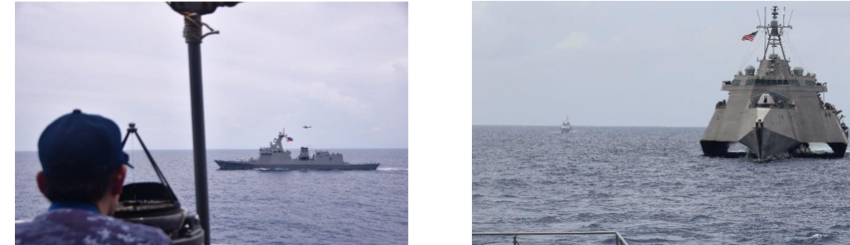
USNI News reported on October 9 that incidents involving Chinese and Philippine forces had spiked across the South China Sea and the Luzon Strait. Its reporting, supported by Philippine Coast Guard imagery, identified a Chinese cutter derived from a 052D-class guided-missile destroyer hull patrolling near Batanes. The important fact is not the ship's label. It is the geography.
Batanes sits at the northern edge of the Philippine archipelago, close to the Bashi Channel, one of the approaches between the South China Sea and the Philippine Sea. A Chinese government vessel operating there can watch, shadow, and complicate movement between the first island chain and Taiwan without crossing the threshold of an overt military operation. The mission is law enforcement on paper. The effect is maritime shaping.
Why the Hull Matters
A Type 052D destroyer is a large, high-end combatant with a modern sensor suite, vertical-launch missile cells, and the speed to remain with a naval task group. A coast guard vessel derived from that hull is not automatically a destroyer in disguise. Its weapons, sensors, crew training, and rules of engagement are different. But the design lineage still points to a useful operational choice: Beijing wants a coast guard platform with more endurance, seakeeping, and command space than a conventional patrol cutter.
That matters in a confrontation below the level of war. A ship that can stay on station for days, coordinate with other government vessels, and physically contest a Philippine resupply or patrol mission imposes costs without giving Manila a clean military target. Any collision then becomes a political contest over who escalated first. The larger hull also makes it harder for a smaller Philippine vessel to force separation safely.
From a fleet-planning perspective, this is a cheap way to turn naval mass into coercive presence. China does not need to deploy a frigate every time it wants to signal control. It can reserve the PLAN for overwatch while coast guard cutters create the daily operational facts.
The Philippine Dilemma
Manila has improved maritime domain awareness and is more willing to publish evidence of confrontations. That helps expose coercion, but publicity does not solve the tactical problem. The Philippine Coast Guard remains optimized for patrol, search and rescue, and law enforcement. It is not designed to absorb repeated ramming attempts from larger steel hulls backed by a state with a much deeper fleet.
The answer is not simply to send more patrol boats. Manila needs a layered force around the northern approaches: persistent unmanned surveillance, reliable communications, rapid legal and diplomatic coordination, and naval escorts available when a coast guard mission becomes a high-risk encounter. The goal should be to deny China the ability to isolate each incident as a one-on-one law-enforcement dispute.
Washington faces a parallel choice. The 1951 Mutual Defense Treaty does not turn every maritime collision into a shooting war, but repeated attacks on Philippine public vessels could test the treaty's credibility. A US response that arrives only after a serious casualty will be too late to shape behavior. Regular US-Philippine and allied presence in the Luzon Strait can raise the cost of coercion, but only if the rules for operating alongside civilian maritime forces are clear before the next collision.
What Beijing Is Testing
China is testing three boundaries at once. First, it is testing whether Philippine forces will continue operating near the Batanes approaches when the risk of physical contact rises. Second, it is testing whether Washington treats gray-zone incidents as alliance problems or as local law-enforcement disputes. Third, it is testing the practical difference between controlling a waterway and merely claiming it.
This is not a blockade. China has not demonstrated the ability or willingness to stop all shipping through the Luzon Strait. Nor does a single coast guard cutter prove that Beijing has achieved sea control. But sea control is not the only objective that matters. Persistent presence can create a form of sea denial by making Philippine and allied movements slower, more cautious, and more expensive.
The Bottom Line
The Luzon Strait is becoming a pressure point because China can combine naval technology, coast guard authority, and operational patience. The Philippines has the legal position and growing international support, but those advantages matter only when backed by ships that can remain on station and networks that can document every encounter.
The next collision will not be a surprise. It will be a measure of whether Manila and Washington prepared for the gray-zone fight they have been describing for years. If the response is improvised after impact, China will have learned that a coast guard cutter can move the first island chain without firing a missile.
Sources: USNI News, October 9, 2026; U.S. Naval Institute background on Chinese naval forces.
A China Coast Guard cutter operated near Batanes on October 1, 2026, leading to increased incidents with Philippine maritime forces in the Luzon Strait. These confrontations are part of China's strategy to exert pressure in the region without overt military action. The Philippines is enhancing its maritime awareness but struggles against larger Chinese vessels, while the US is evaluating its response to these gray-zone challenges.
- A China Coast Guard cutter derived from a Type 052D destroyer was operating near Batanes on October 1, 2026.
- Incidents involving Chinese and Philippine forces have increased in the South China Sea and Luzon Strait.
- The Chinese cutter's presence complicates maritime movement between the first island chain and Taiwan.
- The Philippines is improving its maritime domain awareness but faces challenges from larger Chinese vessels.
- China is testing the response of Philippine and US forces to gray-zone incidents.