
China’s 100 Ship First Island Chain Surge Exposes Taiwan’s Patrol Math
 Marcus Chen
China’s 100 Ship First Island Chain Surge Exposes Taiwan’s Patrol Math
More than 100 Chinese vessels across one maritime arc is not a drill detail. It is the size of the problem Taiwan has to track before anyone fires a shot.
Taiwanese officials said on May 23 that China had deployed more than 100 navy, coast guard, research, and other vessels from the Yellow Sea down through the South China Sea and into the Western Pacific. The next day, Taiwan’s Coast Guard described a separate but related pressure point near Dongsha Island, where the Chinese coast guard ship 3501 entered restricted waters and faced a standoff lasting more than 20 hours before leaving 26.6 nautical miles west of the island.
Those two facts belong in the same operational picture. Beijing is not only counting hulls. It is forcing Taiwan to count contact reports, assign patrol craft, burn crew hours, process radar tracks, and decide which gray-zone move is a warning and which one is rehearsal.
The Deployment Is Bigger Than Taiwan’s Coast Guard Problem
The public map shared by Taiwan’s National Security Council chief Joseph Wu showed Chinese maritime activity spread around the First Island Chain rather than clustered only around Taiwan. That matters. A force distributed from the Yellow Sea to the South China Sea can make Japan, Taiwan, the Philippines, and the United States watch different pieces of the same board at the same time.
If this were a classic blockade rehearsal, the geometry would be easier to read. The useful point is that it is not that clean. Navy ships can signal combat power. Coast guard cutters can test law-enforcement thresholds. Research vessels can collect bathymetric, acoustic, and current data that matter for submarines and unmanned systems. Fishing or auxiliary traffic can thicken the radar picture until the defender has to spend time sorting noise from intent.
Anyone who has stood watch on a destroyer knows that a track is not just a dot. It is a classification problem, a communications problem, and eventually a command decision. Multiply that by more than 100 contacts across multiple sectors and the pressure moves from headline politics into watchfloor workload.
Dongsha Shows How Beijing Turns One Hull Into A Decision Trap
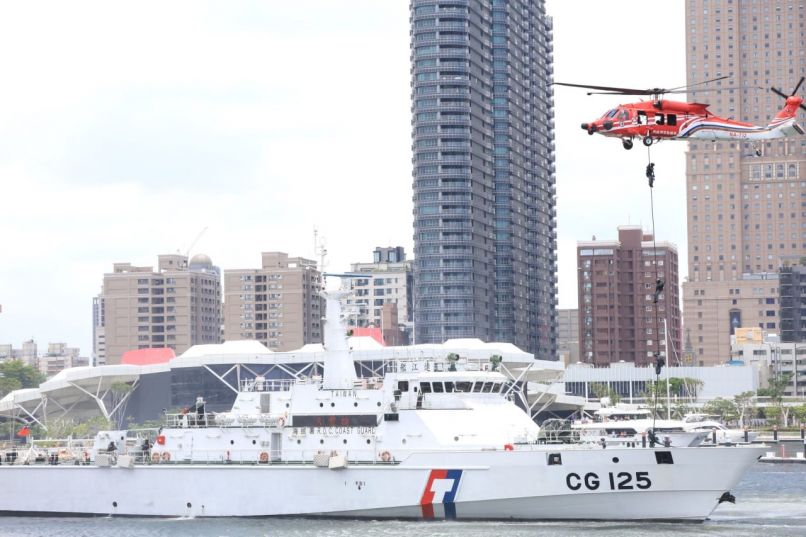
The Dongsha incident is the more concrete piece of the story. Taiwan’s Coast Guard said its patrol vessel Taichung shadowed Chinese coast guard ship 3501 after the Chinese ship entered restricted waters near Dongsha. The standoff ran from Saturday into Sunday and ended only after the Chinese ship left the restricted area.
One ship is not an invasion force. But one ship in the right place can still impose a cost. Dongsha sits in the northern South China Sea, closer to Hong Kong than to Taiwan proper, and it is a useful pressure point because Taiwan must defend it without letting every intrusion become a shooting incident. Beijing understands that geometry.
The tactical choice for Taipei is ugly. Ignore the cutter and China normalizes presence. Intercept it and Taiwan ties up a patrol asset for almost a full day. Escalate too hard and Beijing gets the crisis narrative it wants. The Chinese coast guard does not have to win a battle to make that math work. It only has to make Taiwan spend finite readiness on recurring incidents.
The Research Vessel Angle Is The Part Washington Should Watch
Taiwan News reported that Taiwan’s Coast Guard has tracked roughly 41 Chinese research vessels recently operating near Taiwan and cited Coast Guard comments that Chinese research operations have expanded beyond the First Island Chain toward Guam and even farther into the Pacific. That should get more attention than the usual aircraft-sortie tally.
Maritime survey work is not glamorous, but it is useful. Undersea geography shapes submarine routes, mine warfare, seabed sensors, unmanned underwater vehicle operations, and amphibious planning. If China is putting research vessels into wider patterns while coast guard and naval units apply pressure closer to Taiwan, the campaign is doing two things at once. It is testing political reactions now and improving the operating picture for later.
That is why the number 100 is less important than the mix. A navy-only surge is a military signal. A mixed navy, coast guard, and research-vessel surge is a systems test. It probes the seams between Taiwan’s Coast Guard, navy, intelligence agencies, and political leadership. It also asks whether Washington and Tokyo treat gray-zone maritime pressure as a shared military warning or as a Taiwan law-enforcement problem.
The U.S. Arms Pause Makes The Timing Worse
This maritime surge landed in the same week that Taiwan had to answer questions about a planned U.S. arms sale. The Associated Press reported on May 22 that Taiwan said it had not been notified of any pause in a planned $14 billion sale, after acting U.S. Navy Secretary Hung Cao told senators that some foreign military sales were being delayed so the United States could preserve munitions for the Iran war. President Donald Trump had also described Taiwan arms sales as a negotiating chip in dealings with China.
That does not mean Beijing launched vessels because of one Washington quote. The People’s Liberation Army and China Coast Guard do not need a cable-news trigger to plan maritime pressure. But timing matters in deterrence. When Taiwan sees more than 100 Chinese vessels around the First Island Chain while Washington debates whether its own munitions stocks are too thin to move Taiwan packages forward, the signal received in Taipei is not reassuring.
The problem is not only whether Taiwan gets a specific package this month. It is whether China believes U.S. attention, stocks, and political will can be saturated. If American interceptors, air-defense missiles, anti-ship weapons, and command bandwidth are being pulled toward the Middle East, the Indo-Pacific does not pause politely.
The Hard Number Is Patrol Endurance
Taiwan’s answer cannot be only more press statements. The hard number is how many vessels it can keep at sea, how many crews it can rotate, and how fast it can fuse coast guard, navy, and intelligence tracks into decisions. A 20-hour standoff at Dongsha is manageable. Ten simultaneous standoffs around Taiwan’s outlying islands, plus research vessels beyond the First Island Chain, plus air activity near the median line, is a different problem.
This is where U.S. and allied planning often gets too abstract. Sea denial is not just missiles. It is patrol endurance, maritime domain awareness, communications discipline, and enough small ships to avoid using high-end combatants for every white-hull confrontation. Taiwan needs anti-ship missiles and air defense, but it also needs the boring architecture that keeps a gray-zone campaign from exhausting the force before a crisis becomes visible on television.
China’s 100-vessel surge is not proof that war is imminent. It is evidence that Beijing can create a moving maritime problem larger than Taiwan’s daily patrol rhythm. That is the point.
The United States can talk about deterrence in the Taiwan Strait, but the first test may not be a missile launch. It may be whether Taiwan and its partners can keep enough eyes, hulls, and crews on station when China makes the whole First Island Chain the operating area.
Sources
- Taiwan News, May 24, 2026, on Joseph Wu’s warning about more than 100 Chinese vessels around the First Island Chain.
- Taiwan News, May 25, 2026, on the Dongsha Island standoff involving Chinese coast guard ship 3501 and Taiwan’s patrol vessel Taichung.
- Associated Press, May 22, 2026, on Taiwan’s response to reports of a pause in a planned $14 billion U.S. arms sale.
China deployed over 100 vessels across the maritime regions from the Yellow Sea to the Western Pacific, creating significant operational challenges for Taiwan. A standoff occurred between Taiwan's Coast Guard and a Chinese coast guard ship near Dongsha Island, lasting over 20 hours. Taiwan's Coast Guard has also tracked numerous Chinese research vessels, indicating a coordinated effort to exert pressure on Taiwan's defenses.
- China deployed over 100 vessels from the Yellow Sea to the Western Pacific.
- A standoff occurred between Taiwan's Coast Guard and a Chinese coast guard ship near Dongsha Island.
- Taiwan's Coast Guard tracked 41 Chinese research vessels operating near Taiwan.
- The deployment of Chinese vessels is part of a broader strategy to pressure Taiwan.
- Taiwan's ability to respond is challenged by the scale of Chinese maritime activity.