
China's 100-Vessel Taiwan Surge in 2026 Tests Blockade Readiness
 Marcus Chen
China's 100-Vessel Taiwan Surge in 2026 Tests Blockade Readiness
More than 100 Chinese navy and coast guard vessels were reported operating across the Western Pacific on November 4, while Taiwan also recorded a sharp increase in Chinese air activity. The number is politically useful but operationally ambiguous. A blockade is not created by counting hulls on a map. It is created by keeping enough combat power, surveillance, logistics, and command-and-control in position long enough to make shipping stop.
That distinction matters. Taiwan News and the South China Morning Post, citing Taiwanese officials, described an unusually large maritime deployment. The reports did not establish that every vessel was concentrated around Taiwan, nor that the force had shifted into a formal exercise. The Institute for the Study of War's November 3 China-Taiwan update provides the necessary caution: unusual activity is an indicator of pressure, not proof that Beijing has made a decision to attack.
The Fleet Is a Signal Before It Is a Blockade
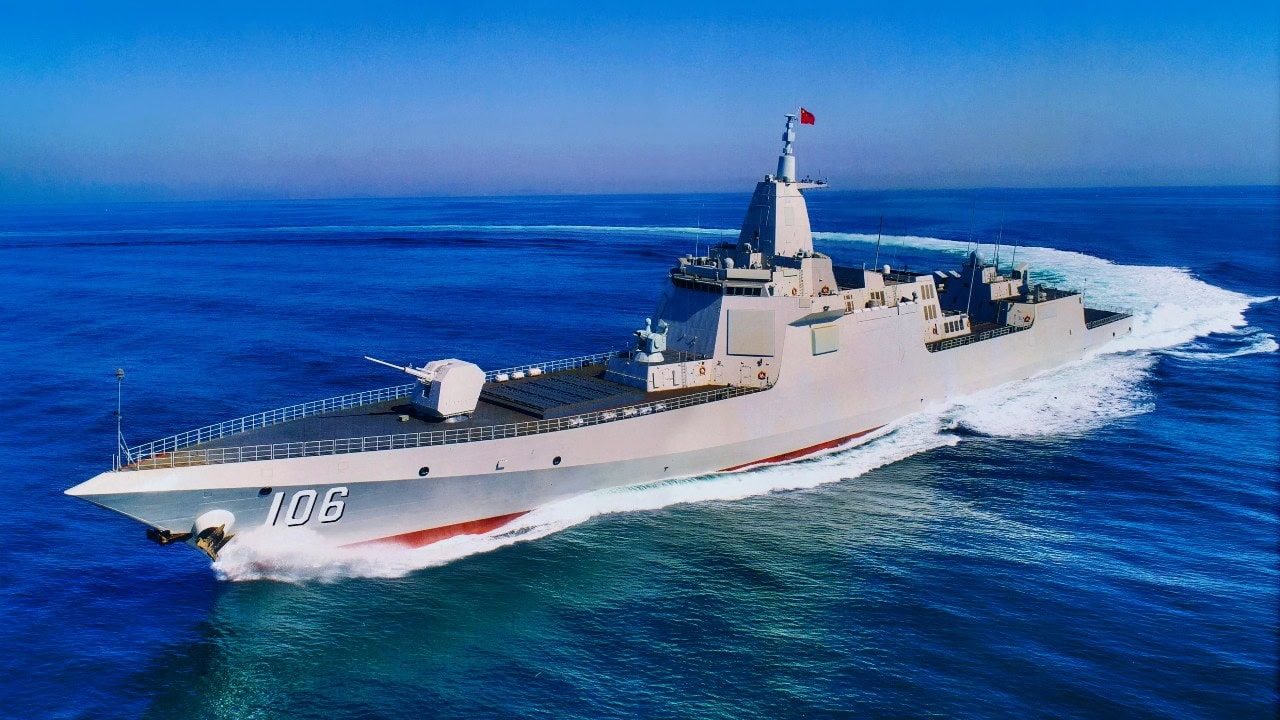
The People's Liberation Army Navy (PLAN) can use a large surface presence to create several problems at once. Warships complicate Taiwan's maritime picture, coast guard vessels provide a layer of law-enforcement ambiguity, and aircraft force Taipei to spend readiness hours tracking contacts that may never cross a red line. The mix is cheaper politically than announcing a blockade and more dangerous than a routine patrol.
A Type 055 Renhai-class destroyer illustrates the military value of the high-end component. At roughly 12,000 to 13,000 tons full load, with a large vertical-launch battery and advanced air-defense radar, it is a command and escort platform rather than a generic patrol ship. But a few destroyers cannot close Taiwan's ports. They need submarines, maritime patrol aircraft, shore-based missiles, replenishment ships, and a surveillance network that can identify a merchant vessel before it reaches the inspection zone.
What 100 Vessels Can and Cannot Do
- Presence: A large mixed force can impose uncertainty across the Taiwan Strait, the Philippine Sea, and approaches to key ports.
- Denial: A serious blockade would require persistent missile, air, submarine, and surface coverage—not simply a temporary concentration of ships.
- Endurance: Fuel, maintenance, crews, ammunition, and secure communications determine whether the deployment lasts days or becomes a campaign.
- Escalation control: Coast guard participation lets Beijing claim enforcement or quarantine activity while naval escorts preserve the option to raise the cost of resistance.
The arithmetic is unfavorable to any force that tries to patrol everywhere at once. Taiwan has multiple commercial ports and approaches, while the surrounding waters are connected to the Luzon Strait and wider Western Pacific. A Chinese commander can threaten several routes, but covering all of them continuously would consume ships rapidly. Merchant traffic can also reroute, sail in convoy, seek insurance guarantees, or wait for an escort decision from the United States and regional partners.
The Air Surge Changes the Calculation
The naval figure matters more because Taiwan reported a simultaneous increase in air sorties. Aircraft extend the sensor and strike envelope beyond the ships themselves. They can cue surface forces, pressure Taiwan's fighter fleet, and complicate any attempt to escort commercial traffic. Yet sortie counts are not the same as combat persistence. Aircraft need weapons, spare parts, tankers, maintenance crews, and rested pilots. Taiwan's daily response burden is real, but China's ability to sustain a high tempo would also be tested under wartime conditions.
This is where the current deployment should be read as a rehearsal for coercion. Beijing is measuring Taiwan's reaction time, communications discipline, and political messaging. It is also collecting information about how the United States, Japan, the Philippines, and commercial carriers respond to a gray-zone maritime concentration. The point may be to make a future blockade look administratively normal before it becomes openly military.
Taiwan's Information Problem Is a Military Problem
Reuters reported on November 2 that Taiwan wants greater control of its maritime information as Chinese pressure grows. That is not a bureaucratic side issue. A blockade depends on who controls the picture. If Taiwan cannot rapidly distinguish a fishing vessel, a coast guard cutter, a missile-capable escort, and a decoy, it will either overreact or leave gaps. Both outcomes help Beijing.
Taipei therefore needs a common operating picture linking coast guard tracks, naval sensors, air-defense data, commercial shipping reports, and allied intelligence. It also needs a public communication plan that states what has been verified without inflating every contact into an invasion warning. Credibility is a combat asset. Once shipowners and insurers believe that Taiwan's authorities cannot explain what is happening, commercial pressure will begin before the first shot.
Washington Should Count Days, Not Hulls
The United States should not answer this episode with another symbolic patrol and a press release. The useful questions are practical: How many days can Taiwan keep ports open? How quickly can allied forces establish a recognized escort corridor? Which Chinese ships can be tracked continuously? How many long-range weapons are available after the first week? Can Japan and the Philippines provide bases without turning a quarantine into a regional war?
The deployment is not proof that China can immediately execute a sealed blockade. It is evidence that Beijing can assemble a credible coercive package using naval, coast guard, air, and information tools. That package can be scaled up or down, and the ambiguity is part of its value.
The headline is 100 vessels. The real test is endurance. If China can keep a mixed force supplied, coordinated, and politically controlled while Taiwan's trade remains under pressure, the blockade option becomes more believable. If the force must rotate, disperse, or stand down after a short period, the number will have been mostly theater. Washington and Taipei should prepare for the first case. The next crisis will be decided by logistics and information long before anyone counts the ships.
Sources
- South China Morning Post, “Taiwan flags massive PLA naval mobilisation, spike in air sorties,” November 4, 2026.
- Taiwan News, “Taiwan says China deploys over 100 navy, coast guard vessels in Western Pacific,” November 4, 2026.
- Reuters, “Facing Chinese pressure, Taiwan says it must be master of its own maritime information,” November 2, 2026.
- Institute for the Study of War, “China & Taiwan Update, November 3, 2026.”
On November 4, 2026, over 100 Chinese navy and coast guard vessels operated in the Western Pacific, coinciding with a spike in Chinese air activity. This deployment is viewed as a potential rehearsal for coercion against Taiwan, testing its response capabilities. The People's Liberation Army Navy's presence complicates Taiwan's maritime security and signals Beijing's intent to exert pressure without formally declaring a blockade.
- Over 100 Chinese navy and coast guard vessels reported in the Western Pacific.
- Taiwan observed a significant increase in Chinese air sorties.
- The deployment is seen as a rehearsal for coercion against Taiwan.
- A blockade would require more than just a concentration of ships; it needs sustained operational capability.
- Taiwan is seeking greater control over its maritime information.