
China's 2026 Haixun Patrol East of Taiwan Maps a Submarine Problem
 Marcus Chen
China's 2026 Haixun Patrol East of Taiwan Maps a Submarine Problem
Four Chinese state vessels, backed by several China Coast Guard ships, moved through the waters east of Taiwan in early June. That number matters more than the slogans Beijing attached to the operation.
The Ministry of Transport called it a special maritime traffic law-enforcement mission. Taiwan's Coast Guard Administration called it gray-zone pressure. Both descriptions miss the operational point. A 10,000-ton maritime safety ship, a 7,500-ton hydrographic survey vessel, a 6,000-ton patrol-and-rescue ship and a rescue vessel of roughly 3,500 gross tons do not need to sail together to check traffic paperwork. They sail together to practice jurisdiction, collect data and test how Taiwan reacts east of the island.
That eastern side is the part of the Taiwan problem Washington too often treats as empty blue water. It is not empty. It is the route by which U.S. and Japanese forces would try to move submarines, surveillance aircraft and logistics around a Chinese pressure campaign. It is also where Taiwan's own maritime rights overlap with Japan-Philippines delimitation talks. Beijing has found a pressure point that sits below the threshold of naval combat but above routine law enforcement.
The Formation Was the Message
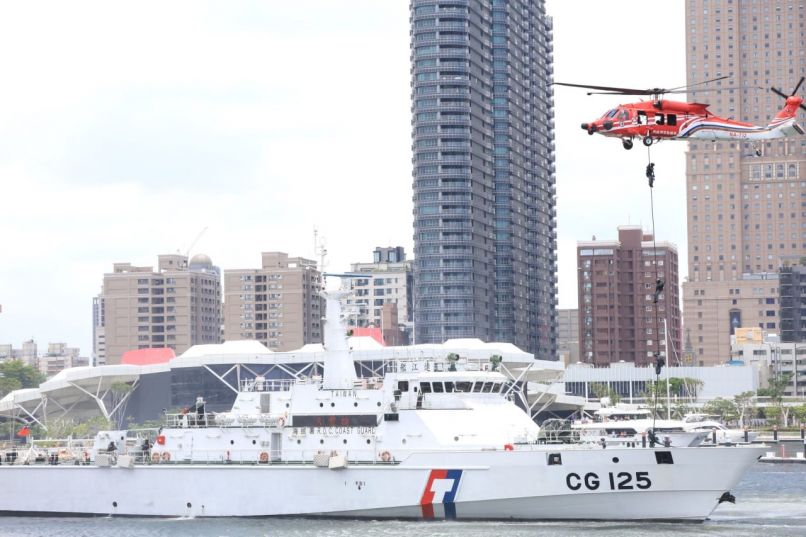
According to Zack Liao's reconstruction of the operation, the Chinese route passed about 40 nautical miles from Lanyu, 51 nautical miles from Taiwan's eastern coast, 35 nautical miles from Japan's Ryukyu Islands and 56 nautical miles from Itbayat in the northern Philippines. Those distances put the patrol near the junction of Taiwan, Japan and the Philippines, not near some abstract open-ocean safety zone.
The named ships were Haixun 09, Haixun 06, Haixun 08 and Donghaijiu 113. The first is a large maritime safety platform with command-and-control value. The second gives the formation patrol and rescue endurance. The third is the important one: Haixun 08 is a deep-sea hydrographic survey vessel. Add several 3,000-to-4,000-ton China Coast Guard escorts and the package starts to look less like traffic management and more like a maritime governance task group.
Taiwan's Coast Guard said Chinese vessels entered restricted waters southwest of Taiwan's southern tip before being warned out by seven Taiwanese coast guard ships, according to Taipei Times reporting. Chinese radio traffic reportedly asserted jurisdiction. Taiwan's reply was the part that mattered: Beijing has no sovereign rights in waters east of Taiwan.
Hydrography Is Not Neutral Here
In peacetime, hydrographic surveys sound harmless. Mariners need depths, currents, seabed contours and acoustic conditions. In a Taiwan scenario, those same data help submarines hide, help surface ships understand where submarines may hide, and help planners define mine danger areas, sensor fields and undersea cable approaches.
Anyone who has served on a destroyer knows that anti-submarine warfare is less about cinematic sonar pings and more about water. Temperature layers, seabed shape and ambient noise decide whether a contact is real, where a submarine can sit, and how long it takes to build a track. The eastern approaches to Taiwan drop quickly into deeper Pacific water. That is good terrain for submarines, but only for the side that understands it in detail.
Indo-Pacific Defense Forum summarized the military utility clearly: Chinese research and survey vessels gather bathymetric, seafloor and oceanographic data that can support submarine operations, amphibious planning, mine warfare and antisurface warfare. That is the right way to read Haixun 08's presence. The ship does not need a missile launcher to change the battlespace.
This is why the operation should worry Washington more than another aircraft sortie count. A fighter crossing a median-line reference is visible, dramatic and easy to brief. A survey pattern east of Taiwan is quieter, but it can improve the People's Liberation Army Navy's wartime math for years.
The U.S. Submarine Assumption Gets Harder
Most serious Taiwan defense concepts lean heavily on U.S. undersea power. That is not wrong. Attack submarines remain one of the few U.S. assets that can operate inside a mature Chinese anti-access network without needing a runway or a visible surface logistics chain.
But the submarine assumption has two weaknesses. First, the U.S. Navy does not have enough attack submarines. The Congressional Research Service has repeatedly shown the fleet falling below long-term requirements while Virginia-class delivery remains slower than planned. Second, submarine advantage is not magic. It depends on environmental knowledge, cueing, maintenance, torpedoes, and the ability to reach patrol areas before China closes the problem set.
China cannot erase U.S. undersea superiority with one Ministry of Transport patrol. It can, however, narrow the information gap in the exact water where U.S. boats would matter most. The PLAN has been building a larger submarine force, but numbers alone are not enough. A submarine force needs charts, acoustic libraries, sensor pathways and repeated operating experience. Civilian-labeled ships can help build that foundation while giving Beijing deniability.
The useful question is not whether Haixun 08 is a warship. It is whether the data it collects would make Chinese warships and submarines more effective later. The answer is yes.
Jurisdiction Is Also a Weapon
There is a legal layer to this. The patrol followed Japan and the Philippines moving toward maritime delimitation talks. Taiwan asked that its rights not be ignored. Beijing answered by sending an administrative fleet to perform Chinese jurisdiction in the same broad maritime space.
That is lawfare with hull numbers. If Beijing can make foreign merchant ships answer Chinese questions east of Taiwan, make Taiwan send coast guard ships to contest it, and make outside observers describe the episode as a minor traffic enforcement dispute, then it has already gained something. It has shifted the baseline of normal behavior.
The same pattern has worked in the South China Sea. First comes a survey vessel. Then a coast guard escort. Then routine presence. Then the other side is accused of provocation for resisting. The difference east of Taiwan is that the water also sits astride the routes U.S., Japanese and Philippine forces would need in a crisis.
What the Response Should Measure
The U.S. and its partners do not need to chase every Chinese research vessel with a destroyer. That would play Beijing's escalation game. They do need a better public accounting of Chinese survey activity, especially when research ships operate with coast guard or maritime safety escorts near Taiwan, the Philippines, Guam or the Ryukyus.
The practical response is dull but necessary: shared track databases, public releases of survey patterns, coordinated coast guard presence, and a legal framework that distinguishes real marine science from coercive data collection. Japan, Taiwan and the Philippines also need a way to discuss overlapping maritime interests without letting Beijing define the conversation by force of presence.
The military response is equally practical. If the U.S. plan for a Taiwan contingency depends on submarines in the Philippine Sea, then the United States and Japan should treat seabed and acoustic data as operational ammunition. Hydrographic capacity, undersea sensors and counter-survey monitoring are not side issues. They are part of sea denial.
China's June patrol did not change the balance by itself. It showed how Beijing is trying to change the map before a crisis starts. That is the uncomfortable part. The first fight east of Taiwan may not be over missiles or carriers. It may be over who gets to know the water better.
Sources include the June 18 China-Taiwan update by the Institute for the Study of War, Taipei Times reporting on Taiwan's Coast Guard response, Zack Liao's vessel reconstruction at Observing China, and Indo-Pacific Defense Forum reporting on China's dual-use research fleet.
Chinese state vessels conducted a maritime patrol east of Taiwan in early June 2026, involving four ships including a hydrographic survey vessel. The operation aimed to collect data and test Taiwan's response, highlighting China's strategic interest in the region. This activity is part of a broader effort to assert jurisdiction and gather intelligence that could enhance military operations.
- Chinese vessels conducted a patrol east of Taiwan in early June 2026.
- The operation involved four state vessels and several China Coast Guard ships.
- The patrol aimed to collect hydrographic data and test Taiwan's response.
- The operation is seen as a form of gray-zone pressure against Taiwan.
- The presence of the Haixun 08 vessel is significant for military planning.