
China's 2026 Scarborough Shoal Drill Turns Coast Guard Friction Into Amphibious Rehearsal
 Marcus Chen
China's 2026 Scarborough Shoal Drill Turns Coast Guard Friction Into Amphibious Rehearsal
The useful number is twelve nautical miles. That is the size of the territorial sea Manila has now drawn around Scarborough Shoal, and it is the distance Beijing used on August 1 to move the problem from diplomacy into a military drill.
China's People's Liberation Army Southern Theater Command announced joint naval and air training in the waters and airspace around Huangyan Island, the Chinese name for Scarborough Shoal. AP reported that the drills tested air-sea coordination and rapid reinforcement after the Philippines submitted charts to the United Nations asserting baselines, a territorial sea, and a contiguous zone around the feature. Reuters separately reported that the PLA and China Coast Guard conducted joint activity around the shoal, making this more than a service-level patrol.
That combination matters. A coast guard confrontation can be treated as law enforcement. A PLA drill can be treated as signaling. A synchronized coast guard and military sequence around the same reef is closer to a playbook.
The Drill Was Built Around Control, Not Presence
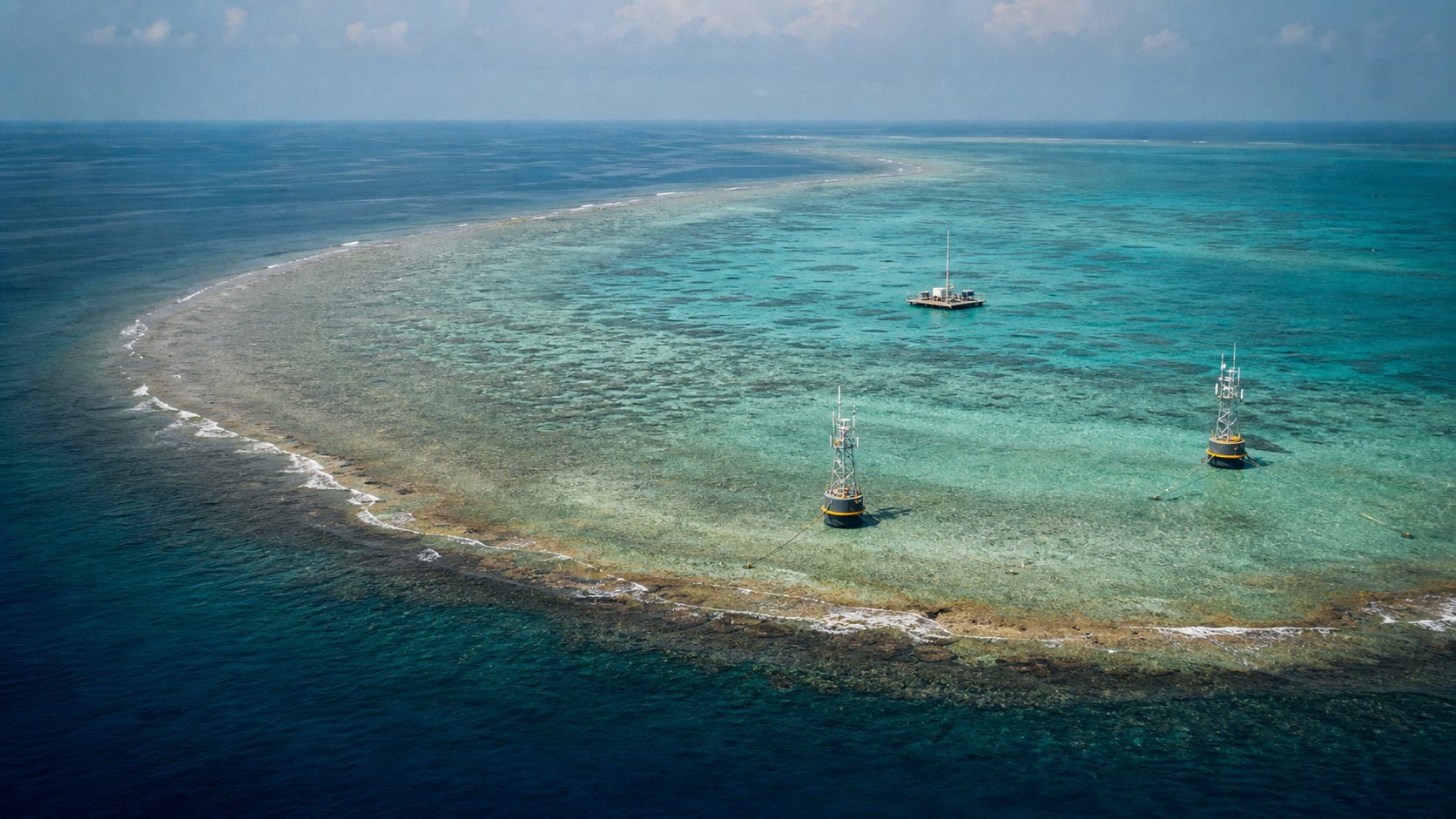
The Southern Theater Command said its August 1 training covered reconnaissance and early warning, deterrent patrols, sea and air control, joint strikes, fast support, and system-level combat effectiveness. The phrasing is boilerplate, but the package is not. Those are the functions required to isolate a small maritime objective, keep Philippine or allied ships at distance, and bring in heavier forces before the other side can turn a standoff into a facts-on-the-water challenge.
Chinese state-linked coverage added the useful operational details. Footage and descriptions showed H-6K bombers carrying YJ-12 supersonic anti-ship missiles, Type 071 amphibious transport dock activity, Type 054A and Type 056A frigates, Z-20J and Z-8C helicopters, and air-cushion landing craft. The exact order of battle is less important than the mix. Bombers threaten ships outside the immediate reef area. Frigates and maritime patrol assets police the approaches. Amphibious ships, helicopters, and landing craft create the option to put personnel and heavy equipment onto shallow or broken terrain.
Anyone who has served on a destroyer knows the hard part is not steaming near a disputed feature. The hard part is maintaining a command picture while small craft, aircraft, legal claims, and media pressure all arrive at once. China's August 1 drill was aimed at that problem. It was not a parade of hulls. It was a rehearsal for compressing decision time.
The Coast Guard Piece Is the Sharp Edge
China Coast Guard statements on the same day were more explicit. The agency said it practiced boarding and inspection, interception of vessels attempting to break through, and forced towing near Huangyan Island. Chinese reports described small-boat launch, chase, boarding, and a two-vessel maneuver to control a high-powered craft. Those are not abstract sovereignty claims. They are the mechanics of removing a Philippine fishing boat, government vessel, or activist flotilla from the lagoon or its approaches.
That is where Washington should pay attention. The United States has treaty commitments to the Philippines, but most Scarborough scenarios will not begin with a missile strike. They will begin with a ladder, a water cannon, a ramming angle, or a boarding team. Beijing is building muscle memory below the threshold where U.S. commanders get clean options.
The PLA can provide the outer ring, while the Coast Guard applies the inner pressure. That division of labor is the point.
Scarborough Shoal sits roughly 120 nautical miles west of Luzon and about 470 nautical miles from Hainan. That geography gives Manila proximity but gives China escalation flexibility. The Philippines can send coast guard ships and aircraft faster. China can layer maritime militia, coast guard cutters, aircraft, and naval units to make every Philippine move look like a police problem until it suddenly is not.
The Philippines Forced the Timing
This round did not appear from nowhere. Manila's submission to the United Nations and its charting of baselines around Scarborough challenged China's effort to keep the shoal in a gray zone. Beijing answered in three channels at once: a PLA drill, Coast Guard enforcement training, and new management rules for the Huangyan Island national nature reserve, including restrictions on unauthorized fishing, mining, and coral harvesting.
The nature reserve rules may sound environmental, but in maritime disputes administration is power. Rules create inspection authority. Inspection authority creates a reason to board. Boarding creates the incident that tests whether Manila, Washington, and other partners are willing to escalate over a reef without fresh water, a runway, or a resident population.
That is the trap. Scarborough is small enough for diplomats to call it manageable and important enough for planners to worry about it every day. If China can normalize enforcement there, it can push a new baseline of behavior into the South China Sea without firing a shot.
The U.S. Problem Is Response Time
For U.S. Indo-Pacific Command, the Scarborough problem is not firepower in the abstract. The U.S. Navy and Air Force can bring overwhelming force if a shooting war starts. The operational question is whether they can arrive early enough, visibly enough, and with rules of engagement clear enough to prevent a boarding or forced tow from becoming the new normal.
A carrier strike group is a poor instrument for a coast guard boarding. A destroyer can show presence, but it cannot easily stop a Chinese law-enforcement maneuver without turning a police action into a naval confrontation. Philippine forces need persistent maritime domain awareness, secure communications, fast public evidence release, and enough coast guard hulls to avoid being isolated one by one. That is less glamorous than another flyover. It is also more relevant.
Japan, Australia, and the United States can help by treating Scarborough as a daily access problem, not an occasional crisis. That means shared surveillance, joint patrol scheduling, legal messaging prepared before incidents happen, and logistics that allow Philippine ships to stay west of Luzon longer. The side that remains on station usually writes the next version of reality.
The Rehearsal Should Be Taken Literally
Beijing's August 1 package should not be inflated into proof that an amphibious seizure is imminent. It does not need to be. The more plausible danger is slower and harder to answer: China rehearses the outer military shield and the inner law-enforcement squeeze until the Philippines faces a choice between accepting exclusion or escalating first.
That is a bad set of options for Manila and an uncomfortable one for Washington. The United States has spent years talking about deterrence in the South China Sea. Scarborough asks a more practical question: when the first move is a boarding team and the second move is an H-6K orbit outside the frame, who exactly is supposed to stop it, and how fast?
The math is not about tonnage. It is about minutes, distance, and who controls the scene before lawyers and admirals can catch up.
China's People's Liberation Army Southern Theater Command conducted joint naval and air training around Scarborough Shoal on August 1, 2026, focusing on reconnaissance, deterrent patrols, and joint strikes. The China Coast Guard practiced boarding and inspection of vessels, indicating a coordinated military and law enforcement approach. These drills are a direct response to the Philippines' territorial claims submitted to the United Nations, aiming to assert control over the area.
- China conducted joint naval and air training around Scarborough Shoal on August 1, 2026.
- The drills included reconnaissance, deterrent patrols, and joint strikes.
- Chinese Coast Guard practiced boarding and inspection of vessels near Huangyan Island.
- The exercises aimed to isolate maritime objectives and deter Philippine forces.
- China's actions are a response to the Philippines' submission to the United Nations regarding territorial claims.