
China's 22-Aircraft Taiwan Patrol Shows the PLA Is Practicing a Kill Chain
 Marcus Chen
China's 22-Aircraft Taiwan Patrol Shows the PLA Is Practicing a Kill Chain
Taiwan counted 22 People's Liberation Army aircraft around the island on May 19, and 11 of them crossed the Taiwan Strait median line or its extension. That number is not spectacular by recent Taiwan Strait standards. The more useful clue was what Taiwan chose to show.
In a rare release, Taiwan's Ministry of National Defense published surveillance images of a Chinese J-16 fighter, the Type 052D destroyer Yinchuan, and the Type 054A frigate Xuzhou. Taipei Times reported that one image was taken by a Taiwanese F-16V using the Sniper Advanced Targeting Pod, while the ship images came from Taiwan's Su Ao destroyer and Wu Chang frigate. Taiwan does not usually put that kind of sensor picture into the public domain unless it wants Beijing, Washington, and Taiwan's own legislature to see the same operational fact.
The fact is simple. This was not just another sortie count. It was an air-sea package with fighters, airborne early warning, and surface combatants operating around Taiwan at the same time.
The Package Matters More Than the Number
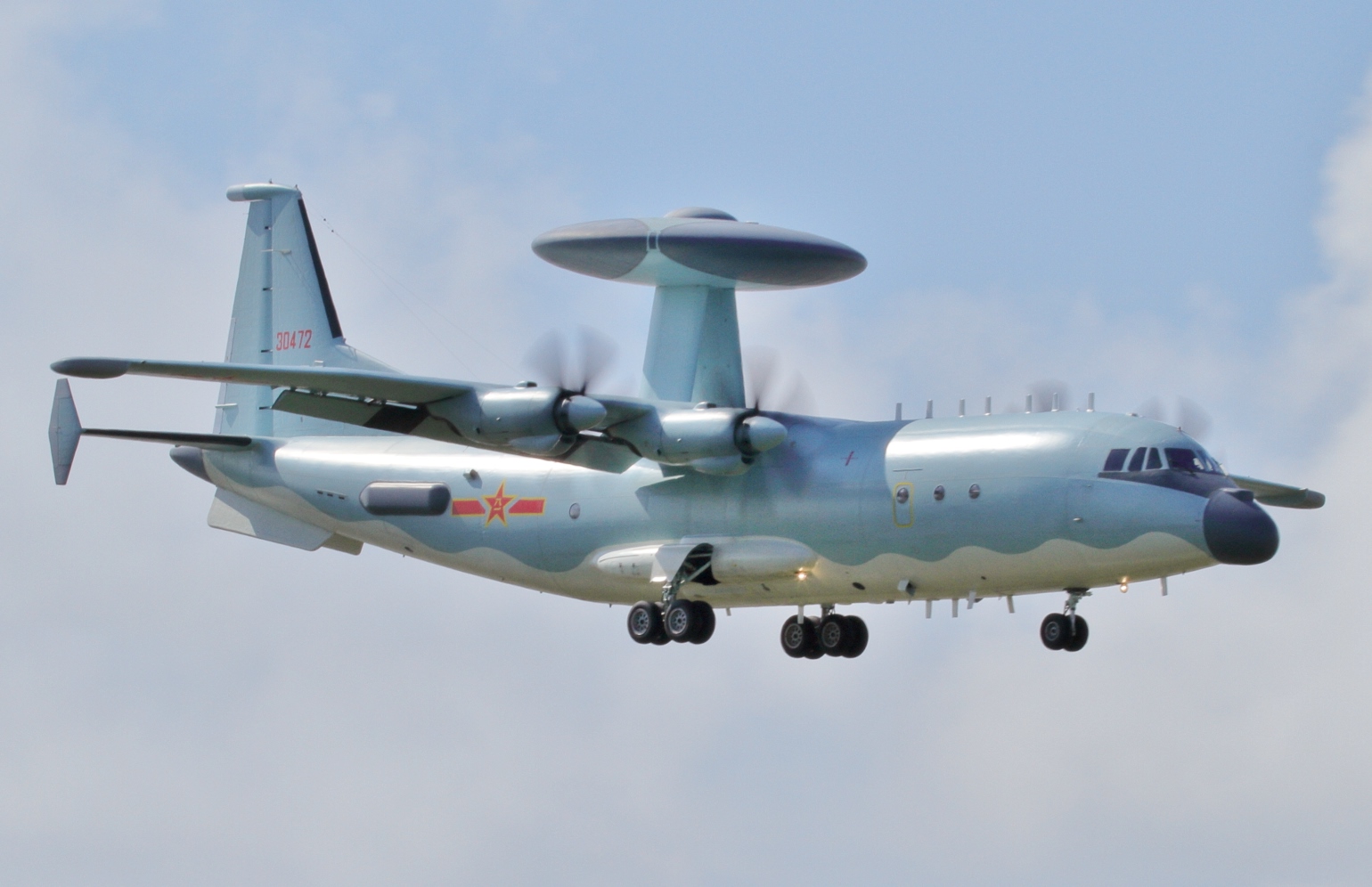
According to Taiwan's defense ministry account cited by Taipei Times, the patrol included J-10 and J-16 fighters and KJ-500 airborne early warning and control aircraft. The J-16 is the important piece. It is a twin-engine, two-seat strike fighter derived from the Su-30 family, commonly assessed to have a combat radius around 1,500 kilometers depending on load and profile, and it can carry air-to-air missiles, anti-ship weapons, and precision strike munitions. In Taiwan scenarios, that makes it less a simple interceptor than a truck for weapons, sensors, and electronic attack support.
The KJ-500 changes the geometry. A fighter package without airborne early warning is a formation. A fighter package with a KJ-500 is a managed air picture. Add the Yinchuan, a Type 052D destroyer with a modern phased-array radar suite and 64 vertical launch cells, and the Xuzhou, a Type 054A frigate with area-surveillance and point-defense roles, and the exercise starts to look like a rehearsal for target custody: find, classify, track, assign, and keep pressure on Taiwan's response cycle.
Anyone who has served on a destroyer knows the hardest part of this work is not seeing a contact once. It is keeping a coherent track while aircraft, ships, jammers, civilian traffic, and political constraints all crowd the screen. That is what the PLA appears to be practicing.
Taiwan Showed Its Own Sensor Chain
Taiwan's image release was also a message about its own kill chain. A Sniper pod picture from an F-16V says Taipei can put an upgraded fighter close enough to identify a J-16 and preserve usable imagery. A Kee Lung-class destroyer watching a Type 052D from Taiwan's southwestern waters says the surface fleet is still in the detection loop. A Kang Ding-class frigate crew monitoring a Type 054A says Taiwan is not relying only on shore-based radars or press statements.
That matters because Taiwan's defense problem is not just intercepting aircraft. It is making sure the chain from detection to decision to engagement remains intact while China tries to overload it. The PLA does not need every J-16 to fire a missile. Some aircraft can force Taiwan to launch combat air patrols, turn on sensors, shift ships, or expose missile batteries. A KJ-500 can help sort which responses are real and which are decoys. Surface ships can add radar coverage and political pressure from another axis.
Taiwan News reported a related incident on May 18 in which intercepted radio calls showed PLA Navy Air Force pilots telling Taiwanese aircraft to keep distance, while nearby US military aircraft broadcast responses asserting their right to operate in international airspace. That small exchange is useful because it shows how crowded the southwestern air picture has become. Chinese aircraft, Taiwanese fighters, US aircraft, and ships are operating close enough that radio discipline and identification procedures are now part of the contest.
The Legislative Timing Was Not Accidental
The release came one day before Taiwan's opposition-controlled legislature was due to review funding for five US-approved weapons systems. That timing is hard to ignore. Taiwan's defense ministry was not only talking to Beijing. It was talking to lawmakers who control money.
The operational case is obvious. A patrol package built around J-16 fighters, KJ-500 airborne early warning, and destroyer-frigate coordination is exactly the kind of pressure that burns through readiness. Taiwan needs aircraft hours, missile reloads, hardened command nodes, coastal anti-ship weapons, electronic warfare resilience, and enough unmanned systems to avoid using a manned platform for every contact. If the legislature treats each weapons package as a procurement debate in isolation, it misses the arithmetic. China is practicing systems. Taiwan cannot answer with single platforms.
This connects to the wider first island chain problem. Taiwan News reported on May 19 that Japan's Ground Component Command and the US Marine Corps' 12th Marine Littoral Regiment began joint drills across Miyako, Ishigaki, and Yonaguni, with Type 88 shore-based anti-ship missile deployment and Scan Eagle 2 drone reconnaissance training. Those islands sit north of Taiwan. The Philippines sits to the south, and President Ferdinand Marcos Jr. said this week that a Taiwan Strait conflict would inevitably affect Manila because nearly 200,000 Filipinos live and work in Taiwan.
Put those pieces together and the map becomes clear. China is rehearsing pressure around Taiwan. Japan and the Marines are rehearsing distributed sensing and anti-ship fire from the Nansei chain. The Philippines is being pulled into evacuation and access planning whether it wants the word "involved" or not.
The Gap Is Endurance
Washington tends to talk about deterrence as if the hard part is signaling resolve. In the Taiwan Strait, the hard part is sustaining a sensor and weapons network under daily stress before any shooting starts. The PLA's 22-aircraft patrol did not prove China can execute a blockade or invasion. It did show a pattern that matters: fighters, airborne warning, destroyers, and frigates operating as a combined pressure tool.
Taiwan's response showed competence. The images were useful, controlled, and specific. But a good sensor picture is not a war plan. If Beijing can make this type of patrol routine, the burden shifts to Taiwan's maintenance crews, pilots, ship crews, missile batteries, and command centers. The United States and Japan can help, but they cannot generate Taiwan's day-to-day endurance from outside the island.
The PLA does not need one dramatic exercise to change the balance. It needs enough ordinary patrols to make Taiwan spend aircraft hours, missile readiness, and political attention every week. That is the math Taipei has to beat.
On May 19, the People's Liberation Army conducted a patrol involving 22 aircraft around Taiwan, with 11 crossing the Taiwan Strait median line. Taiwan's Ministry of National Defense released surveillance images of Chinese military assets, indicating a coordinated air-sea exercise. This operation included J-16 fighters and KJ-500 early warning aircraft, suggesting a rehearsal for maintaining pressure on Taiwan's defense capabilities.
- Taiwan detected 22 PLA aircraft on May 19, with 11 crossing the median line.
- Taiwan released surveillance images of Chinese military assets, indicating operational readiness.
- The exercise involved J-16 fighters, KJ-500 aircraft, and surface combatants, suggesting a coordinated military strategy.
- Taiwan's defense ministry highlighted the importance of maintaining a detection and engagement chain against Chinese pressure.
- The timing of the report coincided with legislative discussions on US military aid to Taiwan.