
China's 49-Aircraft Taiwan Push Exposes a 2026 Readiness Trap
 Marcus Chen
China's 49-Aircraft Taiwan Push Exposes a 2026 Readiness Trap
Forty-nine Chinese military aircraft around Taiwan in a single 24-hour reporting window is not an invasion rehearsal. It is more useful than that: a stress test of how much airpower Taiwan must track, classify, and be ready to engage every day. Taiwan's Ministry of National Defense reported the latest surge on November 5, while Taiwan News described it as the highest daily aircraft count recorded in 2026. The number matters less as a forecast than as a bill for readiness.
The sortie count is the message
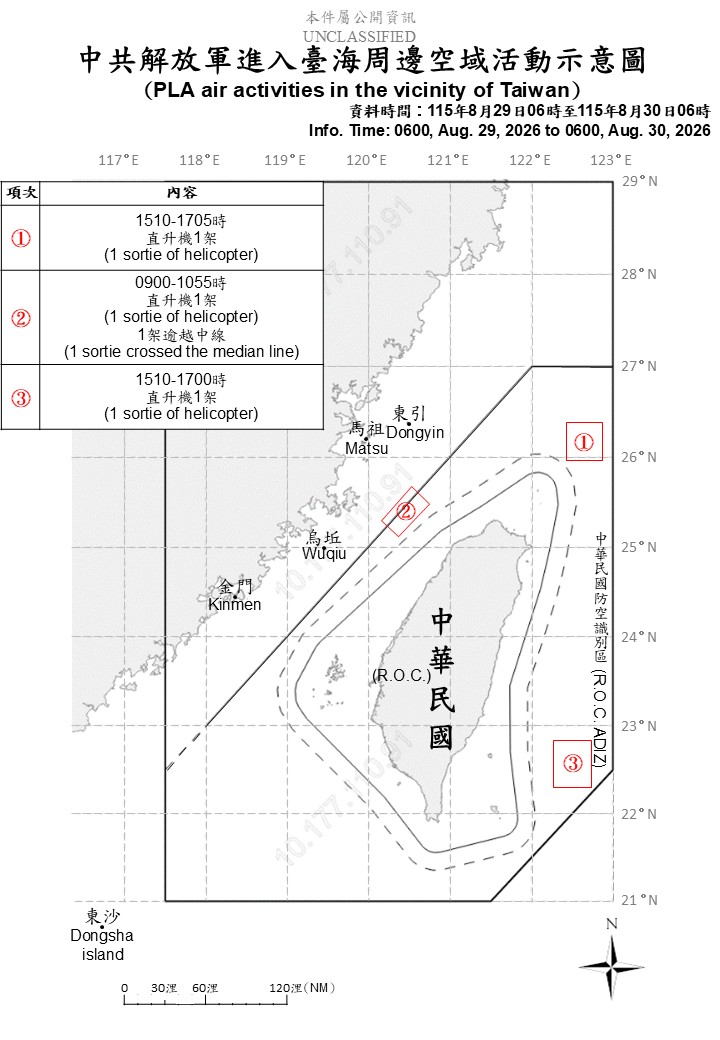
Beijing does not need to fire a missile to create operational pressure. Each large sortie package forces Taiwan to fuse radar tracks, air-defense data, fighter patrols, and maritime surveillance. The People's Liberation Army Air Force and naval aviation can rotate aircraft through the Taiwan Strait, the Bashi Channel, and the approaches east of the island. Even when no aircraft attacks, Taiwan has to decide which tracks deserve an intercept, which can be monitored from the ground, and which may be designed to distract the defense network.
That distinction is critical. A daily count of 49 aircraft is not the same as 49 aircraft simultaneously attacking Taiwan. It is a tempo figure. But tempo is how air forces exhaust an opponent before the first shot. Taiwan's fighters burn fuel and flight hours; ground crews consume maintenance capacity; commanders keep missile batteries and command posts at higher alert. The People's Republic of China gets training and pattern data in return.
Taiwan's fighter fleet cannot answer every sortie
Taiwan operates a mixed fleet built around upgraded F-16Vs, Indigenous Defense Fighters, and Mirage 2000s. Those aircraft are capable, but the force is not infinite. A defensive response to every PLA aircraft would turn a political signal into an expensive exchange of engine hours and maintenance cycles.
The arithmetic is unforgiving. If Taiwan launches even one interceptor for every two tracks, a 49-aircraft day produces roughly 25 additional sorties before accounting for command-and-control aircraft, drones, or ships. If a two-ship patrol is used for each response, the burden rises again. The aircraft that fly today are the aircraft unavailable tomorrow for training, dispersal, or a real contingency. Taiwan's air force can sustain a surge for a short period. The question is whether it can sustain a surge for weeks while preserving enough fighters for a blockade or missile campaign.
This is why Taipei's response cannot be measured only by how many PLA aircraft it shadows. A smarter defense combines passive sensors, mobile air-defense units, hardened command nodes, unmanned systems, and selective fighter launches. The objective is to preserve the force while denying Beijing a clean picture of Taiwanese reactions.
The danger is normalization, not just escalation
CSIS research on Chinese military activity around Taiwan has shown how routine operations have expanded since Beijing began treating the median line as a political boundary it could ignore. The latest spike fits that pattern. It may be connected to training, signaling, or a short-lived operational surge; open reporting does not establish that it is a prelude to an attack.
But normalization creates its own advantage for Beijing. Repeated activity teaches PLA crews the locations and timing of Taiwanese responses. It also makes a future blockade harder to identify. If aircraft, ships, and coast guard forces are already present around the island every week, the transition from pressure to coercion may look like a gradual increase rather than a clear warning.
“The danger is not that every large sortie is the start of a war. The danger is that Taiwan must spend wartime resources to prove that it is not.”
What the United States should measure
Washington should stop treating aircraft counts as a daily scoreboard. The useful questions are operational. How many Taiwanese fighters can remain combat-ready after seven days of elevated activity? How quickly can mobile air-defense units relocate? Can U.S. and Japanese sensors provide enough warning to reduce unnecessary intercepts? Does Taiwan have the spare parts, missile reloads, and runway-repair equipment to keep its dispersed force flying?
The U.S. Indo-Pacific Command will also have to account for the geography. Taiwan's eastern airspace is not a sanctuary if PLA aircraft can operate around the island while long-range missiles and maritime forces threaten the bases that support the defense. Japan's southwestern islands and U.S. facilities in the region therefore matter as sensor and logistics nodes, not simply as political symbols.
The readiness trap is already visible
China's 49-aircraft day does not prove that Beijing has chosen war. It does prove that Beijing can impose a recurring readiness tax without crossing that threshold. Taiwan's answer cannot be to match every sortie with a fighter. It needs a layered system that makes Chinese aircraft count less: passive detection, unmanned surveillance, mobile missiles, hardened bases, and disciplined rules for when to launch.
That is the uncomfortable conclusion. Taiwan may be able to defend against a major attack, but it cannot afford to defend against every daily demonstration as if it were one. If the PLA can force Taipei to spend its best aircraft before the crisis begins, the first phase of a Taiwan contingency will have started long before anyone calls it a blockade.
Sources
- Taiwan Ministry of National Defense, English press releases and PLA activity reports: mnd.gov.tw
- Taiwan News reporting on the November 5, 2026 aircraft surge: taiwannews.com.tw
- CSIS ChinaPower, tracking Chinese military activity around Taiwan: CSIS ChinaPower
- U.S. Department of Defense, Military and Security Developments Involving the People's Republic of China: defense.gov
On November 5, 2026, 49 Chinese military aircraft operated around Taiwan, marking the highest daily count for the year. This surge is not an invasion rehearsal but a stress test for Taiwan's air defense capabilities. The ongoing presence of these aircraft creates operational pressure on Taiwan, forcing it to manage its resources carefully to avoid depletion in the event of a real conflict.
- 49 Chinese military aircraft were reported around Taiwan in a single day.
- This surge is the highest daily aircraft count recorded in 2026.
- Taiwan's air force faces operational pressure without direct attacks from China.
- Normalization of Chinese military activity around Taiwan poses strategic challenges for Taiwan.
- Taiwan must balance its response to avoid depleting its air force resources.