
China's 7,300 km Pacific Missile Test Turns Routine Pressure Into Doctrine
 Marcus Chen
China's 7,300 km Pacific Missile Test Turns Routine Pressure Into Doctrine
The number that matters is 7,300 kilometers. According to Channel NewsAsia's July 6 reporting, China launched a long-range ballistic missile from a nuclear-powered submarine into the Pacific and sent it roughly that distance before it landed in designated international waters. Beijing called it routine training. Australia, New Zealand and Japan did not.
That test would be important by itself. It is more important because it did not happen by itself. In the same two-week window, China and Russia flew bombers near Japan, Chinese coast guard ships operated east of Taiwan, Chinese and Russian naval forces opened Joint Sea-2026 near Qingdao, and the People's Liberation Army Navy kept using the straits around Japan as transit lanes into the wider Pacific. CNA described the pattern on Aug. 3 as an "extraordinary confluence" of Chinese military activity.
That is the wrong phrase if it implies surprise. This is exactly what a maturing Western Pacific posture looks like: not one crisis, but a stack of separate operations that make Chinese presence beyond the First Island Chain feel normal.
The Missile Was a Distance Demonstration
The submarine-launched missile test was the cleanest signal to Washington. A 7,300 km shot into the South Pacific is not about Taiwan's beaches or a Philippine reef. It is about showing that China's sea-based nuclear force can push effects deep into the ocean space where US allies assume geography gives them warning time and room to maneuver.
CNA reported that the missile carried a simulated warhead and that China notified regional governments shortly before the launch. New Zealand said it was informed within hours. Australia called the test destabilizing in the context of China's rapid military buildup. Japan said it expressed grave concern about increased Chinese military activity.
The operational point is simple. If the People's Liberation Army Navy can send a nuclear-powered submarine far enough into the Pacific to fire a long-range missile, the United States and its allies must assume a larger undersea search problem. Anti-submarine warfare is not a press release capability. It is aircraft hours, sonobuoy stocks, surface ship time, undersea sensors, trained crews and maintenance cycles.
Anyone who has served on a destroyer knows the difference between detecting a submarine once and holding contact long enough to do something about it. The missile test was a reminder that the second problem is the hard one.
The Coast Guard Is Building a Blockade Record
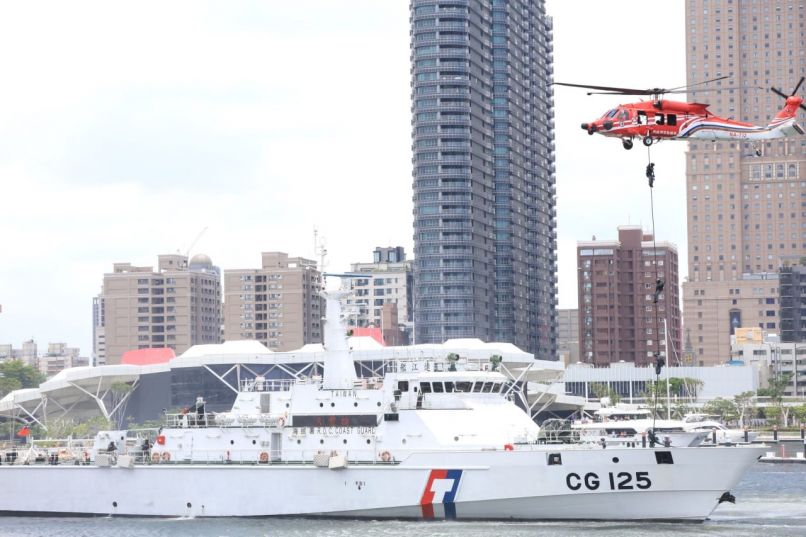
The more immediate problem sits east of Taiwan. On July 4, CNA reported that China had launched another coast guard patrol east of the island, the second such patrol in roughly a month. Taiwan said two Chinese ships were 54 nautical miles east of Hualien, outside restricted waters, while Taiwanese coast guard ships shadowed them.
Hualien is not a random point on the map. It is home to a major air base and faces the Pacific side of Taiwan - the side outside the familiar Taiwan Strait frame. In a blockade scenario, that eastern maritime space would matter because it is where Taiwan would try to keep access to airfields, ports, replenishment routes and potential allied support.
Beijing's coast guard language is legal rather than naval: "law enforcement patrols," "jurisdictional waters," "rights and interests." But the military effect is to create a paper trail and a presence pattern. If Chinese coast guard ships appear there repeatedly in peacetime, then their wartime presence looks less like an abrupt escalation and more like an expansion of an existing patrol line.
That matters because coast guard ships force Taiwan and its partners into a bad choice. Treat them as law enforcement vessels, and Beijing gains room to normalize pressure. Treat them as naval auxiliaries, and Taipei can be accused of militarizing the encounter. China does not need to win a legal argument at sea. It needs to make the next patrol less exceptional than the last one.
Joint Sea-2026 Adds the Outer Layer
Joint Sea-2026 gives this pattern a second axis. Reporting from Defence Security Asia says Russian Pacific Fleet assets arrived at Qingdao for drills scheduled from July 6 to July 13, including the Slava-class cruiser Varyag, the frigate Surovy, the Improved Kilo-class submarine Ufa and the rescue ship Igor Belousov. China contributed Type 052D destroyers Kaifeng and Anshan, the Type 054A frigate Wuhu, the Type 903 replenishment ship Kekexili Lake, a rescue vessel, one submarine, helicopters and embarked marines.
That is not a battle fleet large enough to defeat the US Navy. It is large enough to rehearse the pieces that complicate US and Japanese planning: air defense coordination, anti-submarine warfare, replenishment, submarine support and combined command procedures. The replenishment ship may be the most revealing hull in the group. Missiles get attention, but endurance decides whether a patrol becomes a presence.
China and Russia have run Joint Sea drills for years, so the exercise should not be inflated into a new alliance. But recurring drills reduce friction. They teach ships how to communicate, how to avoid getting in each other's way, how to divide a search area, and how to force allied surveillance assets to watch more than one track at a time.
For Japan, the geography is unforgiving. A bomber patrol through the Miyako Strait, naval transits around the southwest islands, coast guard pressure east of Taiwan and a joint China-Russia patrol into the Pacific all point at the same operational problem. Tokyo has to defend the home islands, keep the Ryukyus open, support a Taiwan contingency, and watch Russian activity to the north. That is a four-front planning burden for a force that still depends heavily on US enablers.
Washington Should Stop Waiting for the Crisis
The US response to this pattern cannot be another episodic freedom of navigation transit or carrier appearance. Those have value, but they answer theater signaling with theater signaling. China's advantage here is cadence.
If there is a Chinese coast guard task group east of Taiwan every month, then the requirement is persistent surveillance east of Taiwan every month. If Chinese submarines are testing long-range missile operations into the Pacific, then allied anti-submarine warfare has to be resourced as a standing campaign, not a surge plan. If China and Russia are practicing combined patrols after annual exercises, then Japan, Australia and the United States need to practice the dull parts of coalition maritime command just as often.
The numbers do not favor complacency. Taiwan's east coast is roughly 1,500 nautical miles from Guam and more than 4,000 nautical miles from Hawaii. Surface ships burn time crossing that distance. Patrol aircraft need bases, tanker support and maintenance. Submarines are scarce. Unmanned systems may help, but they do not erase geography.
This is why the 7,300 km missile shot matters. It was not only a nuclear signaling event. It was part of a wider demonstration that China can press multiple parts of the Western Pacific problem at once: nuclear reach, coast guard lawfare, naval transit, bomber patrols and partner operations with Russia.
There is still no evidence that every move was centrally coordinated into one campaign. That may be beside the point. Operationally, separate lines of effort can still produce one effect if they converge on the same map.
For the United States and its allies, the uncomfortable conclusion is that China's Western Pacific pressure is becoming less event-driven and more procedural. A crisis can be deterred, de-escalated or managed. A procedure has to be outworked.
That is the harder fight. Beijing does not need every patrol to be dramatic. It needs enough of them to make the old baseline disappear.
China launched a long-range ballistic missile from a nuclear-powered submarine into the Pacific, reaching 7,300 km, as part of routine training. Concurrently, Chinese coast guard ships patrolled east of Taiwan, and joint naval exercises with Russia were conducted near Qingdao. This series of military activities reflects a growing Chinese military presence in the Western Pacific, raising concerns among regional allies.
- China launched a long-range ballistic missile from a submarine into the Pacific, reaching 7,300 km.
- Chinese coast guard ships conducted patrols east of Taiwan.
- Joint naval exercises, Joint Sea-2026, involved both Chinese and Russian naval forces.
- Australia, New Zealand, and Japan expressed concerns over China's military activities.
- The missile test signals China's capability to project power deep into the Pacific.