
China's 7,300km SLBM Test Makes Pacific Bastions Matter in 2026
 Marcus Chen
China's 7,300km SLBM Test Makes Pacific Bastions Matter in 2026
The number that matters is 7,300km. That is how far China's July 6 submarine-launched ballistic missile flew before it landed in international waters in the South Pacific, according to Channel NewsAsia's reporting on the test. For a navy that used to be judged mainly by what it could do inside the First Island Chain, that flight path is a blunt operational statement: Beijing is now practicing deterrence at Pacific scale.
The launch did not happen in isolation. Over barely two weeks, China conducted a joint bomber patrol with Russia near Japan, sent naval forces into Joint Sea-2026 from Qingdao toward a follow-on Pacific patrol, kept China Coast Guard ships active east of Taiwan, moved People's Liberation Army Navy ships through key straits near Japan, and then fired a simulated-warhead missile from a nuclear-powered submarine into the South Pacific. CNA called it an extraordinary confluence. I would put it less elegantly: several Chinese services are now training in ways that make old American assumptions about uncontested access look dated.
The Missile Was the Hardest Signal
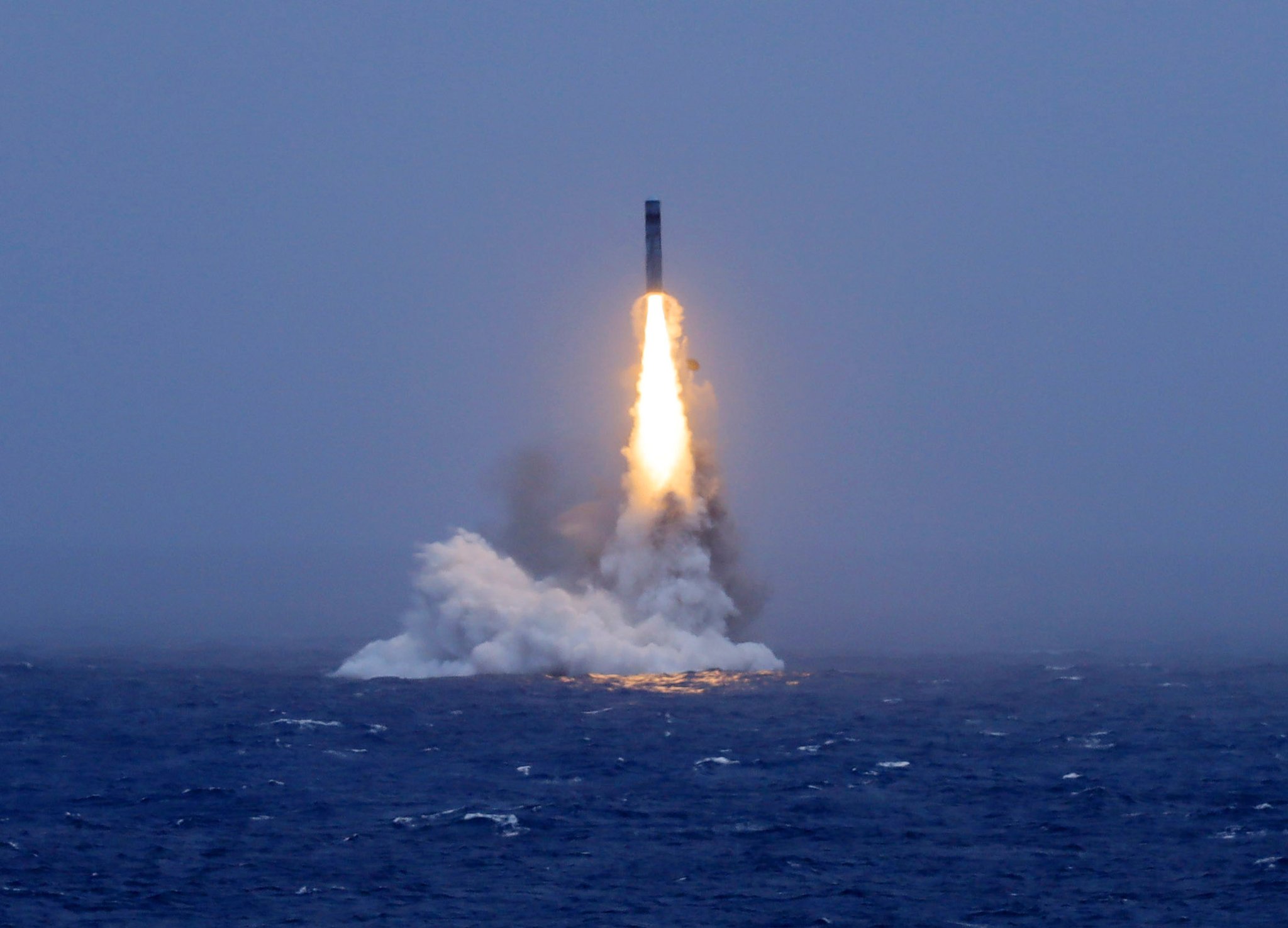
China has not publicly identified the missile. Analysts cited by CNA assessed that it was most likely a JL-2 submarine-launched ballistic missile, normally credited with a range of roughly 8,000km, rather than the newer JL-3, which exceeds 10,000km. Either way, the important point is not the label on the tube. It is the combination of launch platform, distance and geography.
A submarine-launched ballistic missile is a second-strike weapon. It exists so that a state can absorb a nuclear blow and still retaliate. China's land-based missile force has been visible for years. Its sea-based leg has been less convincing because nuclear-powered ballistic missile submarines are only useful if they can survive, communicate, and launch under wartime stress. A public long-range shot into the Pacific is Beijing saying that the sea leg is no longer a briefing slide.
The test also matters because of where it ended. The missile reportedly traveled about 7,300km and landed in international waters in the South Pacific. CNA reported that CSIS assessed the missile likely overflew parts of the Philippines and landed inside the South Pacific Nuclear Free Zone. The warhead was simulated, but Pacific governments do not need a nuclear detonation to understand the message. A Chinese SSBN operating from relatively protected waters can put a ballistic arc over their region without asking anyone's permission.
Why 7,300km Changes the Map
Distance is not strategy by itself, but distance changes what strategy can risk. From waters near China's coast, an 8,000km-class JL-2 gives Beijing reach across much of the Pacific. A 10,000km-plus JL-3 would extend that reach further and reduce the need for Chinese ballistic missile submarines to break into more exposed patrol boxes. That is the core bastion logic: if the submarine can hide closer to home, the opponent must come closer to kill it.
For the United States and its allies, that pulls anti-submarine warfare back into the center of Indo-Pacific planning. Surface strike, long-range fires, and expeditionary basing get more attention because they are visible. But anyone who has served on a destroyer knows the undersea problem is less theatrical and more unforgiving. You either maintain contact, or you do not. There is no partial credit when a ballistic missile submarine disappears under bad water conditions, noise, and distance.
This is where the recent Chinese activity east of Taiwan becomes more than a gray-zone policing story. Isaac Kardon told CNA that the China Coast Guard patrols east of Taiwan build a jurisdictional record on the Pacific side of the island. Ben Brand argued that a continuous CCG task group there would indicate more assertive law-enforcement action to come. In a blockade scenario, the east of Taiwan is not rear-area geography. It is the side from which outside forces would try to sustain Taiwan and the side from which China would want to complicate intervention.
Russia Helps the Signaling But Not the Math
The China-Russia bomber patrol over the Sea of Japan, East China Sea and western Pacific on June 27, followed by Joint Sea-2026 in Qingdao and a planned Pacific patrol, adds political weight. It tells Japan and the United States that a regional crisis could generate pressure from multiple directions. It also forces Tokyo to think in two arcs at once: Taiwan and the southwest islands to the south, Russian-linked activity to the north.
But we should not overstate Russian military value here. The Russian Navy can still complicate the picture, especially with submarines and long-range aviation, but it is not the force that is changing the western Pacific balance. China is. The useful thing Russia provides Beijing is a recurring exercise framework and a way to normalize combined pressure. The hard capability growth is Chinese shipbuilding, Chinese missiles, Chinese coast guard persistence, and Chinese nuclear command-and-control confidence.
CSIS's 2026 China Power review of 2025 activity showed the trend line clearly. China recorded higher military activity around Taiwan, a record 163 PLA operations in the South China Sea, and several unprecedented far-seas activities beyond the First Island Chain, including operations around Australia and New Zealand and simultaneous carrier operations in the Pacific. The July 2026 cluster is not a one-off spike. It is a continuation of a tempo that has already moved beyond demonstration.
The US Response Has to Be Operational
Washington's first instinct will be to condemn the launch notification problem and reassure allies. Both are necessary. CNA reported that the United States said the few hours of warning fell considerably short of standards adopted by other P5 nuclear states. Pacific Island leaders are also considering a strong joint statement. Diplomacy matters, especially when ballistic missile tests cross near or over politically sensitive regions.
But the operational answer is harder. The US Navy and allied forces need more persistent undersea surveillance, more maritime patrol aircraft availability, more distributed acoustic sensing, and more repairable forward bases. They also need to stop pretending that every concept document equals combat capacity. If Chinese submarines can operate from protected bastions, then allied anti-submarine warfare has to be persistent enough to pressure the bastion, not just patrol open ocean after the submarine has already escaped.
That means Japan's southwest islands, Guam, northern Australia, and Philippine access points all matter, but not as slogans. They need fuel, magazines, hardened shelters, runway repair, mobile sensors, and command networks that can survive missile attack. A destroyer cannot do sea control if its helicopter detachment lacks parts. A P-8 cannot sustain search patterns if its base is closed by craters. A smart seabed sensor is useless if the data link is the first thing cut.
A Secure China Is Not a Calm China
The uncomfortable part is that a more survivable Chinese nuclear deterrent may make conventional coercion easier, not harder. If Beijing believes its sea-based second-strike force can ride out a crisis, it may feel more confident applying pressure below the nuclear threshold around Taiwan, Japan, and the Philippines. That does not mean China is looking for war tomorrow. It means the ceiling above conventional operations is getting thicker.
The July 6 launch was not just a nuclear modernization data point. Paired with coast guard operations east of Taiwan, China-Russia patrols, and far-seas naval movement, it shows Beijing knitting together the political and operational map of the Pacific. The United States still has better submarines, better undersea experience, and deeper alliance networks. But those advantages are not self-executing.
One test is a signal. A repeated pattern is a posture. China is trying to make the Pacific get used to both.
China conducted a submarine-launched ballistic missile test on July 6, 2026, in the South Pacific, demonstrating a range of 7,300km. The missile likely overflew parts of the Philippines and indicates a shift in China's military strategy towards enhanced deterrence capabilities. This test coincided with joint military activities with Russia, highlighting a growing military presence in the region.
- China tested a submarine-launched ballistic missile with a range of 7,300km on July 6, 2026.
- The missile likely overflew parts of the Philippines and landed in the South Pacific Nuclear Free Zone.
- China conducted joint military activities with Russia, including bomber patrols and naval exercises.
- The test signifies a shift in China's military strategy towards deterrence at a Pacific scale.
- The operational capabilities of China's submarine-launched ballistic missile force are being enhanced.