
China's Coast Guard Is Turning East of Taiwan Into a Blockade Laboratory
 Marcus Chen
China's Coast Guard Is Turning East of Taiwan Into a Blockade Laboratory
China does not need to close the Taiwan Strait to rehearse a blockade. It needs to keep a coast guard task group east of Taiwan long enough to make the island's Pacific approaches feel administered rather than international. That is the important development in the latest cluster of Chinese military activity.
Channel NewsAsia reports that Chinese Coast Guard vessels have maintained what Beijing calls regular law-enforcement patrols east of Taiwan since late June, while the People's Liberation Army Navy has continued moving through the straits around Japan. In the same period, China and Russia flew a bomber patrol through the Sea of Japan, the East China Sea and the western Pacific, held Joint Sea-2026, and conducted a rare submarine-launched ballistic-missile test that traveled roughly 7,300 kilometers into the South Pacific. These are not one centrally controlled operation. They are separate activities with a common operational effect: more Chinese military and quasi-military presence beyond the First Island Chain.
The Coast Guard Is the Useful Instrument
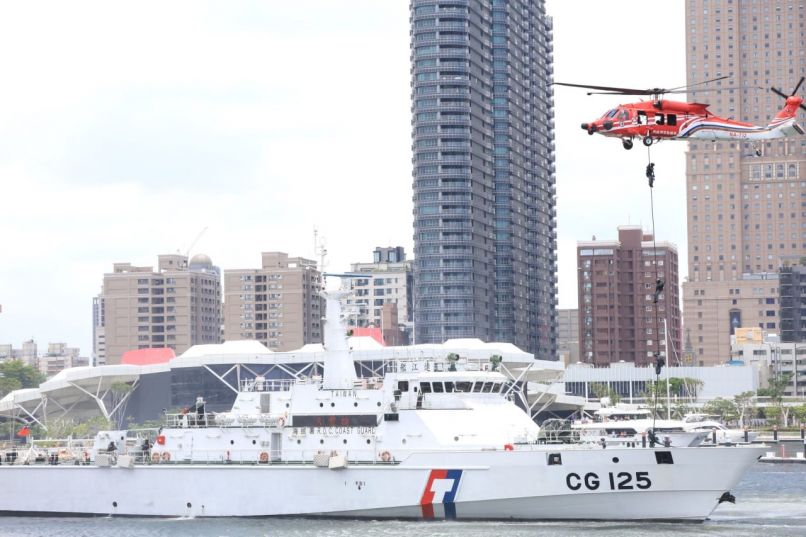
A navy deployment east of Taiwan would be read immediately as a military crisis. A coast guard patrol gives Beijing more room to control the tempo. The China Coast Guard can describe its presence as law enforcement, approach commercial or fishing traffic, and force Taiwan, Japan, and the United States to decide how much risk they will accept when responding. That is not a legal settlement of maritime jurisdiction. It is a practical test of whether a claim can be made operational.
Isaac Kardon of Johns Hopkins told CNA that sustained coast guard operations would be the clearest indicator of whether the current activity becomes a more assertive pattern. That distinction matters. A single patrol produces headlines. A task group that returns on a schedule creates watchstanding requirements, rules of engagement, fuel demand, and an accumulating record of presence. In naval terms, cadence is capability.
What the Numbers Actually Mean
The missile test is the dramatic number: approximately 7,300 kilometers from a nuclear-powered submarine into the South Pacific. It demonstrates a sea-based nuclear deterrent and forces US planners to consider launch geometry beyond the immediate Taiwan scenario. But it does not by itself close a sea lane, escort a boarding team, or maintain pressure on Taiwan.
The more relevant calculation is endurance. A coast guard group operating east of Taiwan needs ships that can remain on station, refuel, rotate crews, and communicate with aircraft and naval units. It needs intelligence on shipping and Taiwanese patrol patterns. It also needs a political script that keeps the operation below the threshold at which an American or Japanese response becomes automatic. The patrol is valuable precisely because it combines low-end presence with high-end backing.
China's June 27 bomber patrol with Russia and the follow-on naval activity add that backing. The Russian ships and Chinese Type 052D destroyers involved in Joint Sea-2026 do not create a combined fleet capable of defeating the US Navy. They do, however, complicate surveillance allocation and show that Beijing can use several axes at once. Japan must watch the Miyako Strait and its southwest islands. Taiwan must watch the waters east of the island. Washington must track the nuclear signal, surface movements, and the possibility that a coercive operation would be distributed across agencies rather than announced as an invasion.
Why This Is Not Yet a Blockade
There is a danger in calling every Chinese patrol a blockade rehearsal. The public evidence does not show a permanent task group, a declared exclusion zone, or an integrated plan linking the Coast Guard, PLA Navy, missile forces, and maritime militia under one command. CNA's sources explicitly caution that the recent moves arose from different services and planning cycles. That caveat should be preserved.
But uncertainty does not make the activity irrelevant. A blockade is not created on the first day of a war. It is built through procedures: which ships challenge traffic, who issues warnings, how fuel and food move, how Taiwan responds, and how foreign navies decide whether to escort commercial vessels. Repeated peacetime patrols allow China to test those procedures without paying the price of a formal blockade.
For Taiwan, the immediate problem is not that the Coast Guard can defeat its navy. It is that a law-enforcement formation can create a decision trap. If Taipei ignores it, Beijing gains a precedent. If Taipei confronts it, China can frame the encounter as a maritime policing dispute. If the United States escorts every vessel, it converts a gray-zone patrol into a military commitment. The instrument is weaker than a destroyer but politically harder to remove.
The Test Washington Should Watch
The next test is persistence, not spectacle. Does a China Coast Guard group remain east of Taiwan continuously? Do patrols become predictable enough to establish a rotation? Do Chinese naval and air units provide overwatch? Do Beijing's notices to mariners, radio calls, or claimed enforcement actions begin to describe the area as one where China exercises routine authority?
Those indicators will tell us more than another one-off exercise. The United States and its allies should measure the response problem in days on station, ships available, replenishment cycles, and escalation decisions—not in the number of press releases issued after each patrol. Taiwan also needs a standing playbook for shadowing and documenting coast guard activity without allowing every encounter to become a crisis.
China's Pacific push is often described through the image of a blue-water navy. The harder problem is more modest: a coast guard that can stay, return, and claim to be doing something ordinary. If Beijing establishes that rhythm east of Taiwan, it will have built the first layer of a blockade without declaring one. The real warning is not the missile's range. It is the patrol's persistence.
Sources
Chinese Coast Guard vessels have been conducting regular law-enforcement patrols east of Taiwan since late June 2023, while the People's Liberation Army Navy has been active in the region. Concurrently, China and Russia executed a bomber patrol and naval exercises, alongside a significant missile test demonstrating a range of 7,300 kilometers. This ongoing military presence aims to assert control over the area without formally declaring a blockade.
- Chinese Coast Guard has maintained patrols east of Taiwan since late June 2023.
- China and Russia conducted a bomber patrol and naval exercises in the region.
- A missile test demonstrated a range of approximately 7,300 kilometers.
- The Coast Guard's presence is described as law enforcement, complicating responses from Taiwan and the U.S.
- The report highlights the importance of sustained operations rather than one-off exercises.