

At 10 am EST today, the U.S. Navy began enforcing a blockade of all maritime traffic entering and departing Iranian ports. The announced purpose is simple enough: deny Tehran the revenue it has been extracting from a Strait it has controlled since February 28. That is the Iran story.
There is another story running underneath it.
Follow the money — specifically, the yuan — and the blockade’s real strategic audience emerges. It isn’t Tehran. It’s Beijing.
The Yuan Trail
CENTCOM’s enforcement language was precise: any vessel entering or departing Iranian ports, regardless of flag or nationality, is subject to interdiction.
That language has a specific implication. Chinese-flagged and Chinese-linked ships have been among the primary customers of Iran’s toll system throughout this war. Lloyd’s List Intelligence, which provides maritime data intelligence, documented at least two vessels paying passage fees in Chinese yuan.
China has continued buying Iranian oil throughout Operation Epic Fury, making Beijing not merely a bystander to Iran’s Strait strategy but a direct financial participant in it.
President Donald Trump made the exposure explicit. “If China does that,” he said Sunday, referring to Chinese support for Iran, “China’s going to have big problems.” That is not background noise. It is a named threat, issued while the Navy was already moving.
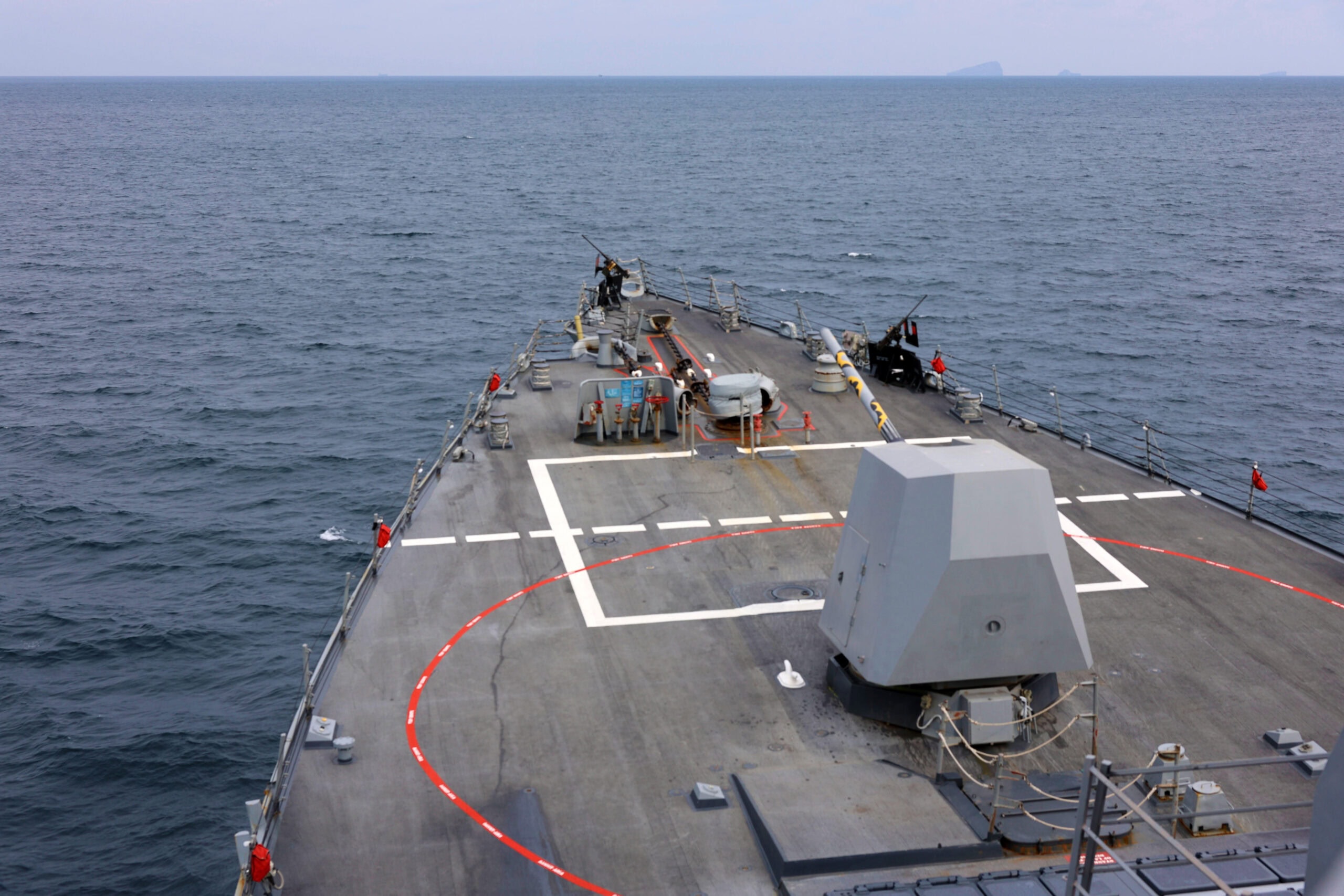
(Dec. 5, 2025) The Arleigh Burke-class guided-missile destroyer USS Roosevelt (DDG 80) transits the Strait of Hormuz in the U.S. Central Command (CENTCOM) area of responsibility. Roosevelt is deployed to the U.S. 5th Fleet area of operations to support maritime security and stability in the CENTCOM area of responsibility. (U.S. Navy photo by Mass Communication Specialist 1st Class Indra Beaufort)
The blockade is partly a message to Tehran. It is also a quiet ultimatum delivered to Beijing. What Washington has not answered — publicly, and perhaps privately — is what it expects China to do with it.
An Impossible Choice
Beijing now faces a genuine dilemma, and neither horn is comfortable.
If China instructs its vessels to comply, stand down from the toll lanes, and accept the blockade’s terms, it concedes something significant: that American naval power can shape the operating environment for Chinese-linked shipping in the Persian Gulf. That is not a small concession.
The Strait carries a substantial share of China’s energy imports. Accepting U.S. interdiction authority over that corridor — even implicitly, even temporarily — sets a precedent Beijing has spent two decades working to foreclose. It also sends a signal to every state watching from the outside: when American pressure lands, China moves. That undermines the credibility of the alternative security architecture Beijing has been assembling across Eurasia and the Gulf.
The other horn is worse. If China defies the blockade — signals to its operators that they may continue transiting, paying tolls, and daring the U.S. Navy to act — Washington faces an escalation decision it was not planning to make. Trump is scheduled to meet Xi next month in China.
A confrontation at sea in the Strait of Hormuz, even a contained one, detonates that diplomatic calendar. It transforms a regional war into something entirely different.
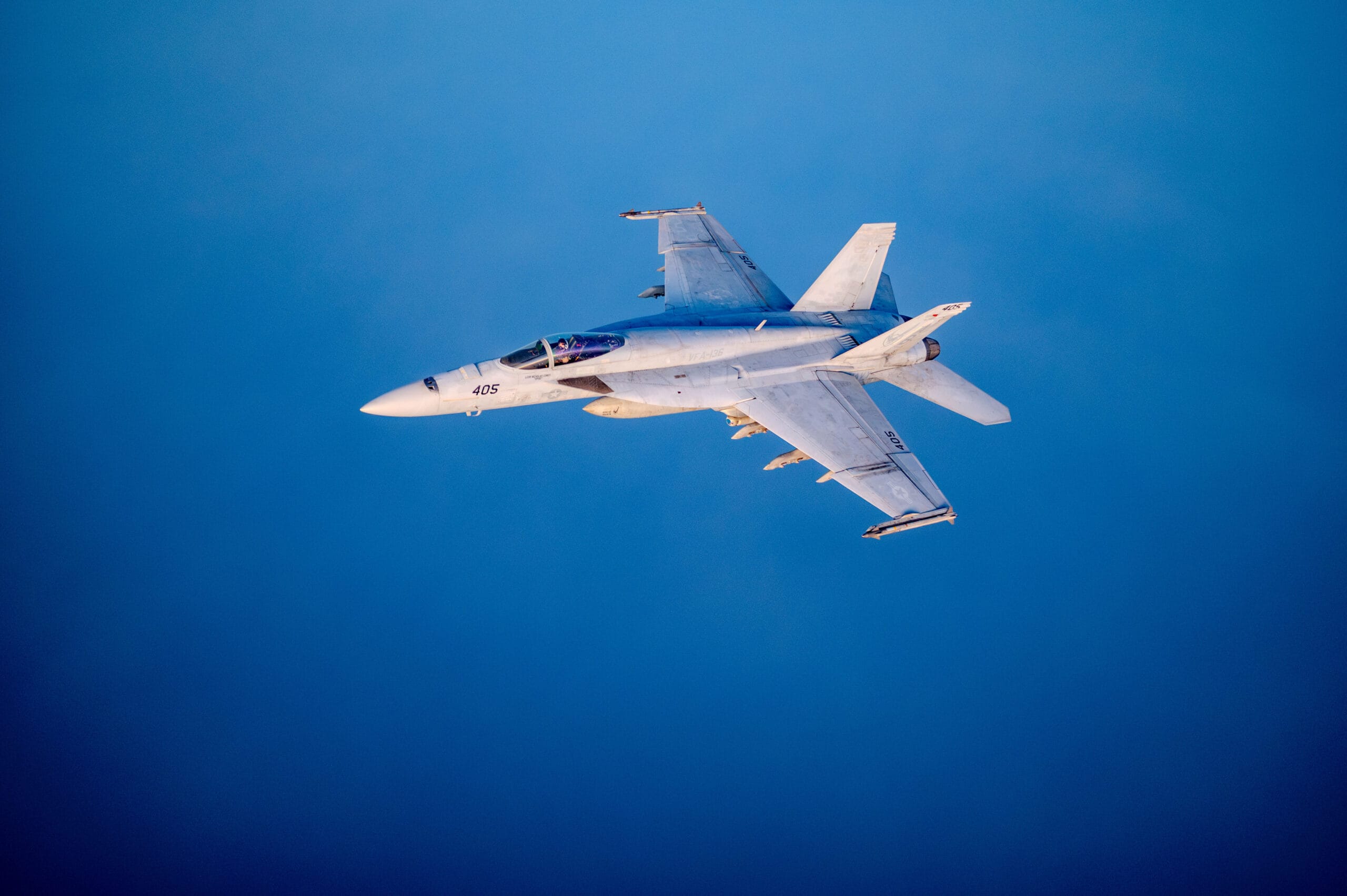
A U.S. Navy F/A-18 Super Hornet, assigned to the Harry S. Truman Carrier Strike Group, flies a mission over the U.S. Central Command area of responsibility, April 8, 2025. The HSTCSG is responsible for patrolling approximately 2.5 million square miles of ocean and includes the Arabian Gulf, Gulf of Oman, Red Sea, parts of the Indian Ocean and three critical choke points at the Strait of Hormuz, Suez Canal and Strait of Bab al-Mandeb. (U.S. Air Force photo by Staff Sgt. Jackson Manske)
The U.S. military is not well-positioned to absorb that transformation. Forty-four days into Operation Epic Fury, precision munitions have been spent at a rate that has drawn serious attention. THAAD batteries are stressed. Two carrier strike groups are committed to the theater. A simultaneous Chinese challenge in the Gulf is the last thing any war planner wants to manage at the same time.
Neither option is acceptable to Beijing. But the blockade forces a choice anyway. And China’s response to a forced choice is itself revealing. Washington should have a clear picture of what it wants that to look like.
The public record suggests it doesn’t.
The Gap in the Logic
Coercive tools work when the side applying pressure has thought through where it leads — what it offers the target if it complies, what it does if it doesn’t, and how it manages the space in between.
Against Iran, that logic is at least clear: accept nuclear limits, get a ceasefire that holds.
Against China, the logic is not yet visible. The blockade creates leverage going into the Trump-Xi summit. Unmanaged leverage, though, has a way of becoming a liability rather than an asset.
There is a longer argument underneath all of this. Throughout the Iran war, Beijing has gained strategic ground without firing a shot. It has watched American munitions stocks deplete, alliance credibility strain under $100 oil, and Washington’s strategic attention pull hard away from the Pacific.
The war has been a free education in U.S. operational limits, delivered at no cost to China. The blockade, if poorly managed, pushes that problem further — adding a potential Gulf confrontation to a situation Washington is already stretched to handle.
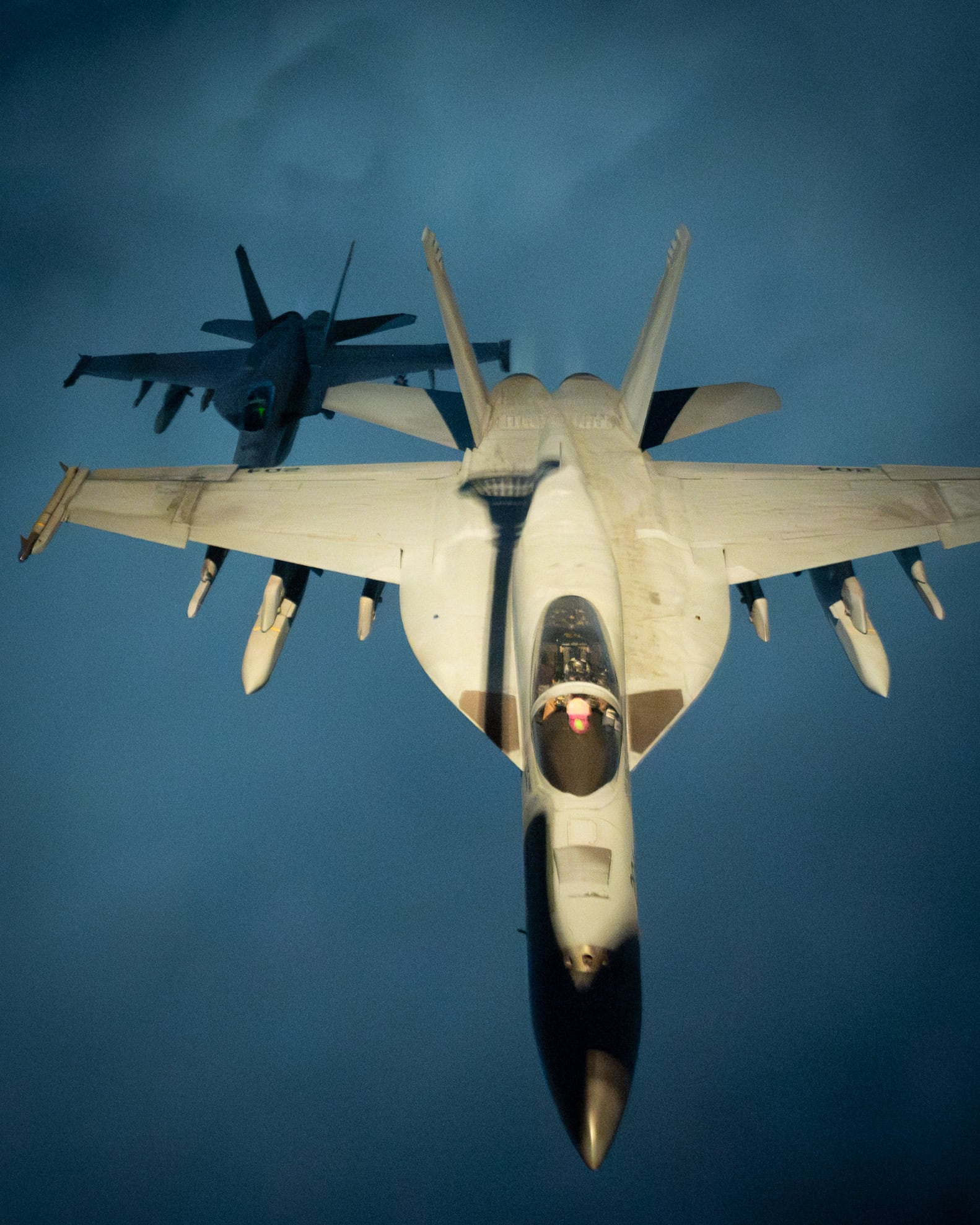
Two U.S. Navy F/A-18 Super Hornets fly in formation over the U.S. Central Command area of responsibility, April 5, 2025. The Super Hornets are assigned to the Truman Carrier Strike Group, which is responsible for patrolling approximately 2.5 million square miles of water space and includes the Arabian Gulf, Gulf of Oman, Red Sea, parts of the Indian Ocean and three critical choke points at the Strait of Hormuz, Suez Canal and Strait of Bab al-Mandeb (U.S. Air Force photo by Staff Sgt. Gerald R. Willis)
The Question That Remains
The Strait of Hormuz has never been only about oil. It is about who writes the rules of the maritime commons — who has the authority to say what moves and what doesn’t. The United States is now asserting that it holds that authority.
The naval power to back the assertion is real.
The blockade is real.
What isn’t clear is whether Washington has reckoned with what it is asking Beijing to accept, or what it is prepared to do if Beijing declines.
That question will outlast the blockade. However, this ends — through renewed negotiations, Iranian capitulation, or something murkier — the precedent being set today about American naval authority over a waterway China depends on will not disappear.
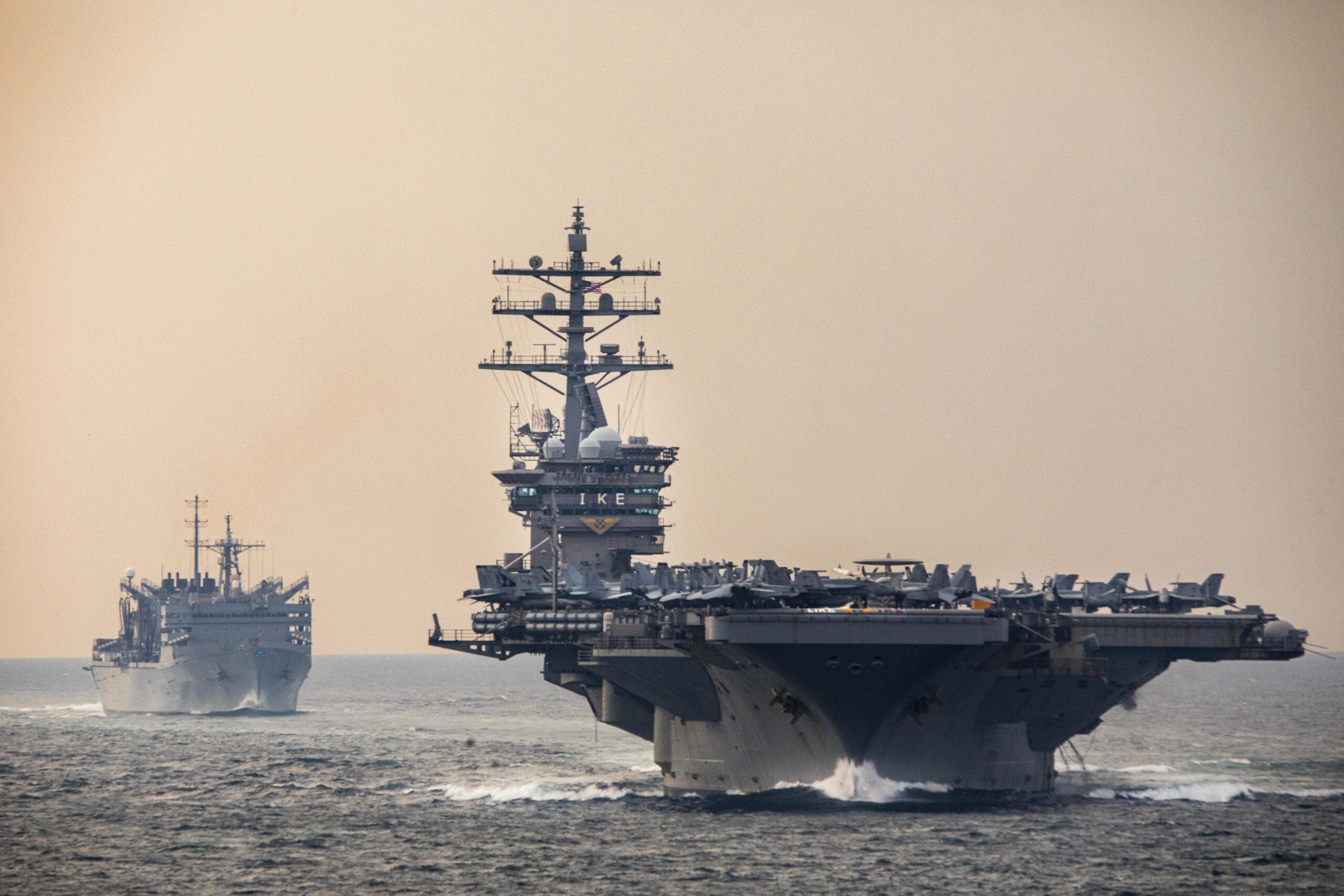
Components of the Dwight D. Eisenhower Strike Group (IKECSG) and the fast combat support ship USNS Supply (T-AOE 6) transit the Strait of Hormuz, Dec 14, 2023. As part of the Dwight D. Eisenhower Carrier Strike Group (IKECSG), the Philippine Sea is deployed to the U.S. 5th Fleet area of operations to help ensure maritime security and stability in the Middle East region. (U.S. Navy photo by Mass Communication Specialist 2nd Class Keith Nowak)
Beijing’s answer to that precedent is what will matter most when this war is finally assessed.
It just hasn’t arrived yet.
About the Author: Dr. Andrew Latham
Andrew Latham is a non-resident fellow at Defense Priorities and a professor of international relations and political theory at Macalester College in Saint Paul, MN. You can follow him on X: @aakatham.