
China's Next Aircraft Carrier May Reach 339 Meters: PLA's Long-Distance Combat Challenges Shift from Hull to Logistics
 Li Minghui
China's Next Aircraft Carrier May Reach 339 Meters, PLA's Long-Distance Operations Shift from Hull to Supply
On September 4, satellite images captured new signs of construction on the bow of China's new aircraft carrier being built at Dalian Shipyard. The South China Morning Post, citing Jane's Information, reported that the ship's final length could reach 336 to 339 meters, about 20 meters longer than the already commissioned Fujian ship, and slightly longer than the U.S. Ford-class aircraft carrier, which has a hull length of approximately 333 meters. The numbers themselves are striking, but what is truly worth analyzing is whether the Chinese aircraft carrier fleet is beginning to prepare structurally for long-term deployments away from the near seas.
What Does an Enlarged Hull Mean?
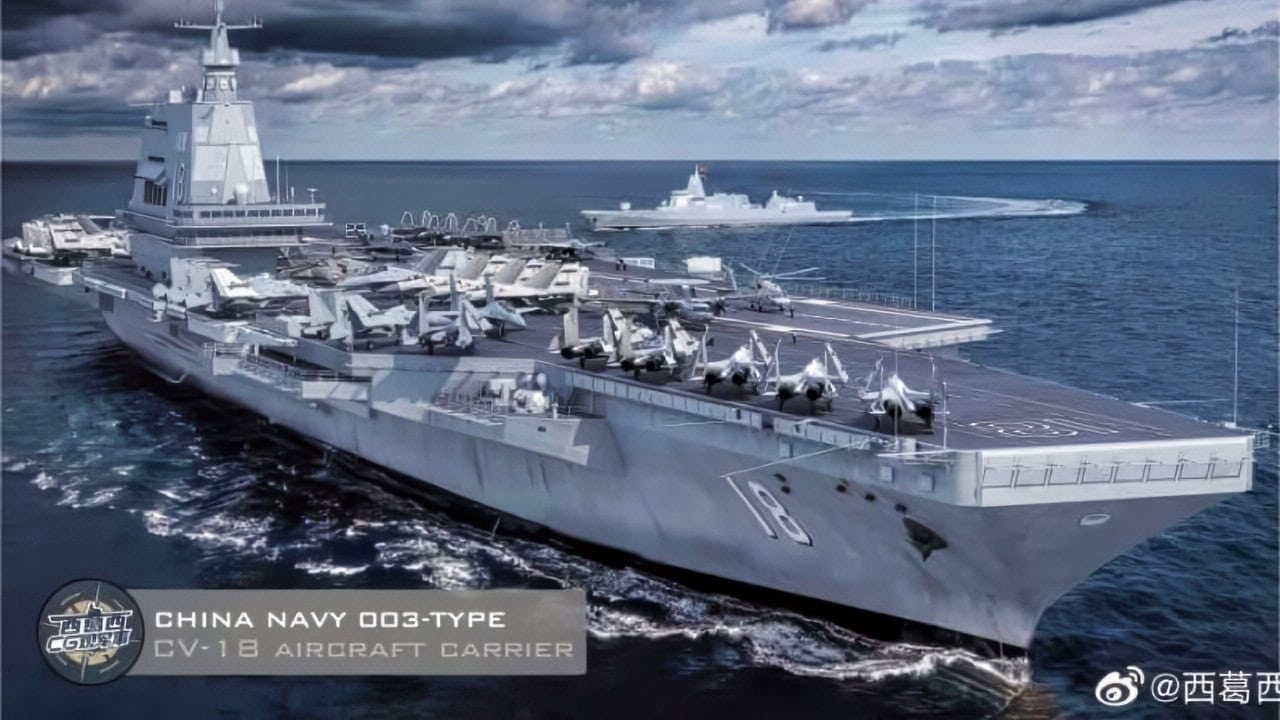
The Fujian ship has already adopted electromagnetic catapults and arrestor wires, addressing the limitations of ski-jump takeoffs on the weight and sortie efficiency of carrier-based aircraft. If the new ship continues along this technological path, the increased hull length may be used for larger hangars, ammunition storage, aviation fuel capacity, and maintenance areas, rather than just for pursuing higher speeds. For carrier-based aviation, deck scheduling and turnaround efficiency often determine how many sorties can be flown in a day more than the maximum displacement.
Public information is still insufficient to prove that the ship will use nuclear power. Jane's and satellite images can indicate size and construction progress, but they cannot directly confirm the power system, the scale of the air wing, or the final configuration of the electromagnetic systems. Equating "longer" directly with "nuclear-powered aircraft carrier" is not rigorous; it is more like reserving several capability options.
The PLA Does Not Need a Larger Lone Ship
The Chinese Navy's recent long-distance activities have not been limited to the first island chain. According to reports from China National Radio, the Navy's 48th escort fleet arrived in Myanmar on September 24; the hospital ship "Peace Ark," on a mission dubbed "Harmonious Mission-2026," arrived in Senegal on September 25, marking the first visit of a Chinese naval hospital ship to that country. The commonality of these actions is their long range, extended stay, and complex supply chains, indicating that a sustained presence in distant seas ultimately relies on continuous support.
Increased aircraft carrier tonnage can improve onboard reserves, but it cannot eliminate the problem of insufficient overseas supply nodes. Fuel, aviation munitions, spare parts, maintenance of carrier-based aircraft engines, and crew rotations all require ports, comprehensive supply ships, and the hospitality of friendly nations. In simple terms, an aircraft carrier can bring an airfield to the sea, but it cannot conjure a complete military maintenance system.
Realistic Impact on the Western Pacific
If the new ship ultimately adopts a larger hull and a higher intensity operational mode for carrier-based aircraft, the PLA Navy's sustained air coverage capability in the Western Pacific will improve, making it particularly suitable for air defense, reconnaissance, and maritime traffic protection tasks in areas far from domestic airfields. It will also force the United States, Japan, and Australia to reassess their deployment combinations of anti-ship missiles, long-range air power, and underwater forces.
However, the size of a single ship does not automatically translate into combat power. The true shortcoming of Chinese aircraft carriers may still lie in the training of carrier-based aircraft pilots, coordination with early warning and refueling aircraft, damage control in distant seas, and maintenance cycles after high-intensity operations. I believe that the key to assessing the value of this new aircraft carrier is not the length record at launch, but whether it can maintain an effective sortie rate for several weeks without the continuous support of domestic land-based air power. What is being increased at the Dalian shipyard is still to be determined: a larger deck or a naval logistics plan aimed at global deployment, which will need to be answered by subsequent sea trials and fleet activities.
Sources
- South China Morning Post, September 24, 2026, citing Jane's satellite image analysis.
- China National Radio Military, September 27, 2026, joint exercises in the air and sea around Huangyan Island in the Southern Theater Command.
- China National Radio Military, September 25-26, 2026, reports on the overseas operations of the Chinese Navy's escort fleet and hospital ship.
China's new aircraft carrier, under construction at Dalian Shipyard, may reach a length of 339 meters, enhancing the People's Liberation Army Navy's long-range operational capabilities. The carrier is expected to incorporate advanced technologies, including electromagnetic catapults, and signifies a shift towards sustained naval operations beyond the first island chain. This development raises logistical considerations for overseas supply chains and operational readiness.
- China's new aircraft carrier may reach 339 meters in length.
- The carrier is being constructed at Dalian Shipyard.
- The new carrier may improve long-range operational capabilities.
- The carrier's design may include advanced technologies like electromagnetic catapults.
- China's naval operations are expanding beyond the first island chain.