
"Chinese Divine Shield" Meets "Aircraft Carrier Killer": Chinese and Russian Officials Visit Each Other's Ships in Qingdao
[Global Times Report, Reporter Guo Yuandan] On the 8th, the sky over Qingdao, Shandong was clear, and the vessels from China and Russia participating in the "Maritime Joint-2026" joint exercise docked on both sides of the Qingdao port. At the top of the main mast of the vessels, the five-star red flag and the Russian white-blue-red tricolor flag flew side by side. The Chinese side opened the missile destroyer Kaifeng, while the Russian side opened the missile cruiser "Varyag." Officers and soldiers boarded each other's ships to visit and gain a direct understanding of each other's daily training and equipment management. On the evening of the 8th, the port phase of the China-Russia "Maritime Joint-2026" joint exercise successfully concluded. The vessels from both sides will set sail from a military port in Qingdao on the morning of the 9th to conduct the maritime joint exercise in the designated sea area.
Learn from each other, mutual learning and mutual reference
The mutual opening of vessels is an international convention and traditional project during naval ship visits, and it is also a beneficial classroom for officers and soldiers from China and abroad to learn from each other. Both sides can see each other's strengths in their foreign counterparts and also pay attention to areas where they can improve, learning from each other and complementing each other's strengths.
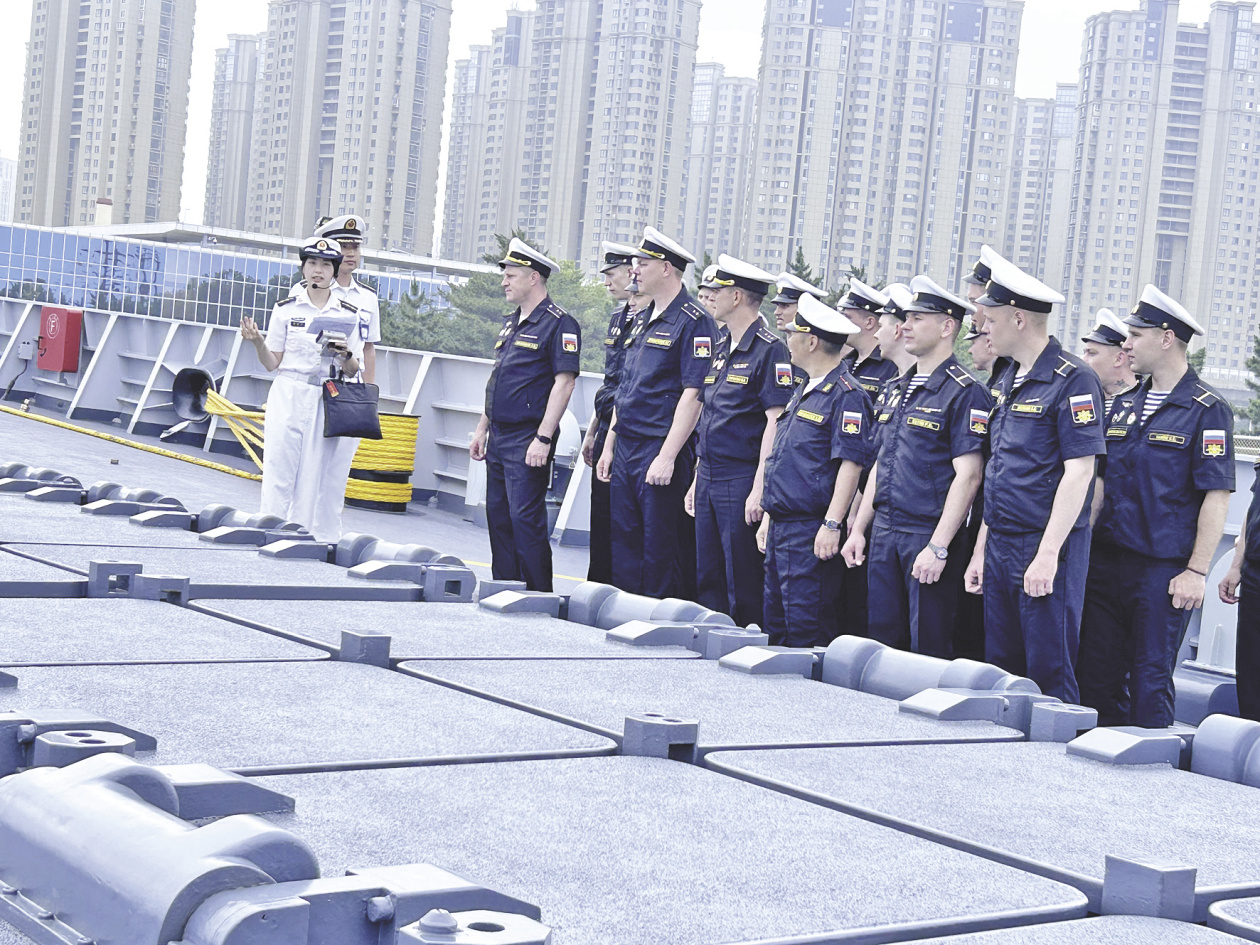
At 8:30 AM on the 8th, Russian officers and soldiers lined up to board the Kaifeng for a visit. Known as the "Chinese Shield," the Kaifeng is a 052D missile destroyer independently designed and built by China, featuring strong air defense and anti-ship capabilities, and is an important component of the maritime joint maneuvering formation. In this exercise, the Kaifeng serves as the command ship for the Chinese side.
For the Russian officers and soldiers, the Kaifeng is a "new face," as this is the first time the Kaifeng has participated in the China-Russia "Maritime Joint" series of exercises. Russian crew member Stanislav is participating in the China-Russia joint exercise for the first time, and he is impressed not only by the ship's neat and atmospheric appearance but also by the well-maintained various weapons and equipment. He said, "It is clear that the daily maintenance work of this ship is solid, and its condition is excellent."
The interest of the Russian military personnel in Chinese vessels is evident. A reporter from the Global Times noticed that they walked along the passageways inside the ship, carefully observing the equipment and flowcharts on the walls, with some stopping to take a closer look. Especially when the crew of the Kaifeng introduced the 64-cell universal vertical launch system and the main gun in the bow area, the Russian military personnel were focused. "You can see our interest in the eyes of the sailors; we want to learn more about the technical performance of the equipment," a Russian support staff member told the Global Times reporter.
Meanwhile, on the other side, Chinese officers and soldiers also boarded the Russian Pacific Fleet flagship "Varyag." Known as the "aircraft carrier killer," the "Varyag" has participated in the China-Russia "Maritime Joint" series of exercises multiple times and is a regular participant in the joint naval exercises of the two countries. The ship has a full-load displacement of over 11,000 tons, and its signature equipment includes eight dual-launch long-range supersonic anti-ship missile launchers on both sides of the bow, which can operate independently or in formation with other vessels to attack enemy warships, disrupt maritime traffic lines, and provide fire support during amphibious landing operations.
Kaifeng crew member Yang Mingyi boarded the "Varyag" for the first time and was immediately struck by the traces of time on the warship. As a core force of the Russian Pacific Fleet, the ship's combat capabilities are still commendable. "Through close communication and observation, I feel that the Russian crew has a strong sense of combat readiness, with armed duty points set up on the gangway and the foredeck, and the duty personnel equipped with helmets, bulletproof vests, and firearms with night vision sights. Their professional quality left a deep impression on us. Through this exchange activity, I have broadened my horizons, and we will also combine our own realities to learn from the Russian experience to enhance our combat readiness construction level," Yang Mingyi said.
15 years of joint exercises, Chinese and Russian officers and soldiers witness the development of the People's Navy together
Since 2012, the China-Russia "Maritime Joint" series of exercises has developed into a joint exercise brand with certain international influence, serving as an important platform for deep cooperation and mutual development between the two militaries, as well as a significant window to showcase the strategic mutual trust and cooperation level between the two countries and their armed forces. Through this window, the officers and soldiers of the two militaries feel friendship, mutual trust, and the shared responsibility of the two major countries to safeguard regional security and maritime peace.
"We live in Vladivostok, right next to the Chinese border, but this is my first visit to China in my life. Your country is very beautiful, and the infrastructure is very developed, which is amazing. The cities are very large, everything is orderly, leaving us with a deep impression," said Russian crew member Stanislav.
From the first "Maritime Joint" exercise in 2012 to now, many Chinese and Russian officers and soldiers have participated in the joint exercises multiple times. Slava, a crew member from the "Varyag," is participating in the China-Russia "Maritime Joint" series of exercises for the third time, and on the 8th, he also participated in a friendly basketball match between Chinese and Russian officers and soldiers. He said, "There is a good relationship between China and Russia; we are good friends with the Chinese Navy, and we can learn from each other's strengths and make progress together."
"Hello!" On the Kaifeng, a crew member from the "Varyag" took the initiative to greet the Global Times reporter in Chinese. He told the reporter that this is his fourth time participating in the China-Russia "Maritime Joint" joint exercise. He said the Kaifeng is excellent, "I would give it a perfect score of ten," and he is very concerned about the development of the Chinese Navy, especially in recent years, as the number of Chinese naval vessels has rapidly increased.
"From Dalian to Kaifeng"
Guo Xihuan, a crew member of the Kaifeng participating in the "Maritime Joint" series of exercises for the fifth time, has truly felt the growth and transformation of the Chinese Navy. In 2012, when the first China-Russia "Maritime Joint" exercise was held, he was 25 years old and still serving on China's first-generation domestically produced missile destroyer Dalian. That year, the "Varyag" also participated in the exercise, and he remembers that when the Russian ship arrived at the port, the Chinese crew all ran to the deck to watch, "a huge object, the deck was full of weapons and equipment, and we had many exclamations at that time." Over the past decade, Guo Xihuan has served on three types of vessels: Dalian, Daqing, and Kaifeng. His attitude towards the Russian vessels and crew has shifted from unfamiliarity to familiarity, becoming more peaceful. "From Dalian to Kaifeng, the Chinese Navy has undergone tremendous changes. The intelligence level of our vessels has continuously improved, with higher system integration and faster combat efficiency. Especially in the field of communication, the data transmission rate has significantly increased, and the collaborative response has become quicker and more precise, greatly enhancing the command and communication effectiveness under information conditions," Guo Xihuan introduced.
In addition to the upgrading and advancement of equipment, Guo Xihuan has also felt another change in the Navy: the overall quality of the crew has qualitatively improved. "The current crew members have higher education, broader thinking, and faster practical skills; our soft power has visibly strengthened."
As the Chinese Navy simultaneously enhances its equipment and talent, the frequency of long-range missions has been increasing year by year, and realistic training has been continuously strengthened, significantly improving naval combat capabilities. Against this backdrop, the organization and planning work on the Chinese side has become increasingly calm and mature. Chang Hao, from the joint command of the China-Russia joint exercise, told the Global Times reporter on the 8th, "The exercise task plan was led and coordinated by the Chinese side, and then we fully communicated and coordinated with the Russian side, adapting the process details based on both sides' daily tactical action habits, and the entire plan was smoothly advanced."
"During the exchange process, there are many strengths of the Russian officers and soldiers that are worth our learning and reference. They have formed a mature and reliable operational model, and the Russian military personnel in navigation, communication, and other positions have solid professional foundations and outstanding comprehensive business qualities, with distinct characteristics," Chang Hao stated.
As a young naval officer, Chang Hao's mindset during the communication phase of the plan formulation with the Russian side is confident and mature. "On the one hand, this is because after more than a decade of development, the China-Russia joint exercise mechanism has become very mature, with both sides understanding and trusting each other, resulting in a high level of tacit understanding. On the other hand, it benefits from the steady development of our Navy, with strong comprehensive hard power and professional planning capabilities, allowing us to propose constructive opinions with reference value based on our practical experience." Chang Hao stated that strong comprehensive strength builds an efficient communication bridge, effectively narrowing the distance between the two militaries, deepening mutual understanding, continuously optimizing the level of exercise coordination and cooperation, and comprehensively promoting the in-depth and practical development of the China-Russia maritime joint exercises.
Chinese and Russian naval vessels conducted mutual inspections in Qingdao on August 8, 2026, as part of the 'Maritime Joint-2026' exercises. The Chinese Navy's Kaifeng, a 052D destroyer, and the Russian Navy's Varyag, a missile cruiser, were involved in the event. This marked the first participation of the Kaifeng in these joint exercises, highlighting ongoing military cooperation between the two nations.
- Chinese and Russian naval vessels conducted mutual inspections in Qingdao.
- The Kaifeng is a 052D destroyer and serves as the command ship for the Chinese side.
- The Varyag is a missile cruiser known for its anti-ship capabilities.
- This is the first participation of the Kaifeng in the joint exercises with Russia.
- The joint exercises have been ongoing since 2012, showcasing military cooperation.