
Chinese Navy 052D Destroyer Repasses Miyako Strait, Indicating Maritime Self-Defense Force Surveillance Pressure in 2026 Japan-Circumventing Voyage
 Tanaka Takashi
Chinese Navy 052D Destroyer Repasses Miyako Strait, Indicating Maritime Self-Defense Force Monitoring Pressure for 2026 Circumnavigation of Japan
About 120 kilometers east of Miyako Island. The track of the Chinese Navy's Type 052D destroyer, confirmed by the Ministry of Defense in late June, is difficult to dismiss as merely a single vessel's passage. According to reports, the ship, accompanied by a supply ship, advanced northwest between Okinawa Island and Miyako Island, entering the East China Sea. The Japanese side reportedly monitored the situation with the escort ship "Yuudachi," minesweeper "Izushima," and P-3C patrol aircraft.
Significance of the 052D
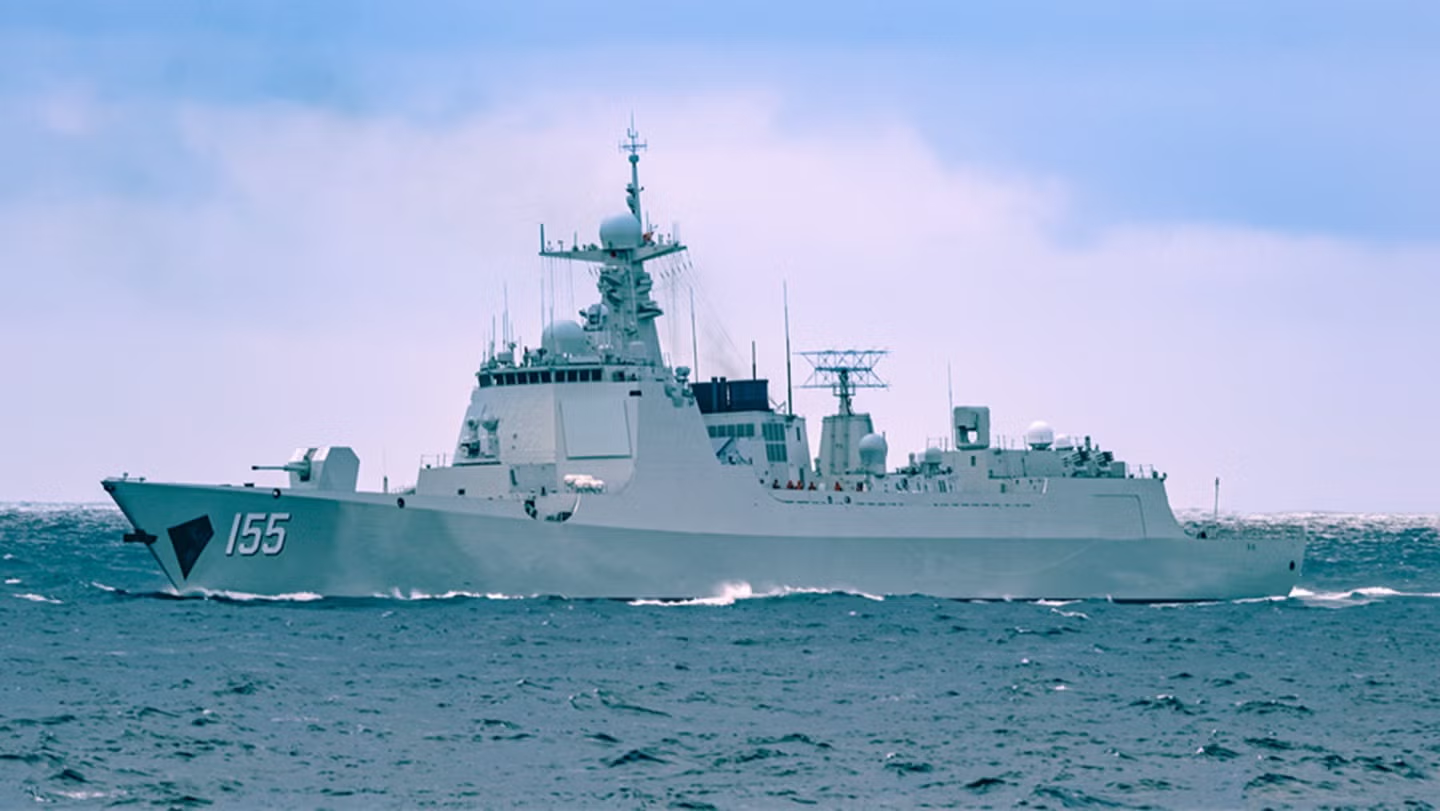
The 052D class is the main air defense destroyer of the Chinese Navy. With a full-load displacement of approximately 7,000 tons, it is equipped with a 64-cell vertical launch system and is designed to perform fleet air defense, anti-ship attacks, and anti-submarine missions all in one vessel. The issue at hand is not just the individual ship's performance, but its operational capability to conduct prolonged activities around the Japanese archipelago while accompanied by a supply ship.
SCMP reported, citing the Japanese Ministry of Defense, that this group of vessels is believed to be the same group that previously passed through the Tsushima Strait and Soya Strait. If true, the track would form a near-complete circumnavigation of the Japanese archipelago. While this is reminiscent of the Soviet Navy's demonstrations during the Cold War, the current Chinese Navy differs in its ability to conduct more sustained operations in terms of ship age, communications, and logistics.
The Miyako Strait is a Pressure Point, Not a Training Area
The Miyako Strait is one of the most natural exits for the Chinese Navy from the East China Sea to the Pacific Ocean. At the same time, it is a critical point for Japan, overlapping with the defense of the southwestern islands and the protection of SLOC (Sea Lines of Communication). Each time Chinese vessels repeatedly pass through this strait, the Japan Maritime Self-Defense Force must mobilize escort ships, patrol aircraft, and coastal surveillance units.
This burden is not insignificant. The JMSDF is advancing a reorganization from escort fleets to surface fleets by 2026, but this has not resulted in an increase in the number of vessels or personnel. Rather, the need to monitor the southwestern islands, the area around Hokkaido, and the Sea of Japan simultaneously has intensified. Even a single passage of a 052D may indicate that China is measuring Japan's monitoring posture, response times, and patterns of air patrol deployment.
Japan-U.S. Exercises and Chinese Vessel Tracks
The timing is also noteworthy. From late June to July 1, Japan participated in the U.S.-led multinational exercise Valiant Shield 2026. This wide-area training included locations such as Kagoshima, Hokkaido, Guam, and Hawaii, and the deployment of U.S. Army Typhon and HIMARS in Japan was also highlighted. While it cannot be definitively stated that the navigation of Chinese vessels is directly linked to this exercise, the demonstration of long-distance navigation by China around Japan during the same period well illustrates the current state of deterrence and monitoring in the western Pacific.
The Ministry of Defense continuously publishes information on the activities of the Chinese Navy. What is important is not just the fact that they were "discovered," but how many personnel, aircraft, and vessels are being consumed to continue these discoveries.
Practical Challenges Remaining for the JMSDF
In the author's view, this navigation is not a crisis in itself. The more troublesome aspect is that this is becoming a standard activity in peacetime. If the Chinese Navy operates around the Japanese archipelago on a monthly basis, and the JMSDF is required to monitor this each time, it is not ammunition that will be exhausted, but the operational system itself.
- The Chinese side demonstrated sustained ocean capability with the combination of the 052D and supply ship.
- The Japanese side deployed escort ships, minesweepers, and P-3C aircraft to maintain multi-layered monitoring.
- The track connecting the Miyako Strait, Tsushima Strait, and Soya Strait has the character of testing Japan's all-around vigilance.
What Japan needs to strengthen is not just flashy long-range weapons. It includes the operational rate of patrol aircraft, information processing personnel, unmanned surveillance means, and the maintenance capabilities of local bases. The real challenge indicated by the Chinese Navy's circumnavigation is not the outcome of maritime superiority, but rather a quiet yet unavoidable war of attrition regarding how many years peacetime monitoring can be sustained.
Main references: Japan Ministry of Defense Joint Staff Office announcements, South China Morning Post June 2026 reports, Valiant Shield 2026 related public information.
The Chinese Navy's 052D destroyer, accompanied by a supply ship, passed through the Miyako Strait in late June 2026, indicating ongoing naval operations and surveillance pressure on Japan. The Japanese Self-Defense Forces monitored the passage with escort ships and P-3C aircraft. This activity coincided with the U.S.-led multinational exercise Valiant Shield 2026, highlighting the strategic significance of the region.
- The Chinese Navy's 052D destroyer passed through the Miyako Strait accompanied by a supply ship.
- The Japanese Self-Defense Forces monitored the passage with escort ships and P-3C aircraft.
- The 052D destroyer is capable of long-term operations around the Japanese archipelago.
- This naval activity coincided with the U.S.-led multinational exercise Valiant Shield 2026.
- The passage of the Chinese vessel is seen as a test of Japan's surveillance and response capabilities.