
Concerns Over the Delivery of 400 U.S. Tomahawks Accelerate Japan-U.S. Joint Missile Production
 Tanaka Takashi
Concerns Over Delivery of 400 U.S. Tomahawks Accelerate Japan-U.S. Joint Missile Production
Upon rereading the Ministry of Defense announcement that Defense Minister Koizumi held a roughly 60-minute meeting with U.S. Secretary of Defense Hagel in Singapore on May 30, what stands out is not the glamorous alliance rhetoric. What caught the author's attention were three practical items named "TRISHIP": the temporary deployment of U.S. missile systems, joint development and production including the SM-3 Block IIA and AMRAAM, and the information sharing on air defense and missile defense among Japan, the U.S., and Australia.
This is not merely a result of the meeting. It should be viewed as a rather realistic reinforcement measure that came shortly after reports of delays in Japan's Tomahawk procurement in late May. In a press conference on May 26, Koizumi stated that there would be no change to the plan to acquire U.S.-made Tomahawks from fiscal year 2025 to fiscal year 2027, denying the reports of delays themselves. However, he also acknowledged that delays could occur in the overseas procurement of defense equipment. This statement carries significant weight for practitioners.
Weaknesses of the 400 Tomahawk Plan
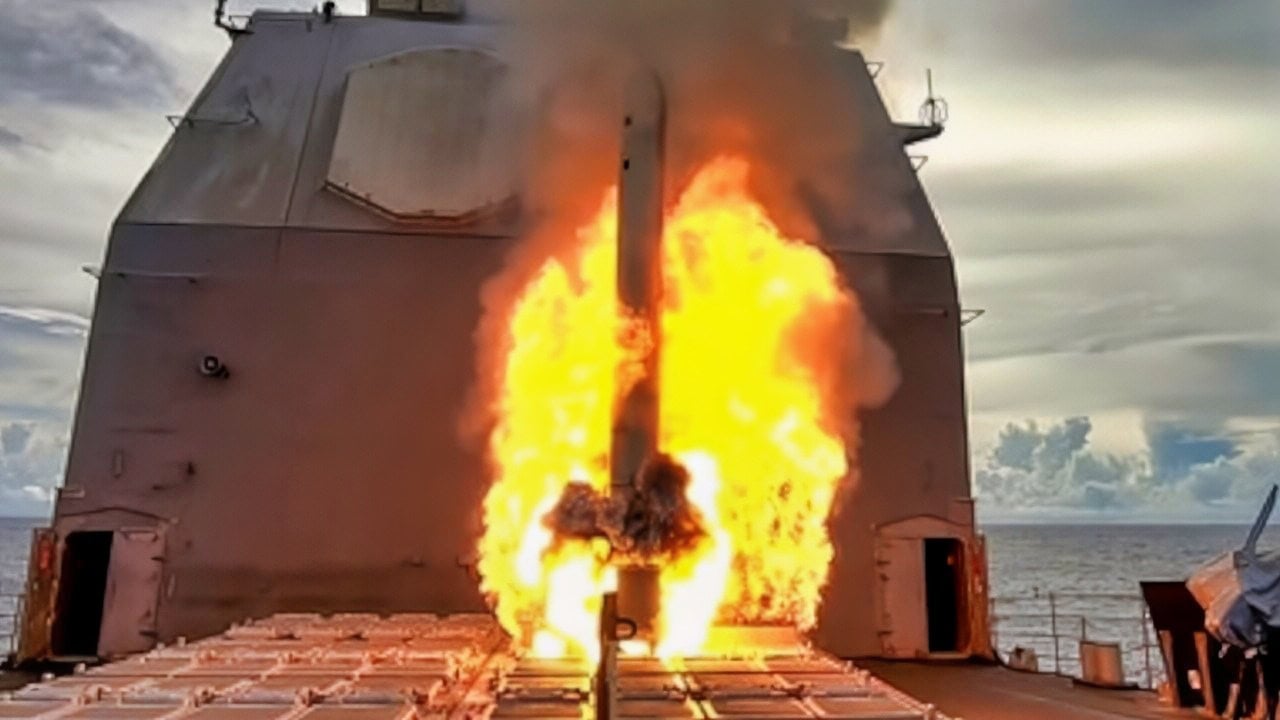
Japan is advancing a plan to introduce 400 Tomahawks and equip eight Aegis destroyers with them. According to Defense News, the destroyer "Chokai" has already become the first Japanese ship to gain Tomahawk launch capability, having undergone modifications to handle the Block IV and Block V variants with a range exceeding 1,600 kilometers. Live-fire training is scheduled for August, with a return to Sasebo planned for September.
However, having ships capable of launching them and ensuring that a sufficient number of missiles arrive on time are two separate issues. A CSIS report from April indicated that the U.S. military's stockpile of precision munitions was strained due to the Iran War, and that the delivery of 400 missiles for Japan could be delayed, which it characterized as a "blow to the U.S. position in the Western Pacific." While there is still room for verification of the details of the numbers, the structure in which Tomahawks, Patriots, THAAD, SM-3s, and SM-6s are all simultaneously in demand around the world is undeniable.
The True Meaning of DICAS 2.0
At DICAS 2.0 on April 14, Japan and the U.S. shared the need to produce equipment "more quickly and on a larger scale." In particular, the missile joint production working group confirmed the inclusion of AMRAAM circuit card assembly in the joint production scope, the possibility of conducting final assembly and inspection in Japan, specific measures to increase SM-3 Block IIA production by about four times, and the streamlining of PAC-3 MSE production.
It is important to note that this does not involve the domestic production of Tomahawks themselves. What Japan is facing is not a shortage of a single weapon, but rather an issue of ammunition distribution across the entire alliance. If Japan can support AMRAAMs and SM-3s, the U.S. industrial base can redirect its capacity to other urgent needs. Therefore, DICAS is not a magic solution to directly fill the gap of Tomahawks, but rather a modest mechanism to distribute the production burden of the alliance.
TRISHIP Compensates for Time Shortages
The TRISHIP agreed upon in the May 30 meeting is a concept that connects air, surface, and missile information among Japan, the U.S., and Australia. The number of air defense missiles is limited. If that is the case, the only option is to detect at greater distances, identify more quickly, and increase hit rates with fewer launches. Those who have experienced air defense training in the Japan Maritime Self-Defense Force should understand that this idea is more practical than merely increasing or decreasing the equipment list.
The agreement to temporarily deploy U.S. missile systems in the southwestern region is also in the same context. If Japan's counterstrike capability is still under development and there is uncertainty regarding the delivery timing of U.S.-made munitions, the immediate solution will be to fill the gap through the forward deployment of U.S. forces and information sharing. This will strengthen deterrence but will also complicate the political situation regarding bases in Japan during a crisis.
Alliance Deterrence Measured by Stockpiles
The Japanese government has described its counterstrike capability as "a necessary minimum self-defense measure." This legal arrangement is important. However, what the adversary sees is not the explanatory text but the number of munitions, training frequency, the number of launch-capable ships, and the endurance of supply lines. If we separate capability from intent, Japan's intent has become quite clear. However, its capabilities are still in transition.
In the author's view, the current issue is not a simple question of "Can the U.S. be trusted?" It is a matter of whether Japan is overestimating U.S. stockpiles as part of its own planning while the U.S. distributes precision munitions simultaneously to the Middle East, Europe, and the Western Pacific. The real risk is not that hundreds of Tomahawks will be delayed by months. The risk lies in the fact that when delays occur, Japan's politics and industry do not yet have the capacity to absorb them during peacetime.
Sources
- Japan Ministry of Defense, Japan-U.S. Defense Ministerial Meeting, May 30 2026
- Japan Ministry of Defense, DICAS 2.0, April 14 2026
- Nippon.com / Jiji Press, Koizumi denies Tomahawk delivery delay report, May 26 2026
- Defense News, JS Chokai Tomahawk capability, March 30 2026
- CSIS, Last Rounds?, April 2026
On May 30, 2026, U.S. Defense Secretary and Japanese Defense Minister discussed the joint production of 400 Tomahawk missiles in Singapore, addressing concerns over delivery delays. Japan aims to equip its Aegis destroyers with these missiles, while the DICAS 2.0 agreement highlights the need for increased production capacity amid global military demands. The situation reflects broader logistical challenges in U.S.-Japan defense cooperation.
- Japan plans to procure 400 Tomahawk missiles for its Aegis destroyers.
- Delivery delays of Tomahawk missiles are linked to U.S. military operations in the Middle East and Europe.
- The DICAS 2.0 agreement emphasizes the need for faster and larger-scale production of military equipment.