
Constantly Breaking Through the "Defensive Defense" Principle, "New Militarism" Gains Ground as a Threat, Japan Frequently Tests Offensive Missiles with Malicious Intent
[Global Times Special Correspondent Chen Yang, Global Times Reporter Ma Jun] This year, the Japan Self-Defense Forces officially participated in the "Shoulder to Shoulder" multinational joint exercise for the first time, and recently conducted a live-fire drill of the Type 88 anti-ship missile, hitting a decommissioned Philippine Navy vessel. According to Global Times reporters, Japan has frequently conducted live-fire drills of domestically produced missiles overseas in recent years. During the "Guardian's Sword" exercises in 2023 and 2025, the Self-Defense Forces also launched the more advanced Type 12 anti-ship missiles multiple times. On the 6th, Chinese Foreign Ministry spokesperson Lin Jian stated that Japan had previously engaged in aggression and colonial rule over Southeast Asian countries, including the Philippines, and that the former aggressor is now sending military forces overseas under the guise of so-called security cooperation. This trend further indicates that Japan's right-wing forces are pushing for an accelerated "remilitarization" process, continuously breaking through the principle of "defensive defense."
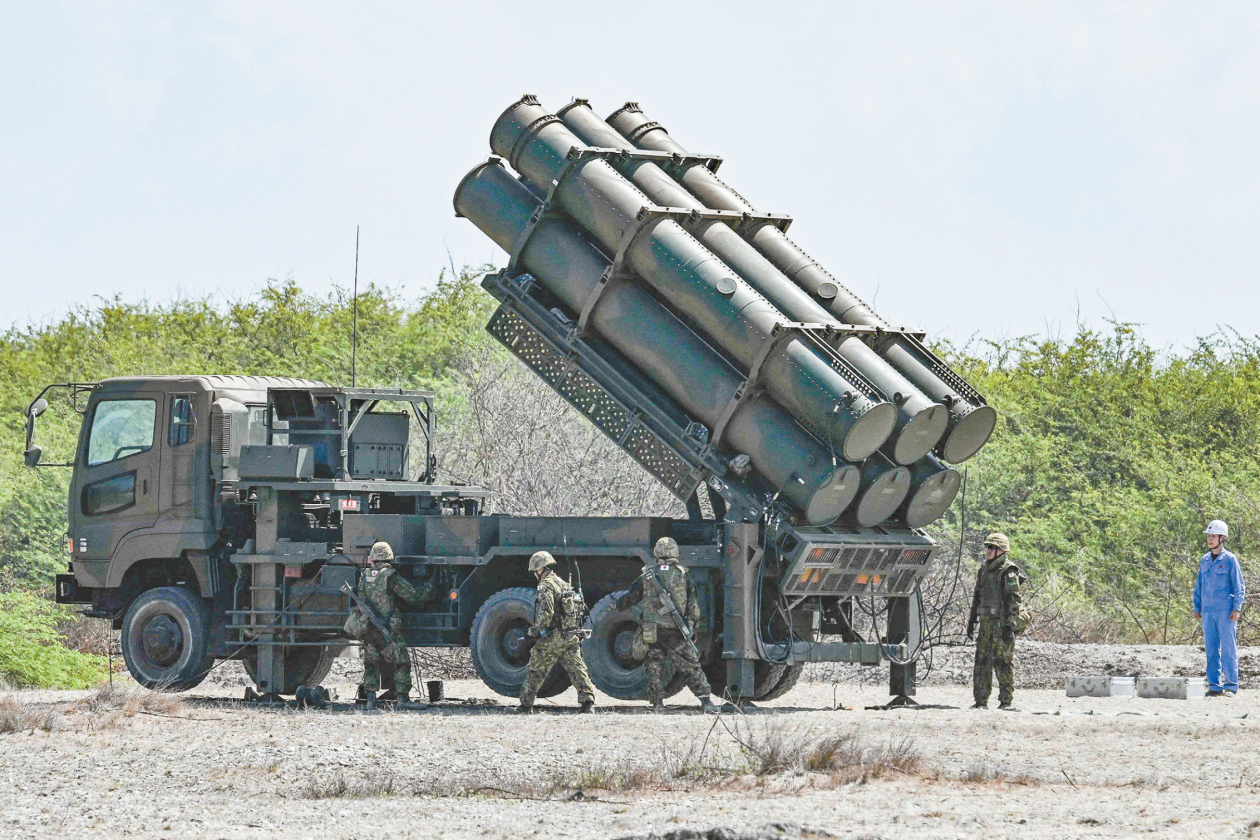
Multiple test launches of domestically produced anti-ship missiles
According to Reuters, during the "Shoulder to Shoulder" exercise held from April 20 to May 8 this year, the Japan Self-Defense Forces dispatched about 1,400 personnel and deployed the "Ise" helicopter destroyer, the "Murasame" class destroyer "Rei," Type 88 coastal anti-ship missiles, C-130 transport aircraft, and other weaponry.
The live-fire exercise of the anti-ship missile conducted on the 6th was carried out by the 1st Special Artillery Group of the Northern Army of the Japan Ground Self-Defense Force, with two Type 88 anti-ship missiles launched successively from the northern coast of Luzon Island in the Philippines, hitting a target ship approximately 75 kilometers offshore.
Japanese Defense Minister Kōzuki Shinjirō and Philippine Defense Minister Teodoro attended the event, indicating the importance both Japan and the Philippines place on this live-fire exercise. The Philippine Department of National Defense stated in a statement that the Type 88 anti-ship missile is designed for "coastal defense and deterring maritime threats."
This is the first time the Type 88 coastal anti-ship missile has undergone live-fire testing in the "Shoulder to Shoulder" military exercise. Although some media reported that this was also the first time post-war Japan launched offensive missiles overseas, Global Times reporters found through public information that Japan had previously launched similar anti-ship missiles during overseas exercises. For example, during the 2018 "Rim of the Pacific" multinational joint exercise, the Japan Ground Self-Defense Force launched four Type 12 coastal anti-ship missiles from the Pacific missile range in Hawaii, hitting the decommissioned U.S. Navy landing ship "Racine," which has a displacement of over 5,000 tons.
In the 2023 "Guardian's Sword" joint exercise led by the U.S. and Australia, the Ground Self-Defense Force launched a Type 12 anti-ship missile from a missile launcher at the Picton Weapons Testing Ground in New South Wales, Australia, using target information provided by drones, with the missile landing in the designated area. This was also the first live-fire launch of this land-based anti-ship missile in Australia. At that time, the Chief of Staff of the Japan Ground Self-Defense Force, Morishita Taichiro, declared, "I believe that the land-based anti-ship missile shooting exercise conducted in cooperation with the Australian Navy will enhance the high level of trust between Australia and Japan."
In the 2025 "Guardian's Sword" joint exercise, the Ground Self-Defense Force also successively launched Type 12 anti-ship missiles and Type 03 medium-range air defense missiles. Australian media described that the Type 12 anti-ship missiles launched by Japan successfully hit a floating target at sea several dozen kilometers from the coast.
Striving to test the missiles
It is reported that the Type 88 anti-ship missile is a domestically produced subsonic anti-ship missile developed by Japan in the late 1980s, with an overall level comparable to the U.S. "Harpoon" anti-ship missile, a range of about 150 kilometers, primarily relying on inertial navigation and terminal active radar guidance, and can only preset target parameters; while the Type 12 coastal anti-ship missile is the successor model to the Type 88 anti-ship missile, with a range increased to 200 kilometers and employing mid-course GPS, inertial navigation, terrain matching, and terminal active radar modes, capable of changing targets after launch via data link.
According to Japanese media reports, Japan has also developed a more advanced Type 25 coastal anti-ship missile based on the Type 12 anti-ship missile, which features a stealthy design and a significantly increased range of over 1,000 kilometers, and is currently in service.
Experts interviewed by Global Times reporters stated that the reason the Self-Defense Forces frequently test domestically produced anti-ship missiles through overseas exercises is against the backdrop of Japan's strong preparations to send military forces overseas, attempting to break through domestic legal restrictions, complete various complex environment live-fire tests, and verify the performance of these domestically produced weapons in different environments.
It is reported that Japan's "Peace Constitution" previously prohibited the Self-Defense Forces from possessing "capabilities to attack enemy bases," thus imposing many restrictions on the development and testing of related weapons. Additionally, due to Japan's small land area, the Type 88 anti-ship missile was sent to U.S. missile launch sites for testing during its development period. After the missile was put into service, it also conducted live-fire exercises multiple times at the Mugu Point Naval Air Station in California starting in 1991.
However, the U.S. missile testing sites differ significantly from other regions, so Japan has been seeking various opportunities in recent years to test these advanced weapons in different combat environments. Through anti-ship missile tests conducted in Hawaii, Australia, and the Philippines, Japan can not only take advantage of the rare "sinking" exercise to test the power of its anti-ship missiles but also assess their adaptability to different environments, accumulating experience for the Self-Defense Forces' future overseas deployments.
It is noteworthy that in June 2025, the Ground Self-Defense Force also conducted live-fire exercises of the Type 88 anti-ship missile at the Jingu area near Hokkaido, marking the first live-fire exercise of this missile on Japanese territory. Previously, the Japan Self-Defense Forces had to go overseas for such training, facing high transportation costs, long training cycles, and low training frequency. This choice to conduct training domestically is the first step towards promoting the "normalization of domestic missile training," aiming to lay the foundation for subsequent target range construction and training system upgrades.
In addition, Japan has also built a "training target range" on the remote uninhabited island of Minami-Torishima, the easternmost point of Japan. This is Japan's first target range that meets the testing and training needs for missiles with a range exceeding 100 kilometers. It is reported that Minami-Torishima has been selected by the Japanese Ministry of Defense as a dedicated testing site for various long-range out-of-area launch missiles, especially for various domestically produced missiles, meaning Japan no longer needs to send testing equipment and personnel to overseas target ranges for testing.
Special purposes for testing anti-ship missiles in the Philippines
Global Times reporters noted that previously, Japan primarily tested its domestically produced Type 12 anti-ship missiles during overseas exercises, which are the main coastal anti-ship weapons of the Ground Self-Defense Force. However, in this "Shoulder to Shoulder" exercise, the Ground Self-Defense Force launched the older Type 88 anti-ship missile. Why did Japan choose to test the older Type 88 anti-ship missile in the Philippines?
Experts told Global Times reporters that Japan's choice to test the Type 88 anti-ship missile in the Philippines is intentionally aimed at demonstrating its power to the Philippines. Currently, Japan is negotiating with the Philippines for the export of second-hand "Abukuma" class frigates from the Maritime Self-Defense Force. Kōzuki Shinjirō and Teodoro have agreed to establish a new working consultation mechanism for the export of these frigates.
It is reported that this lightweight frigate, with a displacement of about 2,000 tons, basically lacks modern air defense capabilities but has enhanced anti-ship and anti-submarine performance, especially as it is equipped with two quadruple missile launchers, providing relatively considerable anti-ship capabilities. The "Abukuma" class frigate can carry U.S.-made "Harpoon" anti-ship missiles or Japan's domestically produced Type 90 shipborne anti-ship missiles, but if Japan provides the "Abukuma" class frigate to the Philippines with "Harpoon" anti-ship missiles, it would require prior export permission from the U.S., which is time-consuming and labor-intensive.
On the other hand, the Type 90 shipborne anti-ship missile and the Type 88 coastal anti-ship missile share the same technological origin and are essentially the same type of anti-ship missile. They are products of Japan's "universalization of anti-ship missiles" strategy, sharing the core technology code SSM-1 (the Type 88 is referred to as SSM-1, while the Type 90 is referred to as SSM-1B). Therefore, Japan's exercise of launching the Type 88 anti-ship missile in the Philippines also has an important purpose: to demonstrate the power of its anti-ship missiles to the Philippines before the formal delivery of the "Abukuma" class frigates. This is also one of the reasons why Kōzuki Shinjirō and Teodoro place such importance on the live-fire launch of the Type 88 anti-ship missile.
On the 6th, Chinese Foreign Ministry spokesperson Lin Jian stated regarding Japan's launch of offensive missiles overseas that Japan has a serious historical responsibility for its past aggression and colonial rule over Southeast Asian countries, including the Philippines. In this special year marking the 80th anniversary of the Tokyo Trials, the former aggressor has not only failed to deeply reflect on its historical crimes but has instead sent military forces overseas under the guise of so-called "security cooperation," launching offensive missiles.
Lin Jian stated that this trend further indicates that Japan's right-wing forces are pushing for an accelerated "remilitarization" process, continuously breaking through the principles of "defensive defense" and relevant regulations of international and domestic law, with some of its policies and actions far exceeding the scope of "self-defense." The serious shortcomings in historical education and fundamental errors in historical perspectives, combined with strategic ambitions for military expansion, have led to the emergence of Japan's "new militarism," posing a real threat to regional peace and stability. China urges Japan to deeply reflect on its militaristic and aggressive history and to adhere to its commitments in the military security field, exercising caution in its words and actions.
Japan conducted live-fire exercises of the 88-type anti-ship missile, successfully hitting a target off the coast of Luzon Island during the 'Shoulder to Shoulder' multinational exercise from April 20 to May 8, 2023. Approximately 1400 personnel from the Japan Self-Defense Forces participated, utilizing various naval vessels and aircraft. This exercise highlights Japan's ongoing military activities and its intent to enhance defense cooperation with the Philippines.
- Japan conducted live-fire exercises of the 88-type anti-ship missile during the 'Shoulder to Shoulder' exercise.
- Approximately 1400 personnel from the Japan Self-Defense Forces participated in the exercise.
- The 88-type missile successfully hit a target approximately 75 kilometers away.
- This marks Japan's first live-fire test of the 88-type missile in a multinational exercise.
- Japan is negotiating the export of used 'Abukuma'-class frigates to the Philippines.