

“There are no great men, only great challenges that ordinary men are forced by circumstances to meet.” — Admiral William “Bull” Halsey.
William Halsey embodied the Navy’s best traditions to the extreme.
Perhaps that’s because he was born into the Navy and, therefore, followed his father’s path.
Ultimately, Halsey graduated forty-second in a class of sixty-two from the United States Naval Academy in 1904.
Yet whatever Halsey lacked in academic accomplishments, he more than made up for in experience.
The Old Sea Dog Rises
He quickly fashioned an impressive career at sea, becoming a true sea dog.
He skippered 12 torpedo boats and destroyers from 1909 to 1932.
Halsey even commanded three destroyer divisions and ultimately served as executive officer aboard the massive battleship USS Wyoming.
In classic Navy fashion, after commanding such an impressive string of vessels, Halsey did some shore duty, including stints with US Naval Intelligence, teaching at Annapolis, and serving as a naval attaché in Europe in the 1920s.
But Halsey wasn’t only a man of naval traditions.
He was a man of action. So, at the age of fifty-two, he volunteered to go to what was then the tiny Naval Air Station in Pensacola, Fla., to earn his naval aviation wings.
He became what the younger naval aviators derided as a “JCL,” or “Johnny Come Lately.”
In May 1935, Halsey completed the air training course in Pensacola and went on to take command of the USS Saratoga, an aircraft carrier in the new and growing fleet of carriers.
At the time, naval aviation was still in its infancy, and the Navy brass frowned upon anything other than a battleship as the Navy’s most prestigious platform.
Halsey was a pioneer.
He recognized the unique opportunities aircraft carriers offered for both his career and the Navy’s growing power-projection capabilities.
Halsey wanted to be on the front lines of that wave of innovation.
Here again we see the Halsey quote at the top of this essay playing out in real time for Halsey’s career.
From 1927 to 1938, Halsey was a captain.
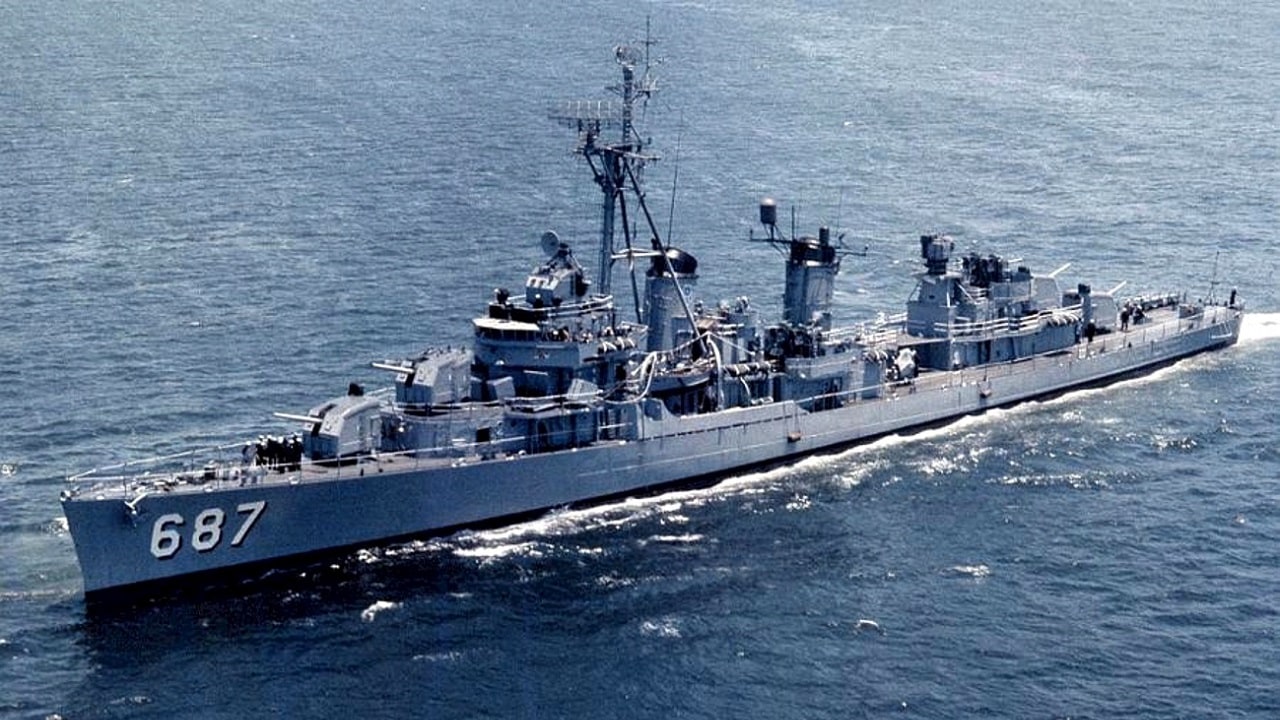
Fletcher-class Destroyers
That might seem like a long time, but during the Great Depression, the Navy didn’t promote often.
It wasn’t because he took the carrier route instead of the battleship route.
Inevitably, though, Halsey rose to a flag rank, commanding carrier divisions in the Atlantic and the Pacific. In June 1940, Halsey received his third star and became Vice-Admiral.
That was a fateful promotion, as it took him to Pearl Harbor the year before the fateful surprise attacks by Japan.
An Impressive Career
During peacetime, Halsey’s new command, the Aircraft Battle Force based in Pearl Harbor, was the most prestigious assignment an officer could get.
In wartime, that assignment became Halsey’s path to glory.
Halsey’s commanding officer at Pearl Harbor was fellow USNA classmate, Adm. Husband Kimmel.
Under Kimmel’s orders, Halsey’s carrier force was forward-deployed to show the flag in the Pacific amid rising tensions between Washington and Tokyo.
Halsey departed Pearl Harbor with his carrier force on November 28, 1941.
His flagship was the USS Enterprise. On their way home to Pearl Harbor, early on Sunday, December 7, 1941, an advanced scout patrol from the Enterprise flew out ahead of the carrier force to Pearl Harbor.
The Japanese attack was underway when those planes entered Hawaiian airspace.
Some of those planes were even shot down by Japanese Zero warplanes that were attacking Pearl Harbor.
The next day, Halsey’s carriers returned to a ruined port.
While surveying the smoldering rubble of what was left of Pearl Harbor, Halsey, the old sea dog, was rumored to have growled, “Before we’re through with them, the Japanese language will be spoken only in hell!”
Taken Down By Dermatitis and the Weather?
Once war began, the assertiveness that defined his peacetime rise became the aggressiveness that defined his wartime service.
Halsey became the chief warhorse for Adm. Chester Nimitz (who replaced Adm. Kimmel after the Pearl Harbor attack).
Under Nimitz’s command, Halsey was given every tough assignment Nimitz could muster.
Halsey’s Enterprise task force conducted hit-and-run raids against the periphery of the Japanese Empire, giving the US press and frightened American public a sense of victory following the humiliating experience at Pearl Harbor.
Even after his fleet was caught in a terrible typhoon that resulted in three destroyers being sunk and much of the Third Fleet being damaged, Halsey never ceased his abject aggression against the Japanese Empire. “Halsey Typhoon” was a blight on his career.
And a bad case of dermatitis just before the Battle of Midway in 1942 prevented him from leading the carrier force to victory there.
Nonetheless, he will be remembered. One cannot help but wonder, though, what might have been if the typhoon and dermatitis had not taken the old sea dog down before he could achieve the kind of glory he seemed on the brink of.
About the Author: Brandon J. Weichert
Brandon J. Weichert is the Senior National Security Editor at 19FortyFive.com. He also manages The Weichert Brief on Substack. Weichert also hosts “National Security Talk” on Rumble. He is the author of four bestselling national security books, most recently A Disaster of Our Own Making: How the West Lost Ukraine (Encounter Books). Follow him via Twitter/X @WeTheBrandon.