
Deputy Captain Wang Tao of the Navy's Fujian Ship - Strengthening Skills and Pursuing Dreams in the Sea and Sky (The Most Beautiful Revolutionary Soldier of the New Era)
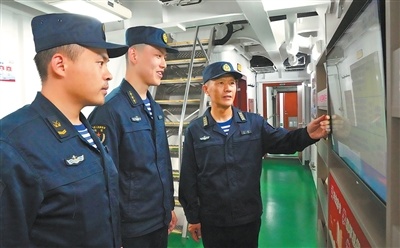
Wang Tao (far right) communicates with the officers and soldiers.
Photo by Wen Zidong
The sky is high and the clouds are vast, with endless blue waves. Deep in the ocean, the Fujian ship cuts through the deep blue sea like a drawn sword, with Deputy Captain Wang Tao standing at the command platform, closely watching the takeoffs and landings of each aircraft.
This year, Wang Tao was reassigned to serve as the deputy captain of the Fujian ship, marking a new beginning in his military career. From being a top pilot in the blue skies to commanding a warship in the deep blue, Wang Tao continuously embraces challenges and changes roles, using his skills and courage to protect the blue territory of the motherland.
"Enhancing oneself in a broader field"
Wang Tao, who joined the military at a young age, was admitted to the Air Force Changchun Flight Academy due to his strong overall qualities. He studied diligently and often rehearsed operational procedures in the simulator during his spare time. Even after meeting training standards, he continued to refine his movements.
After graduation, Wang Tao was assigned to the "Sea and Air Eagles Regiment." In this heroic unit with a glorious tradition, the loyal and combat-ready red gene deeply influenced Wang Tao. He once wrote in his diary: "Inherit the eagle's blood, forge a sharp blade in the vast sky, and guard the motherland's thousands of miles of sea and sky."
Wang Tao has safely flown for over 1,700 hours and has long been engaged in combat readiness patrol missions, honing his psychological quality and emergency response capabilities. During an emergency takeoff mission, his aircraft encountered a bird strike, causing the fuselage to shake violently. In a critical moment, Wang Tao remained calm, quickly assessed the malfunction situation, and precisely controlled the aircraft's speed, successfully resolving a major crisis with his quick thinking.
Just as Wang Tao's flying career was reaching new heights, news came of the Navy selecting pilots for ship captains. With the People's Navy accelerating its transformation and construction, the troops urgently needed a group of composite command talents proficient in joint command. Wang Tao, undeterred by the challenge, signed up. Some advised him: "You've been flying for over a decade, your skills are solid, and your future looks bright. Starting over to learn about ships is too hard and too much of a loss; why put yourself through that?"
"Wherever there is a need, I will go!" Wang Tao said firmly, "If the Navy is to advance into the deep blue, we need someone to break through the barriers between sea and sky. I am eager to embrace challenges and enhance myself in a broader field."
After several rounds of selection, he successfully entered the Navy Dalian Ship Academy's ship captain pilot class, embarking on a cross-disciplinary breakthrough.
"The harsher the environment, the better the practical skills developed"
Transitioning from air to sea was akin to a near "second enlistment" transformation.
The differences between aircraft and ships, tactical thinking, command logic, and professional systems are enormous. The brand new ship specialty courses, tens of thousands of equipment parameters, and complex and detailed command procedures turned this ace pilot into a "new student."
Wang Tao started from scratch, working day and night to study core content such as ship control, tactical application, equipment support, maritime emergency command, and fleet cooperative operations. He filled over 30 notebooks with study notes, systematically addressing professional difficulties and filling capability gaps. Hard work paid off, and Wang Tao ultimately graduated with excellent results.
During his time on the ship, Wang Tao dedicated himself to the cabin deck every day. With his tenacity in diligent study, he obtained qualifications for independent operation as deputy captain, job competency, and full training as captain in less than two years. Subsequently, Wang Tao officially took command of the Navy's Xiangtan ship, applying the "dual perspective of air and sea" he had honed over the years: "Future naval battles will rely on joint victory, and we must break out of old thinking to develop new tactics that integrate sea and sky!"
He integrated air force tactical thinking into ship combat training, exploring multiple tactics and training methods in areas such as ship-air coordination for air defense and intensive training for shipborne helicopters, successfully completing over 20 major tasks including combat readiness patrols and exercises.
During a high-intensity training session that spanned day and night, with rolling waves and heavy rain causing the ship to sway, Wang Tao led the training throughout. He combined his flying experience to reverse-engineer enemy low-altitude infiltration tactics, teaching the officers and soldiers how to optimize detection sectors and adjust counterattack timing. Under his strict training, the psychological quality and coordination abilities of the Xiangtan ship's officers and soldiers were honed, and the ship's overall maneuverability and offensive and defensive capabilities continued to improve.
"A strong team is true strength"
In 2024, Wang Tao was ordered to lead the Xiangtan ship on a long-range combat readiness patrol mission, facing a complex maritime situation and significant duty pressure.
One dawn, foreign military vessels suddenly approached our territorial waters at high speed, and the situation became tense. "Warning and drive away, strengthen evidence collection!" Wang Tao decisively issued orders. He commanded the warship to quickly seize advantageous positions while assessing the true intentions of the foreign vessels. Seeing that our response was professional and without gaps to exploit, the foreign ships ultimately retreated.
Wang Tao led all the crew members to take responsibility for defending the territory, successfully handling maritime emergencies time and again, safeguarding the country's maritime rights and interests.
In Wang Tao's view, "One person being strong does not count; a strong team is true strength." In response to the situation of many young signalmen and new officers, he specifically established a "Captain's Practical Classroom," sharing real combat cases and winning skills. He encouraged young officers and soldiers: "As long as you are willing to study, can endure hardship, and dare to break through, everyone can become a 'winning elite'."
There was a young radar operator who, when he first boarded the ship, had weak psychological quality and professional skills, making mistakes during training multiple times. After noticing this, Wang Tao took the initiative to talk with him to provide guidance: "In military combat, the biggest enemy is one's own cowardice. Don't be afraid of shortcomings or mistakes; the battlefield does not believe in tears, only in the strength developed through hard practice." Wang Tao used his duty breaks to provide hands-on guidance, helping this young operator break through his bottleneck and grow into a key member of the team.
Focusing on practical training and systematic education, encouraging officers and soldiers to gain experience in multiple positions; relying on long-range missions, major exercises, and frontline maritime struggles to hone the team and promote the upgrading and tiered growth of the ship's officers and soldiers... Wang Tao tirelessly strives to continuously reserve talent for the warship. Over twenty years of hard work, from soaring in the skies to guarding the ocean, from the Xiangtan ship to the Fujian ship, what has changed is the position, but what remains unchanged is the unwavering loyalty to protect the motherland's sea and sky.
Standing on the flight deck of the Fujian ship, Wang Tao gazes into the distance: "Only by strengthening our skills can we live up to our mission!"
(Contributed by Lin Qinggang)
Wang Tao, the deputy captain of the Fujian ship, is actively engaged in military training and operations, focusing on enhancing the capabilities of his crew and conducting naval exercises. In 2024, he led the Xiangtan ship in complex maritime operations, demonstrating effective command and control. His leadership emphasizes teamwork and the development of young naval officers, ensuring readiness for future challenges.
- Wang Tao has over 1700 hours of safe flight time and has transitioned from an air force pilot to a naval commander.
- He successfully led the Xiangtan ship in various military exercises and training missions.
- Wang Tao emphasizes the importance of teamwork and training for young officers in the navy.