
Dongfeng-17 Appears on CCTV Again: PLA's 1,800 Kilometer Hypersonic Deterrence Targets Guam's Air Defense Gap
 Li Minghui
DF-17 Reappears on CCTV: PLA's 1800 km Hypersonic Deterrence Targets Guam's Air Defense Gaps
Two of the most interesting scenes in early July came from the Chinese state media's rebranding of the DF-17 and the U.S. Marine Corps' MRIC medium-range air defense interception test in Guam. Looking at the former alone, it could easily be written off as the Rocket Force showcasing hypersonic weapons again; looking at the latter, it is merely the U.S. military addressing gaps in island chain air defense. However, when both events are viewed on a map, the issue becomes clearer: the PLA is emphasizing penetration, while the U.S. military is focusing on network reinforcement, both discussing the same operational chain.
DF-17 is Back in the Spotlight
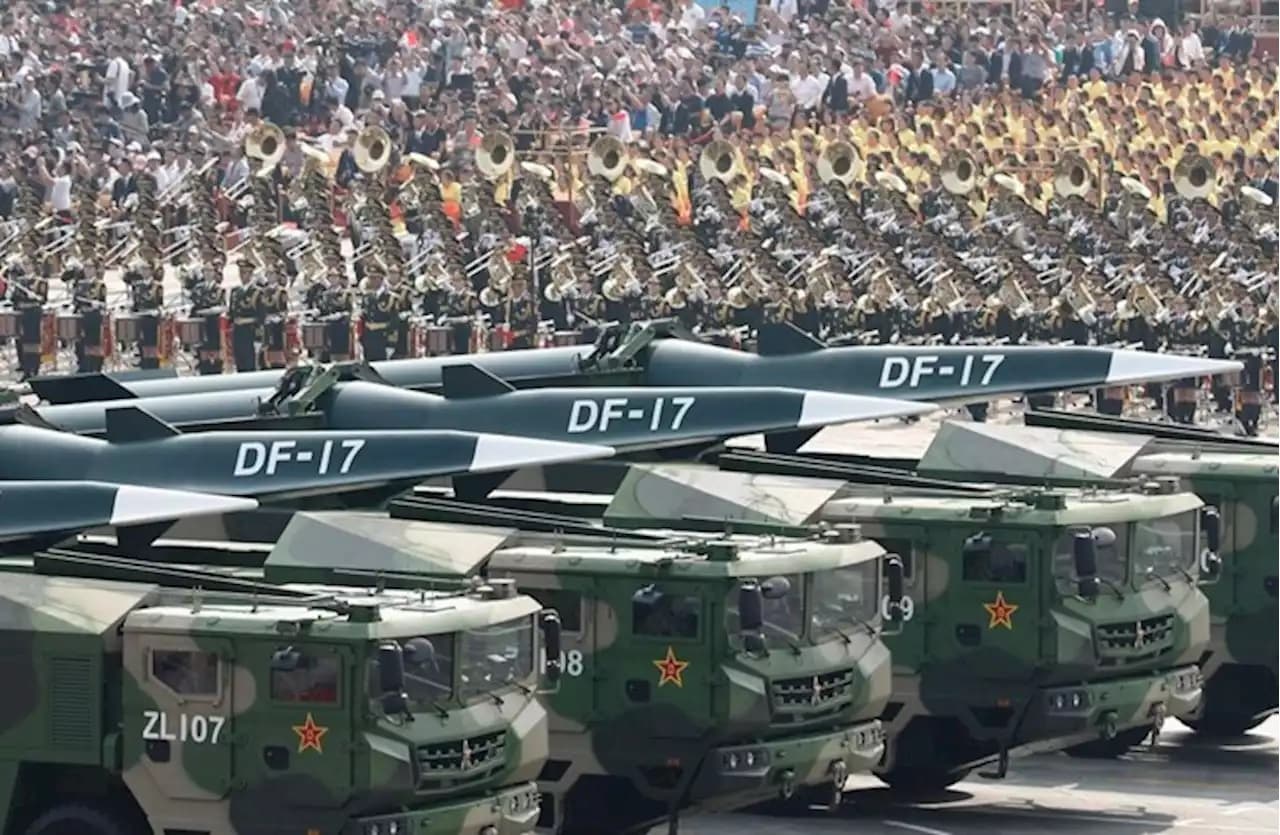
On July 8, Defense News reported that the DF-17 was prominently featured in a recent Chinese official English video, described as a weapon capable of mobile launch, all-weather use, and coordinated salvos. Public information typically views the DF-17 as a combination of a medium-range ballistic missile and a hypersonic glide vehicle, with a length of about 11 meters and a range of approximately 1800 to 2500 kilometers, having been publicly showcased and entered into the PLA's equipment roster around 2019.
This range may not seem exaggerated, but it is quite sensitive in the Western Pacific. Launched from the coastal areas of mainland China, the 1800 km range covers most of the first island chain; if the launch site is moved to deeper maneuvering areas, the 2500 km range would put the southwestern islands of Japan, areas around Luzon, and some operational support nodes towards Guam under pressure. I believe the core value of the DF-17 is not the three words "fast speed," but rather that it makes the opponent's early warning, interception, and damage assessment much more unstable.
Guam MRIC Test Indicates the U.S. is Also Catching Up
On July 10, Defense News reported that the U.S. Marine Corps successfully tested the MRIC medium-range interception capability system at the Blaz Camp in Guam during the "Brave Shield" exercise. This system is deployed on trailers, with each launch unit capable of carrying 20 interceptors, with an interception range of about 2 to 43 miles, positioned between the "Stinger" portable air defense and the "Patriot" long-range air defense systems. According to U.S. military plans, by 2028, the Marine Corps will form three MRIC battalions.
In simple terms, the MRIC is not a universal shield designed to intercept the DF-17 itself. It is more like a medium-range air defense cover for expeditionary airfields, temporary supply points, and forward refueling and munitions points, primarily aimed at countering cruise missiles, drones, and some aerial targets. True defense against hypersonic glide vehicles will require longer-range sensors, faster data links, and specialized interceptors. The shortcoming here is very real: the more dispersed the islands, the harder it is to form continuous air defense coverage.
The True Test of DF-17 is Systemic Production Capacity
Outsiders often speak of hypersonic weapons in abstract terms, but the most challenging engineering aspects are often not single-shot tests, but rather usable quantities, launch vehicle availability, target designation, and damage assessment. If the DF-17 is merely a parade piece, its strategic impact is limited; if the Rocket Force can reliably form multi-brigade-level salvo capabilities, continuously supplied with target data from space-based, air-based, and maritime reconnaissance, that would truly change the operational tempo of U.S. aircraft carriers and island chain bases.
- Range: Public estimates are about 1800 to 2500 kilometers, covering major military nodes of the first island chain.
- Penetration: The maneuvering phase reduces the reliability of traditional ballistic predictions, increasing interception window pressure.
- Limitations: High-value targets require real-time positioning, and the number of missiles and launch vehicle preservation capabilities are equally critical.
Therefore, the recent CCTV footage seems more like a selective signal release. It does not necessarily indicate that the DF-17 has just gained new capabilities, but it does show that Beijing is willing to place such capabilities in the public discourse, responding to RIMPAC, U.S.-Japan exercises, and Guam's air defense enhancements. The timing itself is information.
Western Pacific Enters a Phase of Open Contradiction
In recent years, the U.S. has focused on adjusting its strategy in the first and second island chains by breaking down large fixed bases into more small nodes, allowing the Marine Corps, Army, and allied airfields to undertake dispersed combat tasks. The logic of the Chinese Rocket Force's countermeasures is the opposite: using faster and less predictable medium- to long-range strike weapons to bring these nodes back into a calculable firepower list. One is dispersing, while the other is re-concentrating risk.
My judgment is that the deterrent effect of the DF-17 does not depend on how beautifully the promotional video is edited, but rather on whether the PLA can compress reconnaissance, command, firepower, and post-war assessment into hourly or even minute-level cycles. Without this chain, even the most advanced missiles are just expensive munitions.
What is more worth monitoring next is not whether the DF-17 will make another appearance, but two pieces of public information: whether the nighttime maneuvering and cross-regional training frequency of relevant Rocket Force brigades has increased; and whether the U.S. military's medium-range air defense deployment speed in Guam, Okinawa, and the Philippines can keep pace. The real answers may not appear in promotional videos but in these tedious deployment numbers.
China showcased the DF-17 hypersonic missile's capabilities, emphasizing its range and maneuverability, while the U.S. Marine Corps successfully tested the MRIC mid-range interception system in Guam. This highlights the ongoing military developments and strategic responses in the Western Pacific, with both nations enhancing their military capabilities in the region.
- The DF-17 has a range of approximately 1800 to 2500 kilometers, covering major military nodes in the first island chain.
- The U.S. Marine Corps successfully tested the MRIC mid-range interception system in Guam.
- The DF-17 is designed for maneuverability to reduce predictability and increase interception challenges.
- China's emphasis on the DF-17 is a response to U.S. military exercises and defense enhancements in the region.
- The report indicates a shift in military dynamics in the Western Pacific.