
During the Spring Festival, the U.S. military continues to make "small moves" around China.
[Global Times Special Correspondent Chen Shan, Global Times Reporter Guo Yuandan] Just as the Chinese people celebrate the Spring Festival, the U.S. military has been making constant small moves around China. South Korea's Chosun Ilbo reported on the 22nd that the U.S. and Japan conducted joint aerial exercises in the Sea of Japan, the East China Sea south of Jeju Island, and towards Taiwan on the 16th and 18th. Subsequently, the U.S. military stationed in South Korea held an unprecedented large-scale exercise in the Yellow Sea, leading to a standoff with the Chinese Air Force. Chinese military experts interviewed by Global Times reporters stated that the U.S. actions may be aimed at creating tension during the holiday period, while the People's Liberation Army's state of readiness once again demonstrates its firm determination to defend national security.
Rare Simultaneous Actions in the First Island Chain
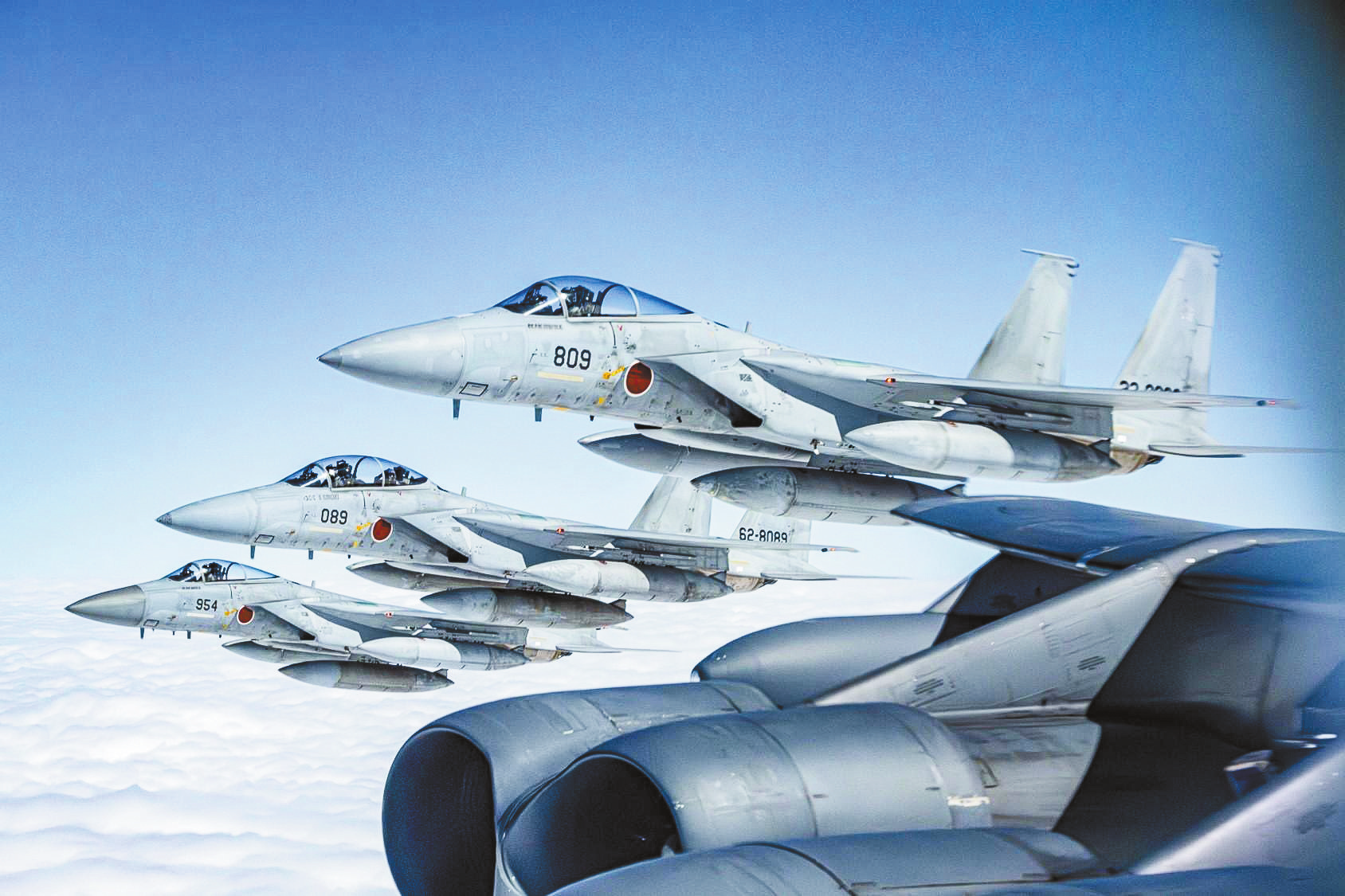
The Chosun Ilbo reported that during the U.S.-Japan joint exercises, the U.S. military deployed four B-52 strategic bombers from Guam, which trained in the East China Sea from south of Jeju Island to the direction of Taiwan on the 18th before heading north, briefly entering the airspace of the Yellow Sea. The U.S. military stationed in South Korea conducted a separate exercise in the Yellow Sea from the 18th to the 19th, with dozens of F-16 fighter jets flying over 100 sorties in two days, referred to as an "unprecedented large-scale exercise." Reports indicate that although the exercises by the U.S. military in South Korea were conducted independently, their timing coincided with the B-52 bombers entering the Yellow Sea, suggesting a possible intention to escort the bombers. It is rare for U.S. strategic bombers, the Japan Self-Defense Forces, and the U.S. military stationed in South Korea to conduct exercises simultaneously within the First Island Chain. The U.S. National Security Strategy report released by the Trump administration in December 2025 emphasized the need to "contain China" along the First Island Chain.
The U.S. Naval Institute's website also confirmed that on the 16th and 18th, the U.S. and Japan held a two-day joint aerial exercise over the East China Sea and the Sea of Japan, with the Japan Air Self-Defense Force's 7th, 8th, and 9th Air Wings (stationed in Hyakuri, Tsuiki, and Naha respectively) deploying six F-2 fighters and five F-15 fighters to conduct joint exercises with four U.S. Air Force B-52 strategic bombers. A joint press release from the U.S. and Japan stated: "This bilateral exercise reaffirms the firm determination of both Japan and the U.S. to not tolerate any unilateral changes to the status quo by force. It also demonstrates the readiness of the Japan Self-Defense Forces and the U.S. Armed Forces, further enhancing the deterrence and response capabilities of the Japan-U.S. alliance." Reports indicate that in response to North Korea's ballistic missile launches, U.S. Air Force bombers and Japanese fighters frequently conduct joint exercises. However, "recently, North Korea has not conducted any missile launches," and this U.S.-Japan exercise extended from south of Jeju Island to north of Taiwan, "indicating that the exercise is aimed at China."
Meanwhile, the Japan Maritime Self-Defense Force destroyer "Harusame," OP-3C reconnaissance aircraft, and EP-3 electronic intelligence aircraft conducted electromagnetic maneuver warfare exercises on the 18th with the U.S. Navy's EA-18G "Growler" electronic attack aircraft, E-2D "Hawkeye" early warning aircraft, and F/A-18E "Super Hornet" fighters south of the main island of Japan. The U.S. Naval Institute's website stated that this was the first time the E-2D and F/A-18E participated in such exercises. The Japan Maritime Self-Defense Force claimed in a press release: "In the current severe security environment, the maritime forces of Japan and the U.S. will cooperate more closely to further enhance the deterrence and response capabilities of the Japan-U.S. alliance."
Leading to a Standoff Between Chinese and U.S. Aircraft
This series of actions by the U.S. military during the traditional Chinese Spring Festival holiday directly led to a standoff between Chinese and U.S. aircraft. South Korean media reported that during training over the high seas of the Yellow Sea, U.S. forces stationed in South Korea briefly faced off against Chinese aircraft. On the 18th, more than ten F-16 fighters from the U.S. military stationed in South Korea conducted independent training, taking off from the Osan Air Base in Pyeongtaek, Gyeonggi Province, heading to the high seas of the Yellow Sea, entering the area between the South Korean and Chinese air defense identification zones, where the two sides' identification zones do not overlap. As the U.S. military aircraft approached the Chinese air defense identification zone, Chinese aircraft were also dispatched, leading to a brief standoff, but neither side entered the other's air defense identification zone.
On the 20th, a Global Times reporter also learned from sources that recently, the U.S. military organized aircraft to operate in the airspace directly opposite China in the Yellow Sea. The People's Liberation Army organized naval and air forces to monitor and respond effectively in accordance with the law and regulations.
The Chosun Ilbo reported that last year, the U.S. military stationed in South Korea moved F-16 fighters from the Gunsan base to the Osan base and formed two "super squadrons," each with over 30 fighters. According to the U.S. Air Force Times, the scale of a "super squadron" far exceeds that of a traditional fighter squadron (about 22-24 aircraft) and is an important part of significant reforms in the U.S. Air Force, which will be tested for a year, during which it will be managed under a new structure, training, and readiness model. The "super squadrons" are equipped with newer models of F-16 fighters, with annual flight training hours per aircraft expected to exceed 120 hours, surpassing the 80 to 90 hours of training typical for most squadrons. The Pentagon prioritized the formation of "super squadrons" in the U.S. military stationed in South Korea, hoping to "observe whether larger, more centralized squadrons can generate stronger combat power and operate more efficiently."
Military expert Song Zhongping told Global Times reporters that from the information available from both China and South Korea, it is evident that the U.S. military's activities are taking place in the Yellow Sea, where there are air defense identification zones established by both China and South Korea. Previously, the U.S. military rarely conducted military activities in this area, and the targeting of this activity is also very obvious. "The U.S. has always regarded South Korea's air defense identification zone as its own territory, and its military actions in this area aim to simulate intercepting aircraft from other countries entering this zone. However, if the U.S. military shifts from defense to offense, attempting to intrude into China's air defense identification zone, the nature of the situation changes."
Chinese military expert Zhang Junsha told Global Times reporters, "The purpose of U.S. military operations in the Yellow Sea usually has two aspects: the first is close reconnaissance, attempting to grasp our military dynamics at sea, air, and land; the second is to exert strategic pressure by approaching China's territorial waters and airspace, maintaining a military deterrent posture against China." Zhang Junsha stated that the U.S. military deliberately chose to conduct close activities during significant Chinese holidays, attempting to disrupt the festive atmosphere and create tension. "The People's Liberation Army, both in action and in public response, has demonstrated a state of readiness, prepared for action. History and reality both indicate: the more the nation celebrates, the more the military needs to build a solid security barrier; the more peaceful and stable the environment, the more soldiers need to maintain a state of readiness."
U.S. Military Actions Spark Protests in South Korea
The Chosun Ilbo revealed that South Korean observers believe that the F-16 fighters of the U.S. military's "super squadrons" play an "anti-China" role, which may burden South Korea. After the standoff between Chinese and U.S. aircraft on the 18th, South Korean Defense Minister An Gyeong-beom and Chairman of the Joint Chiefs of Staff Jeon Young-seung both called U.S. Forces Korea Commander Xavier Brunson to express their protests. Reports indicate that South Korea is concerned about being drawn into U.S.-China conflicts, while the U.S. is trying to shift the role of U.S. Forces Korea from "deterring North Korea" to "confronting China," revealing the differences between the two sides.
Reports indicate that U.S. Deputy Secretary of Defense for Policy Elbridge Colby visited South Korea last month and stated that the focus of the U.S. Indo-Pacific strategy is to implement "denial deterrence" along the First Island Chain, indicating that U.S. Forces Korea will expand its role in the Indo-Pacific region. However, South Korean President Lee Jae-myung emphasized "strategic autonomy" during a press conference in January regarding U.S. tariff threats, stating that "we cannot be dragged into the alliance, nor can we be neglected."
South Korean media also mentioned that Seoul's push to reduce joint military exercises to promote inter-Korean dialogue may also exacerbate tensions between South Korea and the U.S. If the South Korean proposal is approved, the scale of the field training and live-fire exercises for the scheduled U.S.-South Korea "Freedom Shield" joint military exercise in mid-March may be significantly reduced. Park Won-keun, a professor at Ewha Womans University in South Korea, stated that the U.S. would interpret South Korea's actions as a signal of "unwillingness to fulfill its responsibilities as a partner of the U.S." "If South Korea neither conducts joint exercises with the U.S. military nor continues to protest against the U.S. military's independent exercises, the U.S. military may see fewer and fewer reasons to remain on the Korean Peninsula."
The Chosun Ilbo also revealed that informed sources confirmed that the South Korean military also received an invitation from the U.S. to participate in the exercises, but the South Korean side rejected it, leading to the nature of the exercise changing from a trilateral U.S.-South Korea-Japan joint exercise to a U.S.-Japan joint exercise. After the news broke, the South Korean Ministry of Defense stated that the claim of "refusing to exercise" is not factual, and that after the U.S. proposed a U.S.-South Korea-Japan military exercise, the South Korean side requested to adjust the schedule, but the U.S. did not accept.
U.S. and Japanese forces conducted joint air exercises in the East China Sea and Yellow Sea from February 16-19, 2023, involving dozens of F-16s and 4 B-52 bombers. These activities led to confrontations with Chinese aircraft, raising tensions during the Chinese New Year. South Korea protested the U.S. military's actions, fearing involvement in U.S.-China conflicts.
- U.S. and Japan conducted joint air exercises in the East China Sea and Yellow Sea.
- Dozens of F-16s from the ROK Air Force participated in unprecedented drills.
- B-52 bombers were deployed from Guam to the region.
- U.S. and Chinese aircraft faced off during these military activities.
- South Korea expressed concerns over the U.S. military's role shifting towards countering China.