
Eagle Strike-18A Black Coating Sea Trial Exposed: PLA 052D Anti-Ship Penetration Capability May Advance Further
 Li Minghui
YJ-18A Black Coating Sea Trials Exposed, PLA 052D Anti-Ship Penetration Capability May Advance Further
On August 26, the South China Morning Post cited military observers stating that during a recent sea trial by the Chinese Navy, a YJ-18A anti-ship missile with a black appearance was spotted. This detail may be small, but it is eye-catching. In the past, publicly available footage of the YJ-18 series mostly maintained common paint schemes; if this time it indeed features a radar-absorbing layer, it indicates that the PLA's focus on anti-ship cruise missiles has shifted from merely range and terminal speed to also considering "how to be detected later before being discovered."
The Change is Not in the Missile Name, But in the Last Few Dozen Kilometers
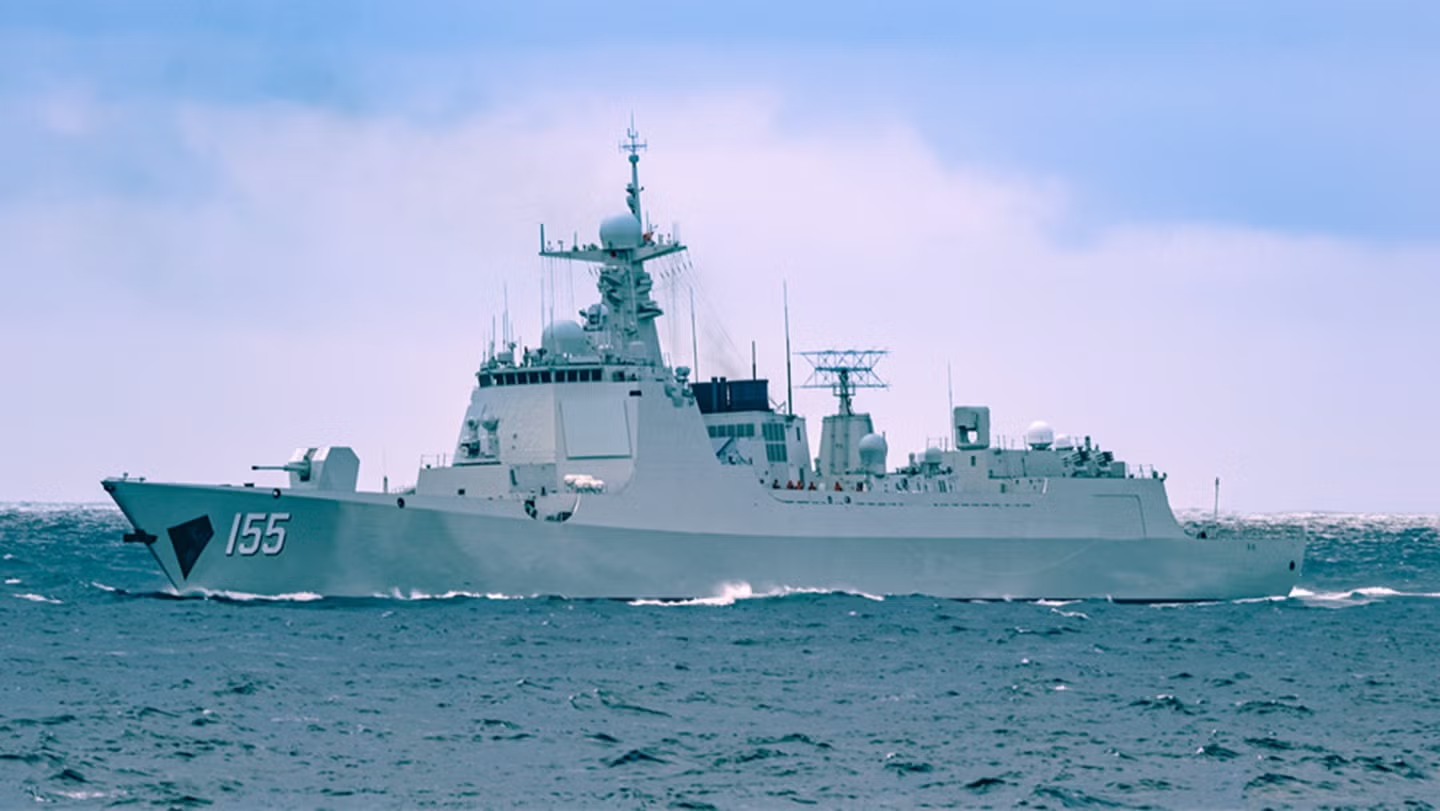
Public information shows that the YJ-18A is a shipborne vertical launch variant, primarily equipped on platforms like the 052D destroyer and the 055 large destroyer. The common parameters provided by the CSIS "Missile Threat" database are: a cruising speed of about 0.8 Mach, a terminal speed that can reach 2.5 to 3 Mach, and a range roughly between 220 to 540 kilometers. The most challenging aspect of intercepting this type of missile is not its speed, but rather its ability to fly at low altitudes over the sea, suddenly accelerating in the terminal phase, which compresses the reaction time of air defense systems.
If the black outer layer indeed corresponds to radar-absorbing treatment, then it strengthens the most critical segment of this approach. In simple terms, terminal acceleration is already putting pressure on the opponent's "stopwatch," while the radar-absorbing layer delays the start of that stopwatch. For a missile flying at low altitudes, even a slight delay in the distance at which it is stably captured by shipborne radar can further compress the window available for the interception chain to complete search, identification, allocation of firepower, and launch interceptors.
There are Three Layers of Significance Worth Monitoring
- First, the PLA Navy is shifting its focus on anti-ship missile upgrades from "whether there are any" to "which link in the system is still lacking." The YJ-18A is no longer a new model; the novelty lies in the continuous refinement of penetration details.
- Second, the mass deployment of the 052D and 055 means that once this improvement is finalized, it is not just an enhancement of individual ship capabilities, but an upgrade issue for the entire batch of platforms' munitions.
- Third, if the radar-absorbing layer enters regular production, it will test not only the design capabilities but also materials, processes, and at-sea maintenance capabilities. Naval missiles are not parade models; salt spray, temperature differences, and deck storage and transport can undermine the impressive metrics seen in the laboratory.
What This Means for the Taiwan Strait and the Western Pacific
The author believes that these changes have greater significance for the Taiwan Strait than for distant maritime battles. The reason is simple: the first island chain has dense air and sea targets, with early warning aircraft, shore-based radars, shipborne radars, and electronic warfare platforms supporting each other. Any improvement that can shorten the opponent's response chain will be amplified. In this environment, a missile that "only seems to have changed its coating" actually affects the success rate of the entire saturation attack.
On the other hand, there is no need to exaggerate this matter into a technological generational gap. A radar-absorbing coating can enhance penetration probability, but it cannot replace target indication, data link updates, and coordinated salvo firing. Without a stable reconnaissance chain, even the longest range can become "visible but untouchable"; without sufficient production capacity, even the best variant struggles to form an overwhelming numerical advantage. Li Minghui has always placed great importance on production capacity, and this time is no different. What truly determines deterrent strength is not the appearance of a black missile body for a few seconds in a video, but how many of this variant can be produced in a year and whether they can be stably allocated to the main fleet.
A Bigger Signal in the Naval Industrial Chain
In recent years, China's military industry has already established a basic framework for ship platforms, general vertical launch systems, and long-range anti-ship munitions. Now, moving forward, the competition lies in materials and processes, which are the parts that are least visible to the outside world but take the most time to refine. An easily overlooked detail is that the missile's shape has not undergone major changes, indicating that this may not be a "new missile from scratch," but rather a small-step upgrade on a mature model that can be mass-produced. This approach is often more practical than pursuing a disruptive breakthrough all at once.
What is truly worth continuing to observe is not whether the black coating appears, but whether the PLA will repeatedly showcase similar missile bodies in more footage of 052D, 055, or even live-fire training in the coming months. If it only appears once, it resembles a test sample; if it starts to appear in batches, then it is not just a sea trial highlight, but a signal that the Chinese Navy's anti-ship munitions are entering a new batch.
The People's Liberation Army Navy tested the YJ-18A anti-ship missile with a new black coating in the South China Sea on August 26. This upgrade may enhance the missile's stealth capabilities, indicating a shift in focus towards improving penetration strategies. The YJ-18A is primarily deployed on the 052D and 055 destroyers, and this development could significantly impact naval operations in the Taiwan Strait.
- The YJ-18A missile was tested with a new black coating that may include radar-absorbing technology.
- The missile is primarily deployed on the 052D and 055 destroyers of the Chinese Navy.
- The upgrade focuses on enhancing the missile's stealth capabilities during its terminal phase.
- The change in coating indicates a shift in the PLA's approach to anti-ship missile technology.
- The implications of this upgrade are particularly significant for operations in the Taiwan Strait.