
Eastern Theater Navy Destroyer Brigade: Multi-Service Staff Integrated into "Maritime Command Tent"
Eastern Theater Navy's Destroyer Flotilla Strengthens Command Integration Training——
Multi-Service Staff Integrated into the "Maritime Command Tent"
■ Li Yiyang Wei Chenping
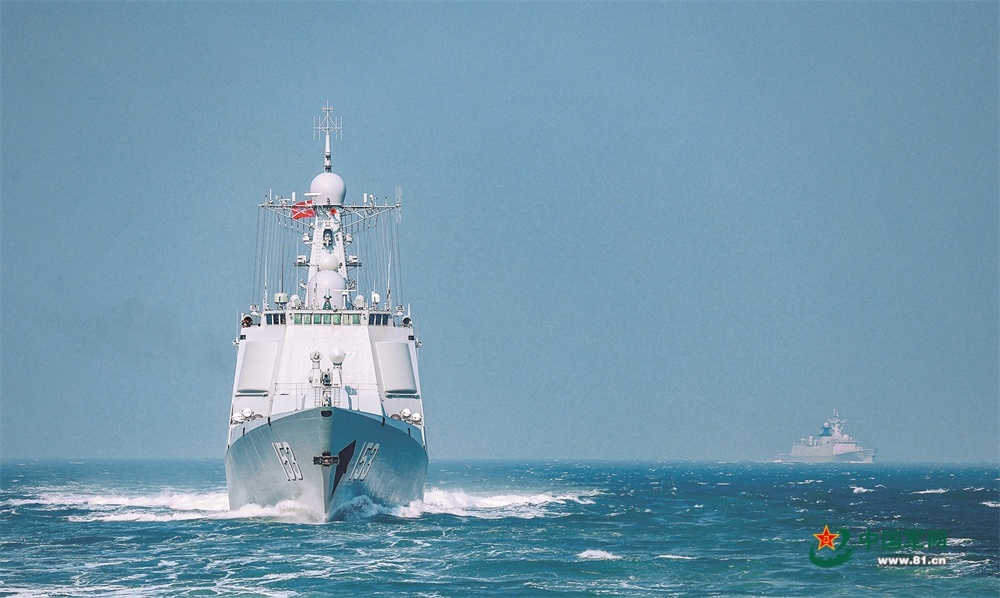
The flotilla conducted maritime training. Photo by Li Jinbiao
In summer, in a certain area of the East China Sea, waves are rolling. A flotilla of several ships from the Eastern Theater Navy's destroyer flotilla formed a formation and conducted a joint training exercise with aviation troops and ground-to-air missile units, focusing on comprehensive offensive and defensive operations at sea.
Unlike in the past, in the operational command room of the formation command ship Xi'an, staff from the theater joint command and the theater air force were integrated into the "Maritime Command Tent." During the training, they not only participated in situation assessment and plan formulation but also directly embedded into the command chain to carry out cross-service command and coordinated operations.
"War is not only about hard confrontations but also a competition of operational command capabilities." The formation commander introduced that in the past, during command integration training, staff from different services usually conducted command operations at their respective command posts according to plans. When faced with complex emergencies, issues such as long decision-making cycles and low coordination efficiency were prominent. Now, multi-service command elements are pre-positioned and aggregated to the formation command ship, conducting joint operational planning simultaneously, and timely mutual consultation and complementing each other, significantly improving joint command efficiency.
"Battle alert!" As soon as the training began, the formation command post received a report: multiple batches of "enemy" aerial targets were approaching the formation using a combination of low-altitude and ultra-low-altitude penetration tactics, relying on a complex electromagnetic environment, putting immense pressure on the formation's shipborne air defense system.
"Activate the joint air defense operation plan!" On the command seat of the command ship, the air force liaison officer quickly established communication with the air force command agency, requesting real-time air situation data from the theater air force's early warning aircraft and ground-based long-range radar. The command elements from various services within the "Maritime Command Tent" worked together, jointly assessing the situation and making rapid decisions, quickly weaving a multi-dimensional air defense fire network covering land, sea, and air information.
At the training site, I observed that under the support of a unified battlefield situation, operational orders were simultaneously issued to various operational platforms through data links. Amidst the waves, ship-to-air missiles were poised for launch; on the air defense positions, ground missile units were ready; in the high-altitude cloud sea, air force fighter jets roared in… Strike platforms from multiple services responded to orders, entering attack procedures based on uniformly assigned target parameters, and a three-dimensional air defense operation commanded and coordinated by the "Maritime Command Tent" quickly unfolded.
"Thanks to the information-sharing mechanism of the 'Command Tent,' the ship formation can access the joint operational system in real-time." The formation commander explained that this change stemmed from a previous training failure.
In a previous multi-service exercise, the flotilla's ships engaged in confrontation with air force aviation and rocket force units in the same maritime area. Due to incompatible data formats and delays in information transmission among the units, relevant information failed to connect effectively, missing the optimal interception window, and ultimately, the formation's ships were "hit."
"Directly commanding air forces for air defense protection from the ship is an unprecedented experience." During a break in training, a staff officer from a certain air force unit admitted that stepping into the "Maritime Command Tent," they were no longer just information providers but deeply involved in the air defense command decision-making of the maritime operational formation. They gained firsthand experience of the maritime formation's maneuverability, air defense boundaries, and weak points, making their air cover suggestions more targeted, achieving a leap from "physical superposition" to "chemical integration" in joint air defense.
"Completing multiple tasks in one sortie, achieving multiple benefits in one voyage." The flotilla leadership told me that integrating multi-service staff into the "Maritime Command Tent" not only promoted the in-depth development of joint training but also effectively released the training efficiency of the system. During the training period, they utilized opportunities such as co-located command and training reviews to repeatedly discuss and validate topics with participating brother units, such as "cross-service firepower coordination rules" and "joint intelligence support processes." In this joint training, they jointly revised the "Multi-Service Frontline Autonomous Coordination Guidelines," refining and improving a series of operational norms such as unified target numbering, phases of coordinated strikes, and joint damage assessment.
"How to connect different data links?" "How to maintain continuity in joint command under communication constraints?"… During the voyage, similar joint problem-solving seminars in the conference room often lasted until late at night, addressing various real issues that constrained joint command efficiency. Staff from various services sought optimal solutions through intense brainstorming and simulated exercises.
"The maritime joint command 'Command Tent' hones not only the joint qualities of command personnel but also the adaptability and resilience of the entire command system in complex battlefield environments." The formation commander stated that immersive joint command training allowed staff from various services to understand each other's capability boundaries, operational rhythms, and command habits, effectively testing decision-making, planning, coordination, and adaptability skills.
It is reported that the flotilla has organized multi-service command integration training multiple times, exploring and forming several joint command processes and collaborative tactics. "Now, the ship formation sailing towards the deep blue not only carries advanced weaponry but also possesses a high-efficiency, capability-integrated 'smart brain,'" the flotilla leadership said with delight, noting that as command integration training continues to deepen, the capability for joint maritime operations command will surely rise significantly.
The Eastern Theater Command Navy conducted a joint military training exercise in the East China Sea, involving multiple naval vessels and air force units. The exercise focused on integrated command and defense operations, enhancing coordination and response times among different military branches. This training aimed to address challenges faced in previous exercises and improve overall operational effectiveness.
- Eastern Theater Command Navy conducted joint training in the East China Sea.
- Multiple military branches participated, including naval and air forces.
- The training focused on integrated command and defense operations.
- The exercise aimed to improve response times and coordination among forces.
- Lessons learned from previous exercises were applied to enhance effectiveness.