
EC-2 Electronic Warfare Aircraft Begins Flight Testing: Japan's Air Self-Defense Force Disrupts China's A2/AD Network with Stand-Off Jamming for the First Time in 40 Years
 Tanaka Takashi
EC-2 Electronic Warfare Aircraft Begins Flight Testing: Japan Air Self-Defense Force Breaks 40-Year Standoff Jamming Streak Against China's A2/AD Network
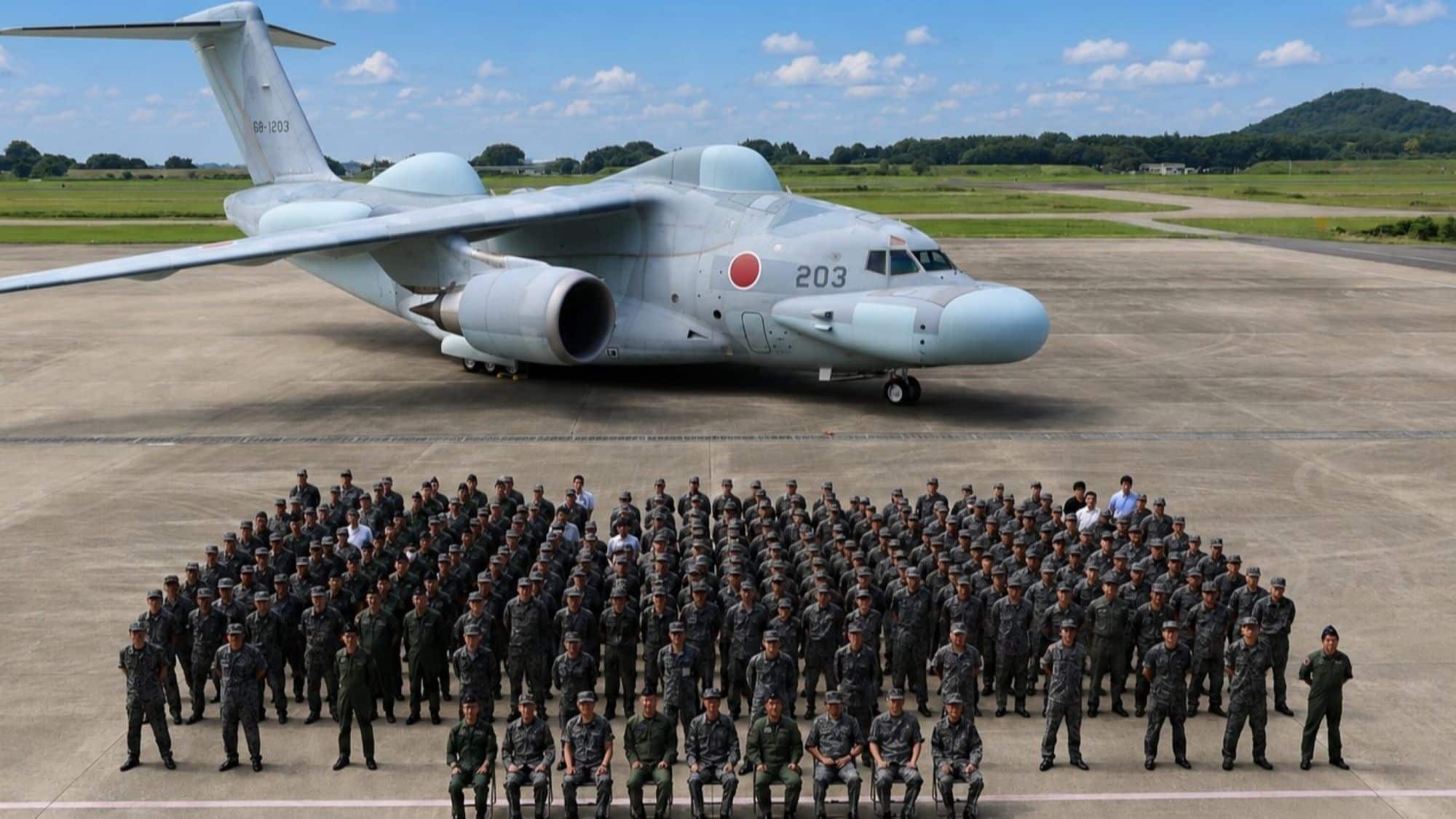
On July 15, an unusual aircraft took off from the runway at Gifu Air Base. With two bulges on the upper fuselage and a nose that bulges to the point of being mocked as a "platypus," this is the Japan Air Self-Defense Force's standoff electronic warfare aircraft, the development test aircraft XEC-2 (tail number 68-1203). The start of this full-scale flight test, accompanied by an F-2 fighter, was hardly reported domestically.
However, this takeoff signifies a return to the Self-Defense Forces' electromagnetic warfare capabilities after 40 years. The Air Self-Defense Force has relied on a single EC-1, which entered service in 1986. That EC-1 is set to retire in 2025, and since then, there has literally been no standoff jamming aircraft.
From Reliance on One Aircraft to a Four-Aircraft System
The XEC-2 is a modified version of Kawasaki Heavy Industries' C-2 transport aircraft (initial production model, aircraft number 203). The C-2 has a total length of about 43.9 meters and a maximum payload of 36 tons. The ability to carry high-output jamming devices and their cooling systems is the greatest advantage that the EC-1, based on the older C-1, does not have.
The nose radome houses the J/ALQ-5 electronic jamming system (Toshiba-based jamming antenna), which has been inherited and modernized from the EC-1. The two fairings on the back and the fairing on the side of the rear fuselage provide wide-angle jamming and electronic warfare support capabilities that were physically impossible with the EC-1.
The planned budget is approximately 41.4 billion yen (about 260 million dollars). Maintenance will be handled by the Electronic Warfare Group at Iruma Air Base, and ultimately, up to four EC-2s will be operated. This marks a shift from the single aircraft "single point of failure" EC-1 system to a decentralized system capable of simultaneous jamming across multiple axes.
Development is expected to be completed by the end of fiscal year 2026, with operational deployment targeted for fiscal year 2027. According to Jane's, flight testing is expected to be completed in early 2027.
Response to China's A2/AD Network
The significance of this aircraft lies in its ability to counter China's anti-access/area denial (A2/AD) network, which is spread across the East China Sea and the Taiwan Strait. China's integrated air defense network is designed to network radar and command and control systems, capturing approaching aircraft well before they reach the defensive line.
Standoff jamming disrupts that premise. The EC-2 will continuously bombard enemy search radars, fire control radars, and data links with high-output electromagnetic waves from outside the engagement zones of surface-to-air missiles and fighter interceptors. The planners refer to this as an "electronic corridor." It aims to degrade the enemy's situational awareness before friendly invasion forces enter dangerous airspace.
In my view, the essence of this aircraft is its ability to "blind the enemy without firing a shot." While an increase in anti-ship missiles and fighter aircraft is necessary, whether Japanese and American naval vessels and aircraft can survive within the first island chain during a Taiwan contingency will ultimately depend on the superiority of electromagnetic domains.
U.S.-Japan Interoperability and Remaining Questions
The EC-2 is expected to be operated alongside the U.S. Navy's EA-18G Growler. If Japan and the U.S. can coordinate their electronic attack assets, the options for joint mission planning will expand. When combined with the RC-2 electronic reconnaissance aircraft, it will enable continuous mapping of enemy radar emission sources and jamming, allowing for a "PDCA cycle of electronic warfare."
However, questions remain. First, is four aircraft too few? While the Growler units operate at multiple squadron levels, four aircraft would struggle to simultaneously deploy across two fronts in the East China Sea and the Sea of Japan. Second, there are doubts about the figure reported by some Chinese media stating a "detection and jamming range of about 900 kilometers." Official figures have not been disclosed, and overestimating the range could lead to a misunderstanding of the actual situation.
Third, it is essential to remember that the accumulation of radio wave information during peacetime is more critical than the aircraft itself. Electronic warfare is determined by the quantity of electronic warfare support information, such as "what is transmitting where and on what frequency." Even with an increase in aircraft, if the database of radio wave data collected during peacetime is insufficient, jamming will be hit-or-miss.
The true challenge lies not in the speed of information sharing between Japan and the U.S., but in how much of the invisible resource of radio wave information can be accumulated during peacetime. The takeoff of the EC-2 is merely the first step in a long preparation.
The Japan Air Self-Defense Force (JASDF) began flight testing the EC-2 electronic warfare aircraft on July 15 at Gifu, marking a return to stand-off jamming capabilities after 40 years. The EC-2, developed from the C-2 transport aircraft, aims to counter China's A2/AD network and is expected to enhance Japan's electronic warfare capabilities significantly. The JASDF plans to operate up to four EC-2 aircraft by 2027.
- The EC-2 aircraft has begun flight testing as of July 15.
- This marks the first stand-off jamming capability for Japan in 40 years.
- The aircraft is based on the C-2 transport aircraft and is designed to counter China's A2/AD network.
- The JASDF plans to operate up to 4 EC-2 aircraft by 2027.