
EU-Ukraine Drone Alliance 2026 Accelerates Production — But Europe's 3.4 Billion Euro Budget Remains Too Small
 Dr. Klaus Weber
EU-Ukraine Drone Alliance 2026 Accelerates Production — But Europe's 3.4 Billion Euro Budget Remains Too Small
Brussels Discovers Industrial Reality
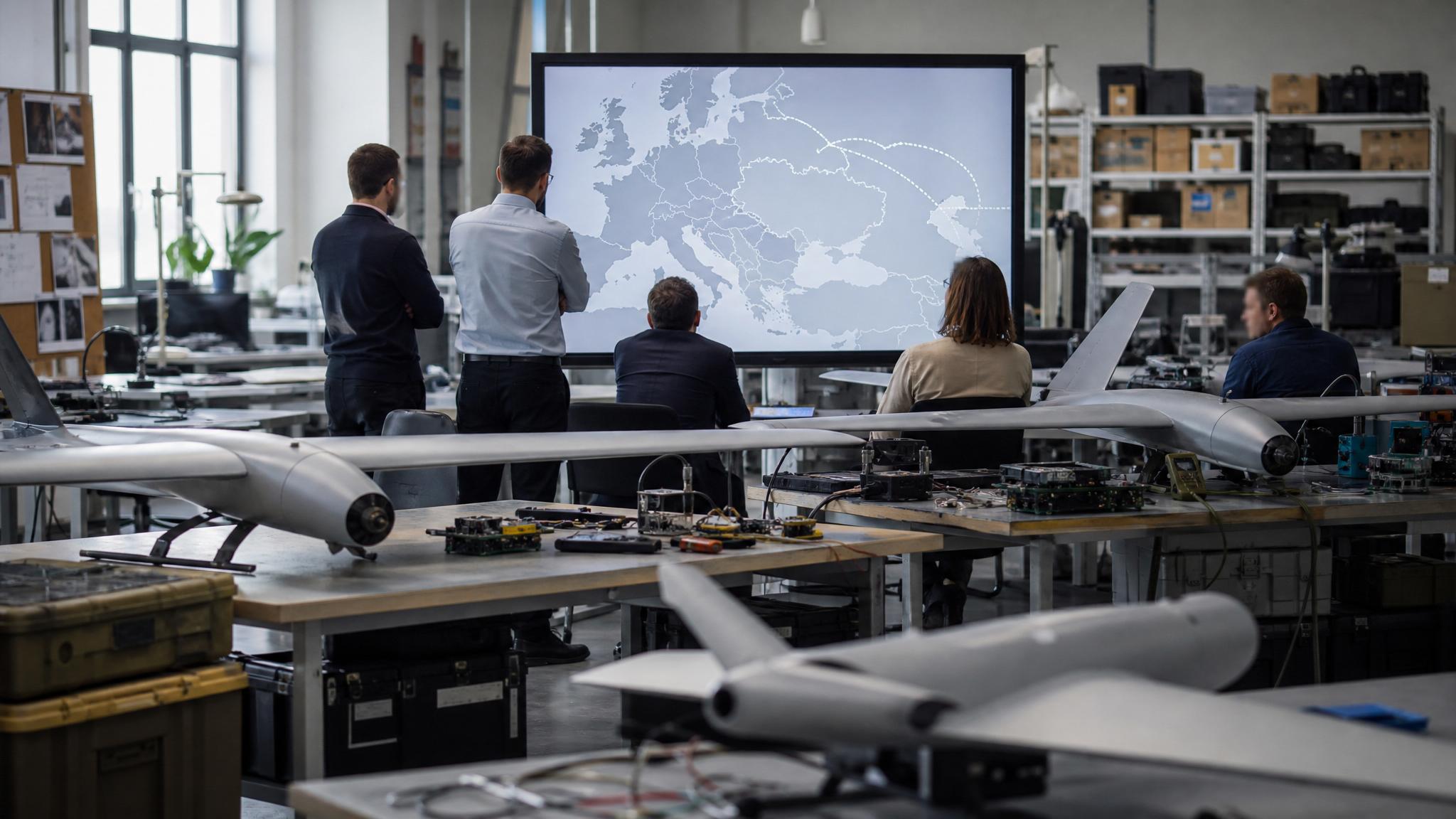
The European Commission hosted the second meeting of the EU-Ukraine Drone Alliance Board on November 11, 2026. On the same day, it was announced that the first call under the European Defence Industry Programme component USI-IRA attracted an unusually high number of proposals from member states and Ukraine. The signal is politically clear: Brussels wants to translate Ukrainian combat experience into European arms production. However, the financial outlook remains sobering. For 2027, around 3.4 billion US dollars are earmarked for the EU defense budget, including increased spending for Ukraine, according to Breaking Defense. This is an improvement over previous symbolic politics, but not an industrial breakthrough.
The crucial question is therefore not whether the EU wants to promote drones. That has been clarified. The question is whether it can turn individual projects into a robust European capability. This is precisely where Europe's well-known problem resurfaces: money is announced, procedures are opened, yet series production, joint procurement, and military integration remain temporally and institutionally decoupled.
The Alliance Addresses a Real Capability Gap
The Ukrainian side brings to the alliance something that European procurement offices cannot derive from tables: experiences from a war where small unmanned systems daily combine reconnaissance, target designation, electronic warfare, and effects. This refers not only to FPV drones. The relevant capability spectrum ranges from cost-effective multirotor systems to fixed-wing aircraft for reconnaissance, as well as jamming and defense systems against enemy UAS. For European defense, it is particularly important that these systems must be integrated into a sensor-effect network. An aircraft without secure data links, electronic countermeasures, and trained operators is not a military system but a display piece.
Therefore, the board meeting is more than just another Brussels working group. It aims to accelerate development and production and connect Ukrainian and European companies with EU funding and industrial partners. In September, reports emerged about the merger of 18 European and Ukrainian defense companies into the Drone Alliance. It will now become clear whether this political coalition will lead to a standardized procurement model. The difference is significant: an alliance can pool interests; a capability requires common technical standards, secured supply chains, spare parts planning, and a decision on who will actually produce in a crisis.
USI-IRA and the Problem of European Scaling
The first USI-IRA call under EDIP has reportedly triggered a high number of proposals from member states and Ukraine, according to the Commission. This initially shows demand. However, it does not yet indicate prioritization. If each country finances its own drone family, its own software, and its own interface, it will create exactly what Europe has produced with larger weapon systems for decades: national sub-markets, small series, and incompatible systems.
The technical peculiarities of drone warfare exacerbate this risk. A Ukrainian system must be able to be quickly modified because radio protocols, jamming techniques, and defense tactics can change within weeks. A classic European program with multi-year certification and procurement cycles cannot accommodate this speed. On the other hand, an improvised frontline system cannot easily be integrated into NATO command networks, air situation pictures, and European security standards. The task is therefore not to choose between Ukrainian agility and European regulation. The EU must build an interface that connects both. So far, clear institutional responsibilities are lacking for this.
3.4 Billion Dollars Are Not a Strategic Benchmark
The planned EU defense budget of around 3.4 billion US dollars for 2027 sounds larger in political communication than it is militarily. Compared to national defense budgets, it is a small amount; compared to the costs of modern air defense, satellite reconnaissance, or ammunition production, it is even smaller. It is correct that more money is earmarked for Ukraine at the same time. However, this should not be confused with additional European capability.
The relevant benchmark is not the sum of approved funds but the number of operational systems, the delivery time, and the ability to upgrade them in conflict. A drone alliance that takes twelve months for a political decision and several more years for a factory will not meet Ukrainian needs. A funding program that quickly finances prototypes but does not provide purchase guarantees creates startups without a market. Therefore, Europe's defense industry needs binding minimum orders, joint certification, and an open mechanism for Ukrainian companies. Otherwise, Ukraine will remain a test laboratory while actual series production disappears back into national budgets.
The Transatlantic Dimension
The drone issue also touches on the relationship with the United States. Washington can continue to provide Europe with crucial capabilities in satellites, data fusion, and strategic reconnaissance. For this reason, the EU must not understand the new drone policy as a substitute for NATO. It should function as a European complement that improves conventional burden-sharing. Europe's strategic autonomy will not be credible by rhetorically replacing American systems with European ones. It will be credible when European forces possess their own reconnaissance assets, their own defenses against drones, and their own industrial reserve capacities.
For Germany, this leads to an uncomfortable conclusion. Berlin supports European funds and regularly speaks of a turning point but must also open national procurement logic and slow tendering processes. The German contribution must not consist of managing EU money and then waiting for national special solutions. Germany should present a concrete capability list together with France, Poland, and Ukraine: reconnaissance drones, FPV carriers, electronic warfare, mobile counter-UAS systems, and the associated data standards. Only then can a political forum become a military architecture.
More Procedures Do Not Mean More Defense
The EU-Ukraine Drone Alliance is therefore a meaningful step, but not yet proof of European defense capability. Its value is not determined by the number of meetings or project proposals but by the speed from the Ukrainian frontline report to European series delivery. The 3.4 billion dollars for 2027 can initiate this process but cannot finance what has not yet been institutionally decided.
Europe has learned that drones can be cheap. It has not yet learned that a cheap drone only has strategic value if an expensive system of data, training, production, and leadership stands behind it.
The real European choice is therefore not autonomy or NATO, but capability or administration. Brussels can translate Ukrainian innovation into common standards — or create another funding structure that confuses its own existence with activity.
Sources: European Commission, Directorate-General for Defence Industry and Space, “Commission hosts the 2nd Board Meeting of the EU-Ukraine Drone Alliance” (11.11.2026); European Commission, “First USI-IRA call under EDIP attracts a high number of proposals from Member States and Ukraine” (11.11.2026); Breaking Defense, “EU sets out $3.4B defense budget for 2027, boosts Ukraine spending” (11.11.2026); The Kyiv Independent, “18 EU, Ukrainian defense companies join up to launch Drone Alliance” (11.09.2026).
The European Commission hosted the second meeting of the EU-Ukraine Drone Alliance on November 11, 2026, aiming to accelerate drone production and integrate Ukrainian war experience into European defense. The EU's defense budget for 2027 is set at 3.4 billion euros, which is seen as insufficient for establishing a robust military capability. The alliance seeks to address the integration of various drone systems and improve procurement processes among member states and Ukraine.
- The EU-Ukraine Drone Alliance aims to accelerate drone production.
- The EU defense budget for 2027 is set at 3.4 billion euros.
- The alliance seeks to integrate Ukrainian war experience into European defense production.
- There is a high demand for drone proposals from EU member states and Ukraine.
- The report highlights the need for standardized procurement and integration of military capabilities.